


Idealised cross-section of the Netherlands from north (left) to south (right), showing all landscapes in their interconnection. Illustration: Crossbill Guides / Horst Wolter
Dutch nature is truly remarkable when viewed through an international lens, conclude biologists Dirk Hilbers and Constant Swinkels. They are launching the fiftieth Crossbill guide: the two-part Nature Guide Netherlands, offering a cross-section of ‘our’ landscapes and the best places to visit them.
‘Don’t be mistaken. Even many ecological researchers don’t always have a broad view of Dutch landscapes and nature. In that respect, our guide can certainly help to build that knowledge, simply by visiting areas here in the Netherlands – in our own back garden – and looking carefully around you. Looking at nature with a little depth is both instructive and enjoyable. What’s more, you’ll discover, just as we did, that Dutch nature is actually quite remarkable’, says biologist Constant Swinkels (1995), who is conducting doctoral research at Nijmegen into the interactions between wild bees and plants. He is also, together with biologist – and his uncle – Dirk Hilbers (1976), the author of the Crossbill Nature Guide Netherlands, which is due to be published in print in mid-November. It is the fiftieth travel guide that the Crossbill Guides Foundation has published in its 20-year existence – a double anniversary.
Reorientation
The publisher of predominantly English-language nature guides to European destinations – from Białowieża to Tuscany – began a reorientation towards the Netherlands almost ten years ago, producing Dutch-language guides to the Veluwe, Achterhoek, Wadden and Weerribben-Wieden. ‘Our concept of accessible yet in-depth nature guides is unique in the world, and we became increasingly aware that Dutch nature is actually quite remarkable too’, says Hilbers. ‘Of course, central Hungary is extraordinary for its cranes, but I myself used to teach in Druten, and there you could hear white-fronted geese calling all day long. Half the pupils had no idea what kind of goose it was, let alone that the Netherlands is the most important country for geese in the whole of Europe. When you look through an international lens, much of Dutch flora and fauna is actually quite extraordinary.’ Swinkels even recalls that on his first visit to Coto de Doñana, the southern Spanish paradise for birdwatchers, he saw an enormous information board featuring a greylag goose. ‘They are very proud of it there, but in the Netherlands hundreds of thousands of greylag geese overwinter, and it is once again a common breeding bird here. That is connected to the presence of grasslands, and these are the kinds of connections we like to make visible in our guide’, says Swinkels.
‘What is also wonderful about the Netherlands is that you can visit virtually all its nature by bicycle’
Swinkels and Hilbers spent nearly five years working on the Dutch guide and quickly decided to split it into two parts. ‘Our guides consist of a general account of how landscapes came into being and of the remarkable plants and animals you can encounter there, followed by routes and locations where you can discover and experience that nature for yourself. The Netherlands is small and its nature is under pressure, but it has a great variety of landscapes, partly because these have historically developed in co-creation with people. Features such as peat meadows, wet heathlands and blue grasslands are found only very rarely elsewhere in Europe. Blue grasslands also occur in stream valleys on high sandy soils and in low-lying, nutrient-poor hay meadows on peat, so there are multiple stories to tell. Hence the split into two handy volumes’, says Hilbers. ‘One to read at home or in the tent, and one to take with you when visiting an area by bicycle or on foot’, adds Swinkels. ‘What is also wonderful about the Netherlands is that you can visit virtually all its nature by bicycle.’ The second volume contains thirty fully worked-out routes and sixty locations (sites) for field visits, divided into four regions with their own character: western, northern, eastern, and central and southern Netherlands, each with its own introduction. ‘We did have to make tough choices. Ideally we would have described everything as a route, but by describing some areas more concisely as a site we were able to do justice to more areas.’ Thus Texel and Terschelling each have their own route, while the other Wadden Islands appear among the sites. These sites have a shorter description (see the three boxes with full text: ‘Kennemerland and Groene Strand’, ‘LOFAR’ and ‘Zwillbrocker Venn’), but often cover areas that are particularly special and less well known. Hilbers: ‘Taken together, the guide offers a fine cross-section of all our landscapes, flora and fauna.’
Teachers
Hilbers and Swinkels both trained as biologists in Nijmegen. ‘We come from the school of Victor Westhoff and Joop Schaminée, and our guide is rooted in a sense in the Atlas Plantengemeenschappen in Nederland and Landschappen van Nederland by the Groningen historian Theo Spek – though those are not books you can simply take into the field’, Hilbers smiles. ‘We have also added a great deal of information on animal species and our own photographs. The two volumes combine extensive descriptions of typically Dutch landscapes and biodiversity with the finest nature routes and practical tips for visiting and making observations.’ This makes them suitable for both beginners and more experienced nature enthusiasts, according to the compilers. Hilbers: ‘Personally, I also hope the guide will inspire teachers to take their pupils out into the field. Many people still hold the impression that the Dutch landscape is a pale imitation of real nature. That is completely wrong. The Netherlands is unique, and it is so in part because of the way in which people have shaped it historically. That is something we need to know – and to cherish.’

CROSSBILL NATUURGIDS NEDERLAND 1 EN 2 – Dirk Hilbers and Constant Swinkels
Softcover, 176 and 288 pages, €38.95
Pre-order: crossbillguides.nl
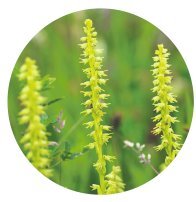

6. Kennemerland and Groene Strand
GPS: 52.452833, 4.565056
The construction of the Zuidpier (see previous site) shifted the sea current further offshore. In the calmer coastal waters, a new sandbar formed, and behind it, cut off from the sea, a lagoon developed whose calcareous shores now support a remarkable flora. Visit in June or July and you will see thousands of wild orchids. Seven species grow here, including the very rare fen orchid and the musk orchid, for which this is currently the only known site in the Netherlands. You will also find bee orchid, early marsh-orchid, bog pimpernel, round-leaved wintergreen, autumn gentian and a host of other special plants. The Groene Strand (which is not a beach at all but a broad, wet dune slack) is easy to visit by taking the bus to IJmuiden Zuidpier (from Amsterdam Sloterdijk railway station, among other stops). The path begins at the large car park in the far south-eastern corner (GPS: 52.456000, 4.567278). Take the first path on the right and then immediately left to walk along the eastern shore of the lake. In the next 800 metres you can find virtually all the species. Paths branch off to the left and lead back to the car park. N.B. This is a sensitive area; please keep to the paths.
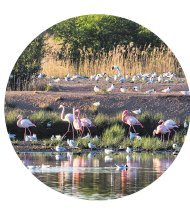

41. Zwillbrocker Venn
GPS: 52.054278, 6.694944
A short distance north of Winterswijk, just a few hundred metres beyond the Dutch border, lies the German Zwillbrocker Venn. This large fen has a broad fringe of raised bog and, surrounding that, birch carr. It is famous for its colony of flamingos – a sight that never fails to surprise: a small island in the middle of the fen where, among many hundreds of black-headed gulls, several dozen pairs of flamingos breed. This is not, however, an entirely natural colony. Most of the flamingos are Chilean flamingos that once escaped from captivity and began breeding independently at the Zwillbrocker Venn. A few pairs of greater flamingos subsequently joined them. Some of these are of wild origin and probably originate from the flamingo colony of the Camargue in southern France. Occasionally a deep-pink American flamingo is also present. By now the birds have lived freely for quite a number of generations and the colony functions as a fully wild one. The birds even have their own migration route: after the breeding season they fly to the Randmeren near Elburg (route 21) and then on to Zeeland (route 11). If you are out and about in the Achterhoek between roughly March and July, a visit to the Zwillbrocker Venn is an absolute must. A footpath runs around the fen (starting point: car park Zwillbrocker Venn, diagonally opposite the ‘Biologische Station Zwillbrock’; GPS: 52.054278, 6.694944). There are two bird hides overlooking the breeding island and another hide with a view over the western side of the fen. In addition to flamingos and black-headed gulls, you have a chance of seeing Mediterranean gull, little grebe, tufted duck and Eurasian hobby, whilst in the woodland pied and spotted flycatcher, common redstart, Eurasian bullfinch, yellowhammer and Eurasian golden oriole breed.

32. LOFAR
GPS: 52.912292, 6.868923
LOFAR is a wetland and grassland area in the Hunze valley. It was established in 2010 in collaboration with the organisation Astron, which conducts research into the universe. Across the marshy landscape lies a large number of antennae, which form the core of an extensive antenna network spanning several European countries. Although everything at LOFAR revolves around the extraterrestrial, it is the terrestrial side that is most interesting for visitors. LOFAR is, in fact, an exceptionally rich area for meadow birds. In spring, skylarks can be heard singing everywhere, yellow wagtails are much in evidence, and the distinctive call of black-tailed godwits fills the air. In the wetter sections you will find reedbeds where bluethroat, marsh warbler and water rail breed, among others. On the western side of the area (accessible via the Achterste Velddijk; GPS: 52.911590, 6.859759), wet grasslands receive seepage water rising to the surface from the Hondsrug ridge. Early marsh orchid grows here in abundance, accompanied by marsh lousewort and yellow rattle, all clearly visible from the path. With a great deal of luck, you may also find one of the area’s star species here: the corn crake, several pairs of which breed annually. The area lies just to the north of Exloo. Parking is available at the Regenhamsdijk, reached via the Buinerweg and Nieuwe Dijk from Exloo (GPS: 52.906805, 6.874250). From here you can make a 9.5 km circular route through the area on foot or by bicycle, or take an out-and-back walk to the reedbeds situated just under a kilometre further on.
ILLUSTRATION: GROSSBILL GUIDES / HORST WOLTER
Read now also