


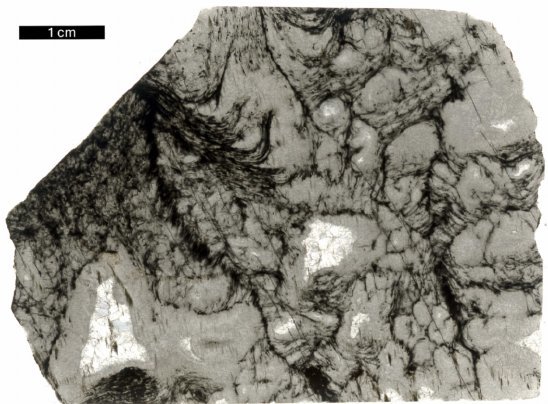
The black structures in this 2.5-billion-year-old thin section are microbial in origin and may have been produced by photosynthesising microbes. Foto: Andrea Corpolongo.
From pulverised organic remains in rocks billions of years old, an AI model is able to identify early microbes and traces of photosynthesis.
In rocks more than 3.3 billion years old, researchers have identified chemical patterns resembling breakdown products of microbial life. In rocks approximately 2.5 billion years old, they also found patterns consistent with material from photosynthetic micro-organisms. The study, published in PNAS (17 November), pushes back the oldest molecular evidence for life by around 1.6 to 1.8 billion years, and that for photosynthesis by more than 770 million years.
The researchers analysed 406 samples – ranging from plants and animals to meteorites and synthetic mixtures – by heating them and measuring the fragments released. These fragmentation patterns act as chemical ‘fingerprints’. A computer model was trained to distinguish such profiles with high accuracy.
Patterns
When applied to 131 ancient rocks containing organic material of uncertain biological origin, several formations stood out. Remains from the Josefsdal Chert in South Africa (3.33 billion years old) and rocks from the Singhbhum region in India (3.51 billion years old) display patterns resembling those of modern microbes. Material from the Gamohaan Formation (2.52 billion years old) shows patterns typically associated with a photosynthetic origin.
According to the authors, even severely degraded organic remains retain chemical echoes of their past. This makes the method, in their view, a promising tool for identifying possible primordial life on Earth – and in samples from, for example, Mars.