


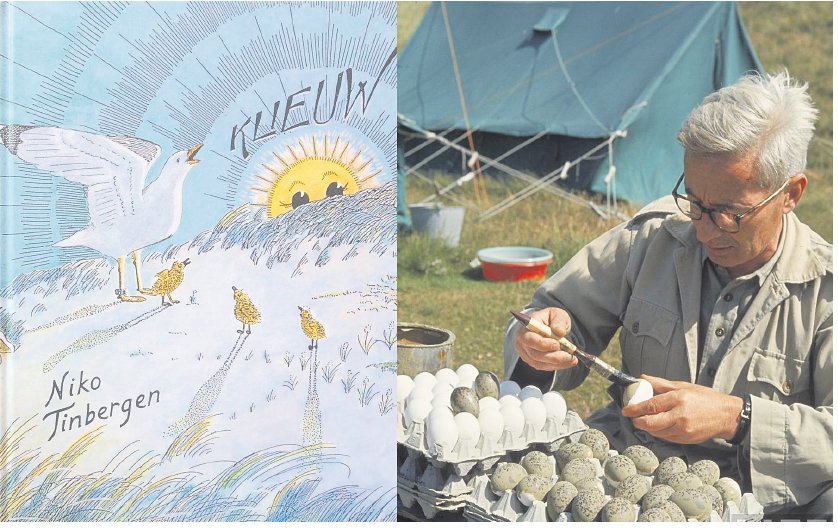
 Links: cover of the children’s book Klieuw. Right: Tinbergen painting hen’s eggs during fieldwork in Meijendel. Photo right: Life Magazine
Observing birds with ingenuity in the open field, guided by four questions. Behavioural biologist Roelke Posthumus offers an insider’s account of the world of Nico Tinbergen and his ethological revival.
‘Encouraged by their nature-loving schoolteachers, these boys and girls patiently watched birds wheeling, turning, clattering and milling about in the open field, made drawings and photographs, and wondered with amazement what it all meant’ – so biologist Roelke Posthumus describes the birth of ethology in Scherpstellen. The book revolves around the world of Nico Tinbergen (1907–1988), the only Dutch biologist ever to receive a Nobel Prize. In 1973 he shared the Nobel Prize in Physiology or Medicine with two other pioneers of behavioural science, the Austrians Konrad Lorenz (‘imprinting’) and Karl von Frisch (‘the waggle dance’). There is no particular occasion for the book, as a thorough biography has existed for over twenty years (Niko’s Nature, Hans Kruuk, 2003), but according to Posthumus the major contribution of Dutch birdwatchers and field biologists to behavioural biology remains ‘fairly unknown’ to the general public.
Personal
She takes a personal approach and develops above all the subtitle: how Niko Tinbergen and his friends taught us to look. Her role as an insider is reinforced by examples from her own student days and her research on mice and avoidant schoolchildren, as well as the frequent – though not entirely consistent – use of first names and nicknames: Jan P., Jac P., Eli, Pelk, Frans, Gerard, Jaap, and of course Nico and Lies. Posthumus is herself a second-generation student of Tinbergen, trained in Groningen by the first-generation ethologists Gerard (Baerends) and Jaap (Kruijt). The book is too much a succession of short biographies of Tinbergen’s mentors, contemporaries and students – all people from his time as a pupil, birdwatcher and enthusiastic member of the Dutch Youth League for Nature Study in The Hague, as a biology student, doctoral researcher and professor in Leiden, and as a celebrated professor and Nobel laureate in Oxford. His students include well-known science writers such as Desmond Morris, Jane Goodall, Frans de Waal and Richard Dawkins. Tinbergen himself was also a gifted networker and communicator, from children’s books about the herring gull (Klieuw) to the bestseller The Study of Instinct – and Posthumus overlooks his publications in, and editorship of, the Vakblad voor Biologen.
That may seem a minor detail, but an article Tinbergen published in that journal as early as 1935 foreshadows his celebrated scientific paper of 1963, in which he formulated his four great ‘why’ questions for the first time. What causes a behavioural expression? How does it develop? What is its survival value? And can anything be said about its evolutionary origin? These four questions are often regarded as his greatest contribution to biology. Scherpstellen unfortunately offers no incisive analysis of why behavioural studies of and experiments with seabirds, beewolves and sticklebacks provide a revolutionary new conceptual framework that transcends the work of earlier animal psychologists. Posthumus does of course discuss the four ‘why’ questions, along with his ethograms and his emphasis on stimuli and functions – rather than drives and goals – but the book remains too much a collection of glimpses into the life of a colourful, amiable and influential biologist and his contemporaries. It offers insights, but these do not seem truly grounded in Nico’s own maxim: ‘look carefully before you ask questions’.
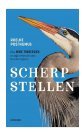
SCHERPSTELLEN – HOE NIKO TINBERGEN EN ZIJN VRIENDEN ONS LEERDEN KIJKEN – Roelke Posthumus
Paperback, 352 pages, €27.90