


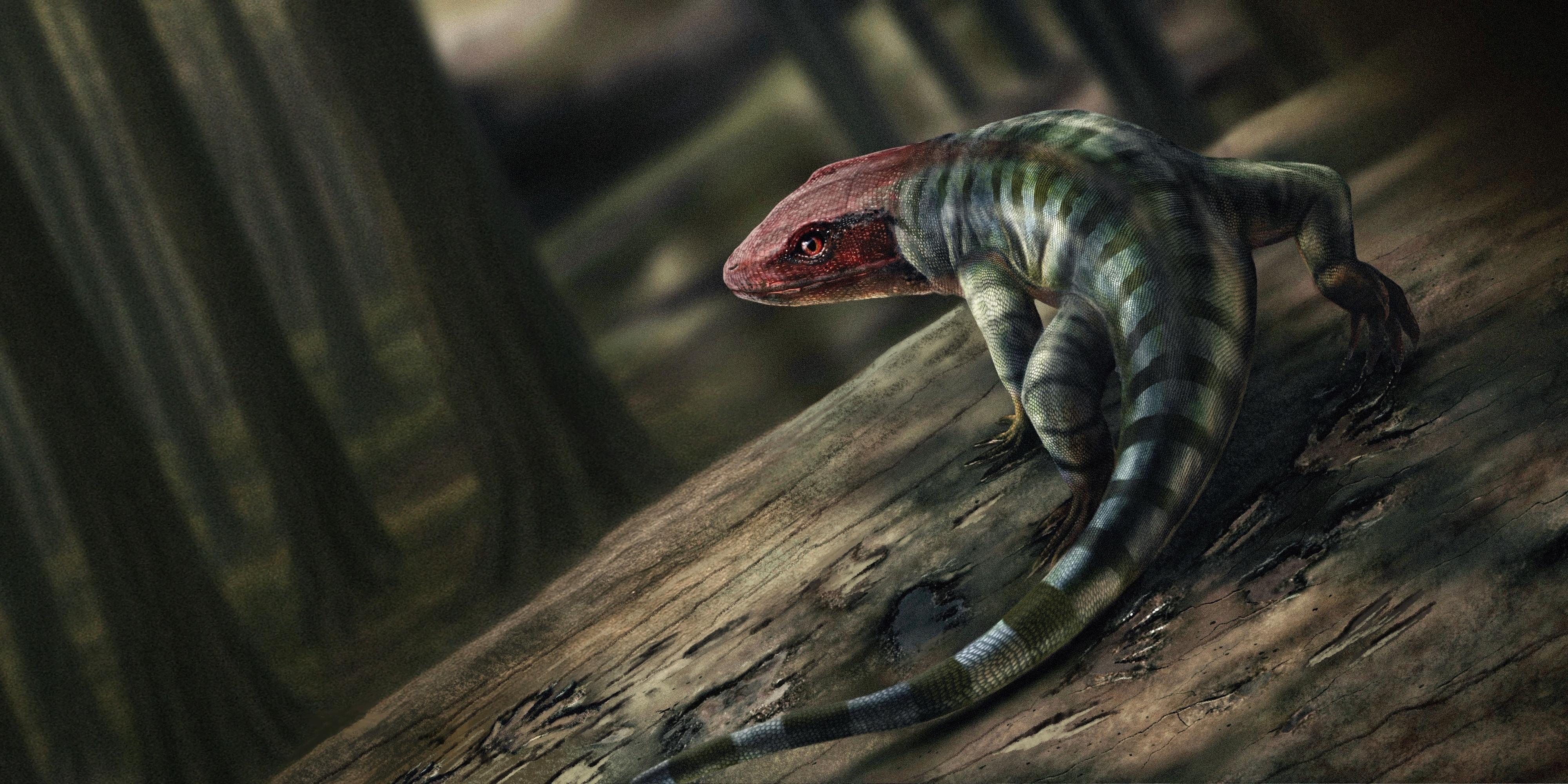
Reconstruction of the ancient reptile that left a trackway 336 million years ago. Illustration: Marcin Ambrozik
The conquest of land by vertebrates took place more than 355 million years ago. That is the implication of a fossil trackway from an ancient reptile discovered in Australia.
It is regarded as a key evolutionary innovation in vertebrates: the development of the amniotic egg, which made permanent life on land possible for early reptiles. Until now, it was thought that this occurred around 320 million years ago, but Australian and Swedish palaeobiologists now claim it happened more than 35 million years earlier, based on fossil footprints they attribute to an ancient reptile (Nature, 15 May). That fossil from the Snowy Plains Formation in Victoria (south-eastern Australia) has been dated to 356 million years ago, meaning the origin of amniotes – reptiles, birds and mammals – is older than previously assumed.
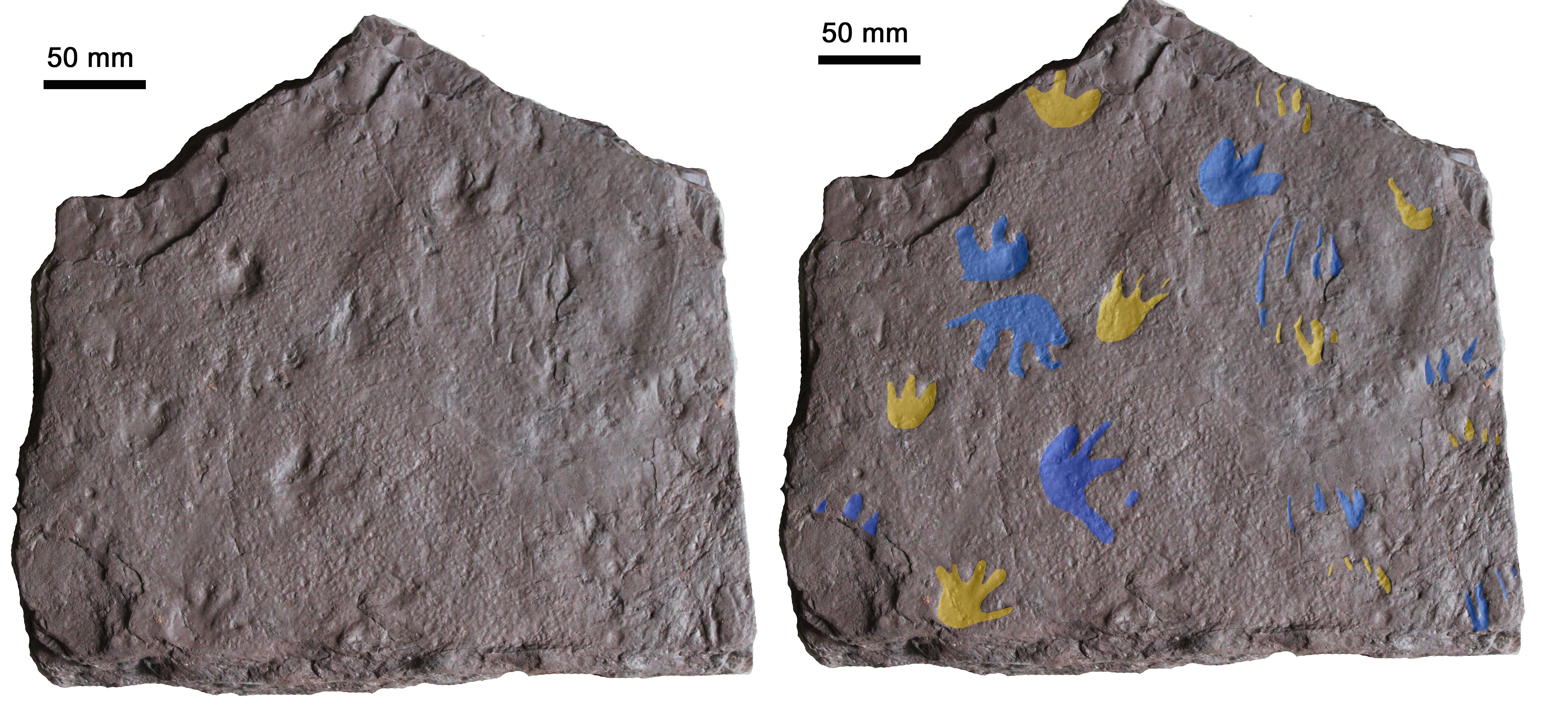 The trace fossil in question, bearing the first claw impressions of an amniote animal (left), found in the Snowy Plains Formation near the Broken River, at Barjarg in Victoria, Australia. It comprises at least two footprints, possibly from the same individual, with the forelimb impressions highlighted in yellow and the hindlimb impressions in blue (right). Photos: Grzegorz Niedzwiedzki
The fossil bears multiple claw impressions from fore- and hindlimbs with five toes, which the authors interpret as evidence of an ancient reptile approximately 80 centimetres in length, with a body size and shape comparable to that of the extant Asian water monitor (Varanus salvator). The Early Carboniferous dating has, according to the researchers, ‘profound and far-reaching implications’ for the evolution of vertebrates. It means that proto-amniotes were already present in the Late Devonian, whilst the well-known transitional form Tiktaalik, which represents the transition from fish to amphibian, has been dated to 383 million years ago, in the Middle Devonian. According to the researchers, this implies that tetrapods underwent a far more rapid evolutionary process during the Devonian than previously assumed, and that the picture of four-limbed animals as primitive, fish-like forms during that period is incorrect. The evolution from aquatic animals to fully terrestrial ones proceeded much faster than previously thought.
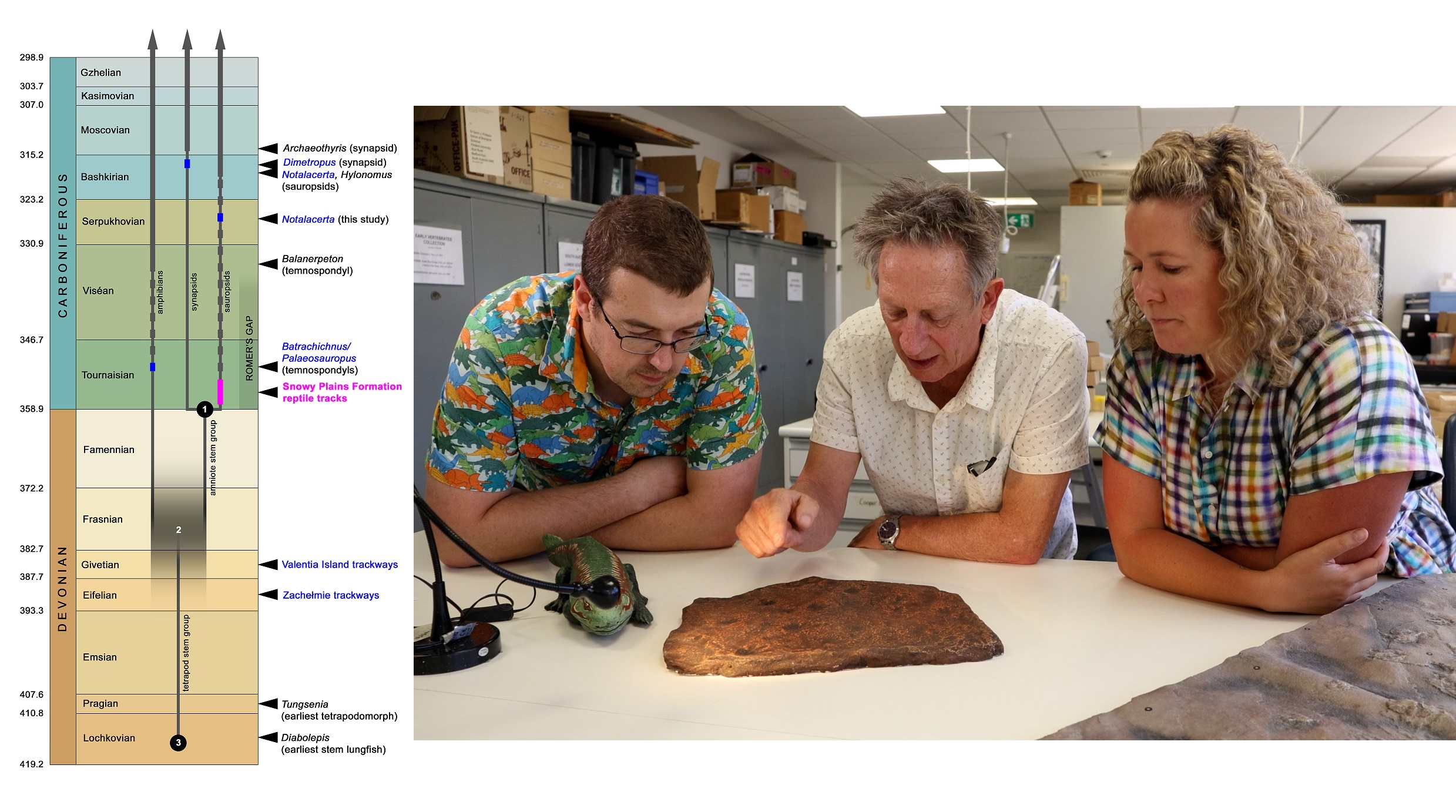 Timeline (left) showing the key finds relating to the origin of the first amniote animals (with the current trace fossil marked in purple) and (right) the team from Flinders University in Adelaide (l. to r.: Aaron Camens, lead author John Long, and Alice Clement) with a replica of the trace fossil. Image: Flinders University
The fossil fills an important gap, as the earliest known amniote fossils date from around 320 million years ago, in the Late Carboniferous. These include very similar trace fossils of Notalacerta from North America and Poland. The fact that tracks of an early representative have now come to light in Australia could lead to ‘a reorientation in the search for early amniotes and their closest relatives’, writes palaeontologist Stuart Sumida of California State University in an accompanying news & views in Nature. ‘It suggests that the search for their origins should not be confined to the northern parts of the ancient supercontinent Pangaea’, said Sumida. The first fifteen million years of the Carboniferous, from approximately 360 to 345 million years ago, is known as Romer’s Gap because of the many lacunae it displays in the tetrapod fossil record. This phenomenon is named after the American palaeontologist Alfred Sherwood Romer (1894–1973), who was the first to recognise the scarcity of fossils from this interval.