


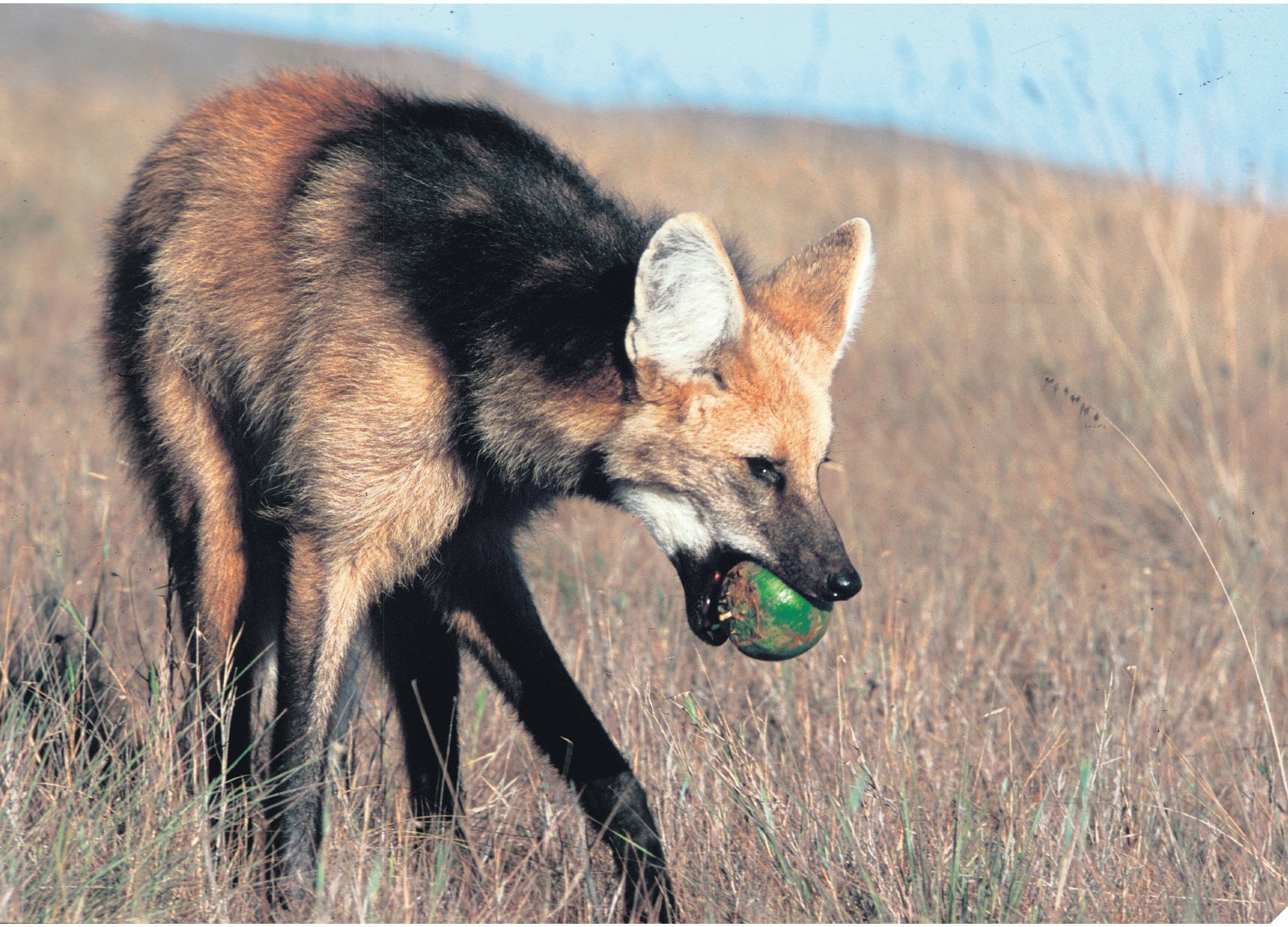
 Maned wolves protect themselves against kidney infection by roundworms by eating the fruit of the wolf apple plant. Photo: Luiz Claudio Marigo / NaturePL / Nature In Stock
Not a pill or cream from the pharmacy, but a hearty mouthful of bitter leaves or a skin treatment with crushed millipedes. Many animals use substances from their environment to prevent and treat disease. Fascinating – but also difficult to prove.
If you have no plasters, insect repellent or blood-pressure tablets to hand, you must rely on nature’s pharmacy. A variety of animal species – ranging from primates and birds to sheep and insects – make good use of whatever their habitat has to offer. The ability of animals to select and voluntarily consume or use plants, minerals or other environmental substances to promote their own health – or that of group members or offspring – is known as zoopharmacognosy. The term is derived from the Greek words zoo (animal), pharmakon (medicine) and gnosis (knowledge).
‘Animals do not merely avoid situations and substances that could harm their health – they also actively make use of their environment to prevent illness or discomfort’, says Maria Groot, who worked at Wageningen Food Safety Research until 2023. There she conducted research into, among other things, the use of antibiotics and hormones, as well as natural remedies in livestock farming. ‘Plants and insects often defend themselves against grazing and predation with toxic chemical compounds, which other animals can in turn exploit’, Groot explains. ‘For instance, up to half the diet of the maned wolf consists of fruit from the wolf apple plant. Consuming this plant protects the maned wolf against kidney infection by roundworms – something that is usually fatal for the maned wolf in the absence of the wolf apple plant.’
‘Another nice example is that of the mongoose, a small mammal that now and then rather enjoys eating a venomous snake’, Groot continues. ‘A bite from such a snake causes a life-threatening rise in blood pressure in its victim. Consuming Rauwolfia serpentina – the Indian snakeroot – has the opposite effect, lowering blood pressure, so mongooses that have eaten it are barely affected after a snakebite.’ Crows, she goes on, hop through anthills so that the agitated insects spray the birds with formic acid, which keeps feather mites at bay. Capuchin monkeys repel insects by rubbing themselves with crushed millipedes. Nest-building behaviour reflects this phenomenon too: starlings and tits are known to deliberately incorporate insect-repelling plants such as lavender and mint into their nests. Insects themselves are no strangers to zoopharmacognosy: the wood ant species Formica paralugubris wards off pathogens using resin from coniferous trees (Proceedings of the Royal Society B, 2007), and bees line their hives with antifungal plant extracts (PLOS ONE, 2012).
Fungal infection
What is more, it goes beyond disease prevention. When animals do develop symptoms of illness or sustain an injury, they can actively seek out substances that promote their recovery. The grey-black slave-maker ant (Formica fusca) opts for an aphid-rich diet when infected with a fungus, which has been shown to help overcome the infection (Biology Letters, 2023). Once the colony has recovered from the disease, the ants quickly switch back to a different food source. In Borneo, scientists discovered that older female orang-utans use leaf extracts to treat muscle and joint pain (Scientific Reports, 2017). Chimpanzees in the African rainforest crush insects and apply them to their wounds (see box: Wound care). And many more examples could be cited.
‘With many other animals, a controlled set-up is not an option and you are dependent on very precise observations’
All these animal stories are extraordinarily compelling, but establishing zoopharmacognosy scientifically is enormously complex, as Tedje van Asseldonk knows well – he is a co-founder of the Institute for Ethnobotany and Zoopharmacognosy (IEZ) and has spent thirty years grappling with the question. ‘Although I have submitted many applications, I have never received funding for our research. The medical world felt the subject belonged more to ethology, while the field of animal behaviour felt it should be funded by the pharmaceutical world.’ Groot too encountered scepticism: ‘When I first started out, I was regularly dismissed as a herb woman. But when rising resistance led to restrictions on antibiotic use in livestock farming, interest in alternatives began to grow (see box: Stalboekjes, ed.).’
Although zoopharmacognosy is taken more seriously today than it once was, it remains something of a neglected field within science. Even the current project of chimpanzee researchers Simone Pika and Tobias Deschner – whose team observed the striking wound care behaviour in chimpanzees – is still dependent on donations due to a lack of funding. This is partly because experimental evidence is difficult to obtain, Van Asseldonk believes: ‘It is very hard to establish why animals do what they do. Insects are small enough that you can observe them relatively easily in an experimental set-up with induced infection.’ This means researchers can now say with confidence that the slave-making ants on an aphid diet are better able to combat fungi than the control group that was not offered aphids. ‘With many other animals, a controlled set-up is not an option and you are dependent on very precise observations’, says Van Asseldonk. She herself has conducted research on, among others, spider monkeys, which at the time roamed freely across a large area at Apenheul with many wild plants. Although keepers had observed that the monkeys selectively ate certain herbs and suspected a link with illness, proving any connection turned out to be impossible. ‘At the time, we mapped the entire vegetation of the enclosure and recorded what the monkeys ate and how much. But we never saw sick spider monkeys eating the herbs, because once the monkeys are ill they are no longer allowed outside. A hypothesis is then very difficult to prove.’
Control group
Pika and Deschner do not, incidentally, claim that the insect pulp actually causes chimpanzee wounds to heal more quickly. Deschner: ‘To establish that, you would need a multi-year plan spanning decades. You have to account for so many factors: logically the size and location of the wounds, but also things like the weather. We would need to follow the entire healing process of hundreds of wounds before we could say anything significant. And even then you cannot assume that you have not missed behaviours during the moments when the animals were out of sight.’ Van Asseldonk adds: ‘A clearly defined control group that differs from the experimental group in only one factor is, in most cases in our field of research, simply extremely difficult to achieve. For example, I once wanted to compare the herbal diet of pregnant and non-pregnant wild cattle. But in the wild, all cows are pregnant except for the young animals, which means that immediately not one but two factors differ. That is how it goes, time and again.’
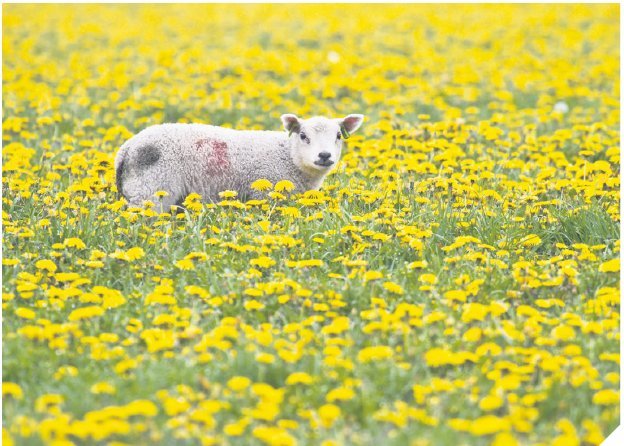 Sheep with worm infections are partial to bitter plants. Photo: ImageSelect
Although not watertight either, alternative approaches are available to provide a scientific basis for zoopharmacognosy. Behavioural biologists support their observation-based hypotheses by taking wild plants or other substances to the laboratory to examine their chemical composition. Laboratory experiments showed a few years ago that leaf extract from Dracaena cantleyi, the plant that older female Bornean orang-utans rub onto their limbs, has anti-inflammatory properties. This is admittedly not a cast-iron argument for the idea that the apes use the leaves for these properties, but the finding nonetheless supports existing suspicions. In a field where experimental evidence is extremely difficult to obtain, science must make do with what it has.
‘It is very hard to establish why animals do what they do’
Stable booklets
Maria Groot and Tedje van Asseldonk together wrote eight stalboekjes (freely available online publications) filled with scientifically grounded advice on animal management and natural remedies, one for each of the most commonly kept livestock species in the Netherlands. The demand for such an overview arose initially from the organic sector. Later, interest also came from conventional livestock farming, when legislation changed and farmers who had used antibiotics as a miracle cure – freely and indiscriminately for decades – were suddenly permitted to use them far less. ‘By no means every livestock farmer consults a stalboekje today, but those who have one are, as a rule, very glad of it’, says Groot. The stalboekjes advocate animal-friendly management and varied nutrition, for example in the form of hedgerows and herb-rich pasture with high biodiversity. ‘Livestock are often given nothing but ready-made pellets, which are in principle nutritious but dull and monotonous. Nobody is happy eating the same thing day in, day out, all day long – and animals are no different’, the two say. Moreover, with such a monotonous diet, animals have no opportunity to select for themselves what they need in terms of nutrients and other substances. Groot explains: ‘Lambs with worm infections demonstrably eat more tannin-rich bitter plants than healthy lambs, and cattle deficient in calcium and minerals such as phosphorus and magnesium will even consume dead animals to make up for these deficiencies. Farmed animals too select their diet according to their state of health, if given the chance.’
Wound care
Simone Pika and Tobias Deschner lead the Loango Chimpanzee Project: with a large team, they have been studying a group of chimpanzees in the African rainforest in Gabon since 2005. This broad behavioural study focuses on, among other things, communication, cognitive abilities, and interactions with pathogens. Since 2019, an additional point of interest has emerged, when a student observed and recorded a female chimpanzee applying a crushed insect to her son’s open wound and removing it again shortly afterwards. This turned out not to be an isolated event – other group members treat injuries in the same way. Researchers had never previously noticed this behaviour, and in the past few years scientists have not observed this form of wound care in any other chimpanzee population either. Follow-up research by Pika and Deschner is now ready for publication, and the primatologists are offering a preview. ‘We have since seen much more frequently that chimpanzees apply the insects not only to their own wounds, but also to those of other group members’, Pika says enthusiastically. The behavioural researchers also succeeded in identifying the insects. Deschner explains that morphological identification was impossible, because the great apes had crushed the insects completely. Direct genetic analysis was likewise not an option, owing to the absence of reference sequences for many insect species. ‘We had to catch living insects and compare both the morphology and the genetics with the remains we could find on the apes, but we managed it.’