


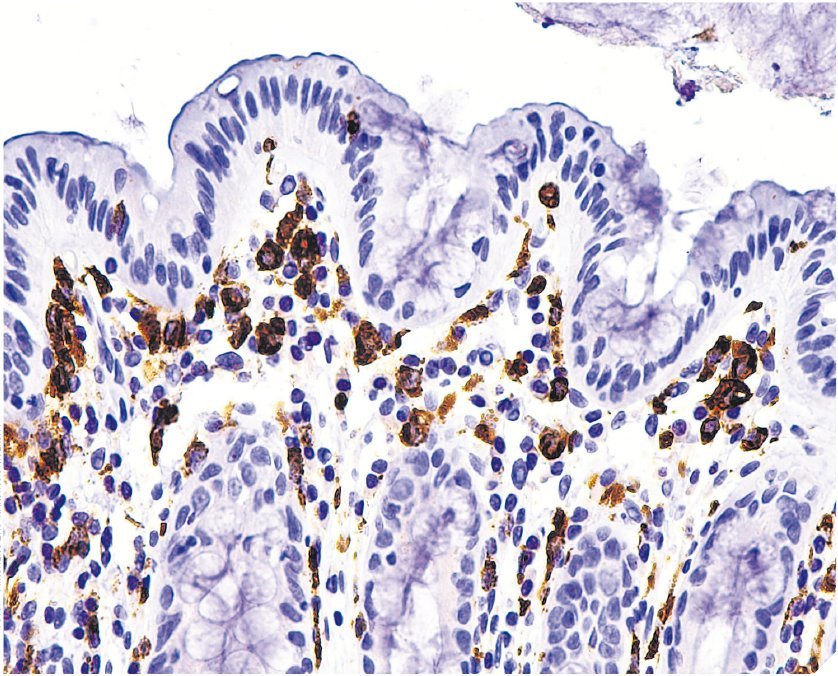
Intestinal epithelium of a mouse in which macrophage protection has been disrupted by toxic MTB bacteria. Photo: © Minsheng Zhu-Nanjing University
A bacterial toxin from the genus Aeromonas has been found to selectively disable intestinal macrophages, which may explain the persistent inflammation seen in ulcerative colitis.
A toxin produced by the bacterial genus Aeromonas has been found to be selectively lethal to intestinal macrophages, and may thereby drive the persistent inflammation of the large intestine that is characteristic of ulcerative colitis (UC). This is reported by Chinese researchers in Science of 20 November.
The toxin, aerolysin, targets the immune cells that normally form a protective layer beneath the intestinal mucosa. The loss of this shield renders the large intestine more susceptible to inflammation. Until now, attention has focused primarily on problems in the epithelium, but the new study points instead to the underlying immune cells as a potential driver of inflammation.
Intestinal macrophages
The Chinese researchers began by mapping intestinal macrophages in biopsies from UC patients. The immune cells were found to be almost entirely absent, even in apparently healthy tissue. ‘The loss of these cells appears to be an early step in the disease process’, says lead researcher Minsheng Zhu in an email. Mice in which macrophages had been artificially depleted were also found to be more susceptible to intestinal damage.
From stool samples, the researchers then isolated an Aeromonas variant they term macrophage-toxic bacteria (MTB). This produces aerolysin, a toxin that binds to specific proteins on cell membranes and causes necrosis-like cell death. Macrophages proved to be twenty to eighty times more sensitive to the toxin than epithelial cells.
In mouse models, infection with MTB substantially worsened colitis, resulting in weight loss, ulceration and bleeding. Genetically modified bacteria lacking aerolysin caused no inflammation. MTB also had no effect in mice from which macrophages had already been depleted. ‘That underscores that it is precisely the loss of immune cells that is the key factor’, says Zhu.
Neutralisation
According to the researchers, the damage can be limited by deploying antibodies against aerolysin: these reduce the severity of colitis in mice. ‘Targeted neutralisation of bacterial toxins may be an alternative to broad immune suppression with antibiotics’, says Zhu. This approach is also promising because the Aeromonas genus is becoming increasingly resistant to antibiotics.
The aerolysin-producing Aeromonas bacterium was found to be present in 72 per cent of UC patients, compared with 12 per cent of healthy controls. In Crohn’s disease patients, the bacterium was almost entirely absent. This points to a specific association with ulcerative colitis. Nevertheless, Zhu emphasises that UC remains a complex condition: ‘It probably does not have a single cause, but involves an interplay of genetic predisposition, lifestyle and microbial factors.’
Risk factor
In a simultaneously published perspective in Science, gut microbiome researchers Sonia Modilevsky and Shai Bel describe the direct targeting of microbes and their toxins as a promising alternative to immunosuppression. Classical criteria for identifying a pathogen cannot, in their view, be applied to conditions of this kind, but the study does offer new leads. For instance, the research shows that MTB is rarely found in healthy mice, and can only colonise following antibiotic treatment – a known risk factor for inflammatory bowel disease in humans.