


To tackle atherosclerosis, technasium students Duco Schrijvers and Paulina Michalewska Urrutia turn to nature for inspiration.
The suction cup of an octopus, the piercing mouthparts of a mosquito, and the implosion mechanism of a pistol shrimp. Technasium students Duco Schrijvers and Paulina Michalewska Urrutia see these not merely as clever tricks these animals use for themselves. In their view, these mechanisms could also prove highly useful for removing plaque from the bloodstream.
‘Using bio-inspired technology, we designed an attachment for a microcatheter’, explains Michalewska Urrutia. The idea: a physician guides a microcatheter along a wire to the correct location within a blood vessel. There, several components slide outwards. ‘The suction cup provides stability, keeping everything in place. The needle, inspired by the mosquito’s proboscis, can then pierce through the vessel wall and ultimately suction away plaque. For hardened plaque, you can first deliver a kind of pistol shrimp claw through that same needle to the plaque. When it snaps shut rapidly, an implosion occurs, which dislodges the plaque by vibration’, Schrijvers explains.
Pluses
The students begin by examining the methods currently used to treat atherosclerosis, distil from these which properties might be useful, and then draw up a long list of animal species that could serve as a source of inspiration. ‘In the end, we created a large table with pluses and minuses for all the properties across the different animal mechanisms. That’s how the octopus, mosquito, and pistol shrimp emerged’, says Schrijvers. ‘The octopus suction cup is suitable, for example, because it works well in a wet environment – which the bloodstream obviously is – and can also release cleanly, without causing damage.’
Piercing mechanism
Is it actually feasible to replicate something like the mosquito’s piercing mechanism? ‘We didn’t get as far as working out the precise technical details ourselves, but it should certainly be possible’, thinks Schrijvers. ‘There has already been a great deal of research into needles. An exact replica isn’t necessary, because this is bio-inspired, not biomimicry. You can adapt things. And then, for instance, still make use of the structure with multiple stylets.’ That aspect also appeals to Michalewska Urrutia: ‘You’re not copying – you’re applying. By drawing inspiration from the animal world, you look at the problem in a completely different way. That helps you come up with creative ideas, and it’s a vast resource to draw from.’
Risky
Of all the mechanisms they chose, both are most impressed by the pistol shrimp. ‘The fact that such a tiny creature can generate such enormous force is quite remarkable’, says Schrijvers. ‘We consulted an additional expert about this component, because an implosion is of course also risky. You don’t want to damage the vessel wall. That conversation made clear that you need to think carefully about the direction of the implosion – away from the vessel wall – and its intensity. And it should only be used for hardened plaque. If the plaque is soft, you can suction it away immediately.’
Thanks to a pitch on the importance of their design – atherosclerosis is a major problem and current treatment methods are either invasive or fail to remove plaque entirely – Schrijvers and Michalewska Urrutia won the Marc Cornelissen Brightlands Young Talent Award on 17 April, an encouragement prize for young sustainability pioneers. ‘It was great fun – a pitch is genuinely different from a school presentation’, says Michalewska Urrutia. Schrijvers: ‘And it’s a wonderful recognition that we’ve created something worthwhile.’
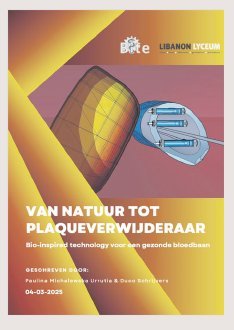
Title: From nature to plaque removal – bio-inspired technology for a healthy bloodstream
Authors: Duco Schrijvers and Paulina Michalewska Urrutia
Category: extended research project / meesterproef
Education: pre-university secondary education (vwo) at Libanon Lyceum Rotterdam
Assessor: Huub van der Loo
Grade: 9.7
Special distinction: winner of the Marc Cornelissen Brightlands Young Talent Award
Submit your thesis
Is your master’s dissertation, bachelor’s thesis, or extended research project of interest to your fellow biologists? Send an e-mail to redactie@bionieuws.nl