


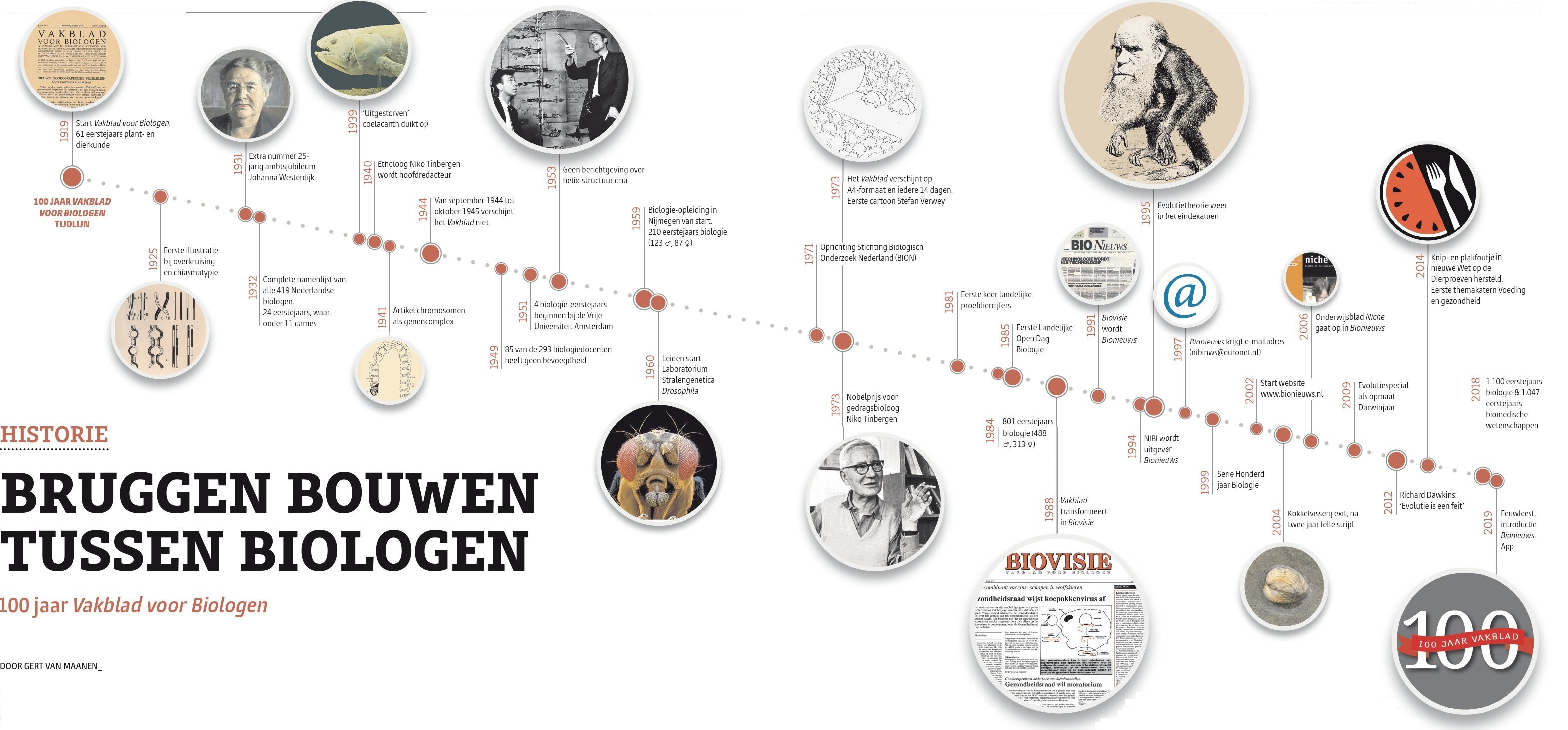
There is a world of difference yet also a strong common thread between the Vakblad voor Biologen of 1919 and today’s Bionieuws.
‘It is still necessary to kindle the sense of solidarity among biologists, which, as I see it, is less well developed among them than among practitioners of other sciences’, wrote the Leiden histologist and first editor-in-chief of the Vakblad voor Biologen, Aemilius Bernardus Drooglever Fortuyn, on the journal’s tenth anniversary in 1929. This wish already resonates in the extremely brief introduction that the Amsterdam zoologist Max Weber gave in 1919, in the first article to appear on the launch of the Vakblad: ‘I trust that not a few will see in it a bond regained, which in this age of specialisation will once again unite zoologists and botanists more closely in their thinking and endeavour, which have so much in common.’ Weber then – also very characteristic of biologists – immediately plunges into the subject matter, writing about the biogeography of coral reefs whilst touching en passant on the far-reaching consequences of climate change and rising sea levels.
The Vakblad aimed to keep biologists informed about developments in science and to strengthen personal connections among them. The former was achieved primarily through lead articles, book reviews and abstracts; the latter by reporting on conferences and other meetings under the heading ‘professional interests’, and through an extensive personal news section. The personal news column recorded not only appointments and changes of position, but sometimes also journeys, working visits already made, and excursions. ‘If someone died, you could write a large part of the obituary simply by leafing through old volumes of the journal. You can see exactly what many biologists did from the moment they graduated’, recalled former editorial secretary and copy editor Simon de Jager in 2002, on the tenth anniversary of Bionieuws. From 1965 he had been ‘almost thirty years the driving force’ and ‘the hardwood-hewn embodiment of the Vakblad voor Biologen‘, according to former editor-in-chief Jelte van Andel in an obituary published in 2010.
‘If someone died, you could write a large part of the obituary simply by leafing through old volumes of the journal’
The tone of the personal news section is often remarkably collegial and self-deprecating, as illustrated by an obituary for the celebrated Amsterdam plant geneticist Hugo de Vries from 1934. ‘Even the great among us are mortal. But their passing evokes different and wider thoughts than the death of someone assigned a more modest place in human society.’ The insider familiarity of a journal written for and by biologists was very high. Salary levels in various positions were shared, a zoologist asked whether anyone could supply him with live mealworm beetles, and plant pathologist Johanna Westerdijk sent readers her regards from the Dutch East Indies. In November 1973, ethologist and former editor-in-chief Niko Tinbergen published a brief note from Oxford, on behalf of himself and his wife, ‘to acknowledge all the congratulations that have reached us from Dutch friends and colleagues on the occasion of the award of the Swammerdam Medal and of the Nobel Prize for Medicine to Ethology’. He apologised for this manner of replying, but ‘I’m snowed under‘. He also used his short message to encourage the Dutch biology community: ‘It is incomprehensible to me, and a great disappointment, that in the Netherlands, where both Ecology and Ethology have such distinguished practitioners, biology education in secondary schools is under threat of being curtailed’, wrote Tinbergen. ‘May these whole animal sciences soon take the important place in society that they deserve.’
HOUSE JOURNAL
The ties between university biologists and biology teachers form another recurring theme in the Vakblad. For the Vereeniging van Leeraren in de Biologie (VeLeBi), founded in 1927, the Vakblad would serve as its house journal for many years. This was again the case from 2006, when the education journal Niche – itself the successor to the Bulletin voor het onderwijs in de biologie, which had grown out of the Vakblad – was once again absorbed into Bionieuws. The journal carried reports on numerous innovations in the teaching of natural history, botany and zoology, and biology across secondary schools of various types. It also reported extensively on the problem of unqualified biology teachers, difficulties surrounding examinations, and the launch of first-degree biology teacher training. Of more practical use to biology teachers were articles on the layout of laboratory classrooms, inaccuracies in textbooks, and teaching materials such as filmstrips, slides, gramophone records, film, and the first biology lessons on television.
As regards university-level biology education, the Vakblad and its successor Bionieuws can draw on an almost unbroken series of records of first-year biology student intake, from the journal’s launch in 1919 to the present day. It began with 61 students of botany and zoology at the four classical universities of Amsterdam, Groningen, Leiden and Utrecht, and – following an exponential surge from the 1950s onwards – reached 1,100 first-year biology students in 2018. The launch of biology degree programmes at the Vrije Universiteit (1951), Nijmegen (1959) and Wageningen (1971) can also be neatly traced in its pages. Particularly in the 1930s, 1970s and 1980s, there was considerable attention to unemployment among biology graduates, with articles on the number of registered jobseekers, application tips, and a years-long survey of biology vacancies in de Volkskrant as an indicator of the job market. Biology students, too, are given a voice in the journal. In one example, Harm Jaap Smit, as chair of the National Consultative Body for Biology Students, offers ‘constructive criticism’ of the rules surrounding compulsory courses, student assistantships and exchange programmes at universities, on the front page of Biovisie on 23 November 1990.
BATAVIA
The focus of coverage in the Vakblad and its successors is, without doubt, biological research. Before the Second World War, relatively much attention was paid to work in the Dutch East Indies, with a regular correspondent in Batavia – present-day Jakarta. The journal covered everything related to the practice of science, including the rules and debates surrounding animal experiments and significant developments in microscopy and other analytical equipment. By far the greatest attention, however, was devoted to results from distinctly Dutch research, such as plant succession in sand dunes, the cause of Dutch elm disease, the role of auxin in root growth, and the behaviour of great tits.
The Vakblad was a true in-house organ – written by biologists for biologists – which did not always make for easy reading. The topics were regularly rather inaccessible and specialised, as illustrated by the 1987 lead article ‘The kinetics of the cell division cycle as a parameter for malignancy and radiation sensitivity of tumours’. All of it was certainly well intentioned, but even former editor-in-chief Hans Linskens acknowledged in 1986 that the journal was ‘actually very dull’ and that some articles were downright ‘indigestible’. It also became increasingly difficult to find biologists willing to write articles, since such publications scored poorly in citation indices. With the introduction of Biovisie, a radical change of direction came in 1988, with a commitment to a more journalistic approach. The journal began genuinely following current developments in biology, and articles became far more readable with the arrival of (science) journalists.
A trend that continued after publisher Stam Tijdschriften merged Biovisie with Biotechnologie in Nederland to create Bionieuws in 1991. A journal that – even after its acquisition by the NIBI in 1994 – grew into a medium for all biologists, with extensive coverage of science news, but also columns, opinion pieces, interviews, and reporting on biology education and the Dutch biology community. Forging connections across the full breadth of biology remained a central aim: from anatomy to zoology, from molecule to ecosystem, from fundamental to applied science, and from secondary to higher education. Bionieuws, too, continues to build bridges between biologists.

Timeline published to mark the 25th anniversary of Bionieuws in 2016.

Ten years old, in 1919
Bionieuws emerged, through a series of intermediate steps, from the Vakblad voor Biologen, which first appeared in September 1919. Form and content have changed radically over 82 years, but the underlying ideal has not disappeared.
(This article appeared in 2001 in the special issue ’10 years of Bionieuws’ in Bionieuws 14 of 15 September 2001 and was written by Arno van ‘t Hoog)
‘I trust that not a few will see in this a renewed bond, which in these times of specialisation will unite zoologists and botanists more closely in their thinking and endeavours, which have so much in common.’ In the very first issue, Prof. Max Weber sums up in a single sentence the ultimate aim of the Vakblad voor Biologen.
The Vakblad sought to bring two separate disciplines – botany and zoology – closer together again, as founder and former editor-in-chief Droogleever Fortuyn explained at the tenth anniversary in 1926.
‘In particular, it remains necessary to foster the sense of solidarity among biologists, which, as I see it, is less well developed among them than among practitioners of other sciences. Perhaps this is so because the subject of our study is so much more diverse than any other subject in the natural sciences, and this may prevent us from seeing the broad outlines that are apparently so clearly visible in chemistry and physics, in medicine, and above all in the technical sciences.’ In biological circles such as NIBI and the Biological Council of the Royal Netherlands Academy of Arts and Sciences (KNAW), such laments can still be heard in virtually undiminished form.
The biological community
The Vakblad sought to strengthen mutual ties by regularly presenting the state of affairs in a given field through ‘lead articles’ – review pieces four to five pages in length – that gave a broad overview. These were explicitly not descriptions of original research. ‘It seems to me that its task must be to give a picture of what is happening in the biological world in our country, and thereby also to forge a bond within the Dutch biological community’, wrote editor-in-chief Dr J. A. Bierens de Haan in 1926.
In addition, there were regular sections: professional interests (covering conferences, courses, and society news), book reviews, and personal notices. The personal notices section in particular was eagerly read – Droogleever Fortuyn wrote after his departure for Peking in 1925 that in China he read that section before everything else.
In 1926, his successor Bierens de Haan expressed the wish that a historian might one day use the Vakblad as a source for describing Dutch biology in the second quarter of the twentieth century. That ambition appears to have been amply fulfilled. The first 68 volumes of the journal give a direct and indirect detailed picture of the changes in biological research and the Dutch biological community. In the 1970s, the personal notices section ran to well over a thousand names per volume!
The personal notices from the war years show, for instance, that Leiden students and researchers found refuge elsewhere after the university was closed. Or there is a call in the first issue after liberation for microscopes to be made available to new students.
Publication pressure
‘You found yourself reflected in the journal, and that creates a bond. If someone died, you could already write a large part of the obituary with old volumes of the journal in hand. You can see exactly what many biologists did from the moment they graduated’, recalls Drs Simon de Jager. De Jager served for twenty-nine years from 1965 as editorial secretary and managing editor of the Vakblad, Biovisie and Bionieuws – alongside his work as a university lecturer in functional and comparative anatomy at the University of Amsterdam (UvA), where he still works.
From the 1970s onwards, under editor-in-chief Linskens, a section entitled ‘from the literature’ was added, featuring short descriptions of national and international publications. The publication frequency also doubled: from monthly to fortnightly. Correspondents in university cities supplied the countless items for the various sections, including reports on dissertations and doctoral defences. They also promoted the journal: the influx of student subscribers sometimes reached one hundred per cent. ‘And they often stayed on after graduating’, says De Jager.
Throughout the decades, editors-in-chief complained that it was difficult to find authors willing to write a lead article. ‘No time’ was a frequently heard excuse.
‘In the early days it wasn’t too bad’, De Jager recalls. ‘Later, enthusiasm waned, partly because of the growing pressure to publish. The Vakblad didn’t score highly in the citation index, of course.’
The content remained dependent on what was submitted, which meant the editorial team could not be very selective, as the last Vakblad editor-in-chief Jelte van Andel lamented on his departure. ‘Articles that hadn’t found a place elsewhere could still find one with us.’
Radical restyling
By the time of Van Andel’s departure in 1988, the Vakblad voor Biologen had, after a turbulent period, acquired a new title: Biovisie. Biovisie would ultimately last only three years, but it formed the editorial blueprint for Bionieuws.
Until that point, the Vakblad voor Biologen had been published by Uitgeverij De Boer, but owing to losses the Hilversum-based publisher sold the journal in December 1987 to Stam Tijdschriften of Rijswijk.
Too difficult
At first, readers notice nothing of this. Behind the scenes, however, a radical restyling is carried out under Van Andel’s supervision by Stam, and on 13 April 1988 the first issue of Biovisie appears. For some it comes as a shock – the publication barely resembles the old journal. It has become a newspaper, and in the opinion of some members of the Biologische Raad – where the Vakblad was a standing agenda item – good enough to wrap fish in. ‘I pointed out that that was impossible, because the paper was too smooth for it’, De Jager recalls. Until Biovisie, the Vakblad had been a for-us-by-us organ run by biologists. De Jager remembers above all the conviviality and the intensive contact with authors. With the arrival of journalists, however, a more businesslike approach also set in, and passages of text began to be cut without consulting the author. The articles do become more accessible.
During the final decade, there is criticism of the journal’s content. Some lead articles carry titles such as ‘The kinetics of the cell division cycle as a parameter for malignancy and radiation sensitivity of tumours’ (no. 10, 1987). Beneath these lie scientific exercises in which researchers plumb the depths of their particular area of biological research. Of the aspiration to convey the ‘broad outlines’ of biological science that Droogleever Fortuyn had envisioned, little is sometimes discernible. Biology is specialising, and this finds its reflection in the Vakblad. ‘The articles were simply too difficult for non-specialists’, Van Andel says on his departure.
Seizing control
In the final volume of the Vakblad, an attempt at change is already being made. Jaap Willems, a lecturer in the popularisation of the natural sciences, spends a year reworking incoming manuscripts. A subsidy from the Biologische Raad ensures that science journalists can contribute to a number of issues. This is an early sign that journalists are gradually seizing control. In Biovisie, that trend continues: current affairs are covered mainly by biological science journalists. Greater emphasis is placed on topical news, leading figures in science and administration, research funding, and politics. Yet space remains for biologists to provide overviews of current developments in their field – in Biovisie Magazine. The newspaper addresses the biologist with topical, short news items; the magazine provides background information on biology. The regular sections diminish in size and importance.
Christian fundamentalist
But biologists also take on the role of journalist. Some professors write the lead story. Even Michiel Linskens, biotechnology campaign leader for the Dutch Society for the Protection of Animals, is allowed in May 1991 to cover a parliamentary debate on transgenic animals on the front page. It is rather like a Christian fundamentalist reporting on a euthanasia debate in de Volkskrant. Even if it is done factually and evenhandedly, it remains irreconcilable with journalistic professional ethics – do not write about matters in which you have a direct interest. For Biovisie – in the midst of the transition from a professional peers’ journal to a journalistic product – this is apparently not yet a problem. Today, however, it would be utterly unthinkable. The losses persist nonetheless, and the magazine folds as early as the end of 1989. Stam asks the NIBI to guarantee 2,800 paying subscribers. This can only be achieved by linking the Biovisie subscription to NIBI membership. The two parties enter into a new contract for 1990. At the end of 1990, Stam launches an operation to merge Biovisie with Biotechnologie in Nederland, a journal that has been published since 1985 in collaboration with the Nederlandse Biotechnologische Vereniging. The merger results, on 27 September 1991, in the birth of Bionieuws – news medium for the biosciences & biotechnology.
Cause for concern
Bionieuws did grow in terms of membership, but under this name too the magazine remained a headache for the publisher. Stam therefore decided not to continue in 1994.
At that point the NIBI took a bold step and a considerable financial risk: the association decided to publish the magazine in-house. On 8 November 1994, members received the first issue, which followed the broad lines of the Stam-era Bionieuws in layout and editorial approach. The transition was thus almost seamless.
The editorial team did not make the move, however. A trio of science journalists, with Dr Jos van den Broek as editor-in-chief, began producing the magazine from the NIBI office in Utrecht. And the venture proved viable: Bionieuws grew steadily alongside the NIBI’s membership. The number of subscriptions crept towards 7,800 over the years. And the publication climbed out of the red, though no commercial publisher would have looked enviously at the balance sheet.
Bionieuws reflected the changing spirit of the times: the molecular dimension of biology received ever greater emphasis, though there were also lively debates about the teaching of evolutionary theory and cockle fishing in the Wadden Sea. The magazine thus became a platform for discussion of all manner of controversies surrounding biological topics, from animal testing to genetic modification. Bionieuws earned a reputation as a magazine that offered depth and scientific explanation on biological matters that the daily newspapers treated only superficially. The accompanying infographics became renowned.
The regular sections had by now become less important, with the exception of the association news. Bionieuws was no longer a chronicle of the Dutch biology community, as the trade journal had been, but a medium whose writers – all journalists with a background in biology – were above all intent on reporting news. Not least on the high-profile topics where biology and society intersect.
Ambitions
In recent years, opinion has featured ever more prominently in Bionieuws – in the form of columns, interviews, letters and commentary. And there are ambitions to grow in both size and content. For how can it be that, at the dawn of the century of the life sciences, the Netherlands’ only biology newspaper is sometimes just eight pages long?
Despite all the changes, ‘balance across topics’ remains a recurring theme in the editorial office. Every biologist – from ecologist to biotechnologist – should be able to identify with Bionieuws: that remains the aspiration. ‘A sense of belonging’, as people put it 82 years ago. The old ideal of Droogleever Fortuyn has not entirely disappeared.
■ Arno van ‘t Hoog
(this article appeared in the anniversary issue ‘Bionieuws – 10 jaar’ of 15 September 2001)

Timeline from 1919 to 2001 in the issue ’10 jaar Bionieuws’, which appeared on 15 September 2001.