


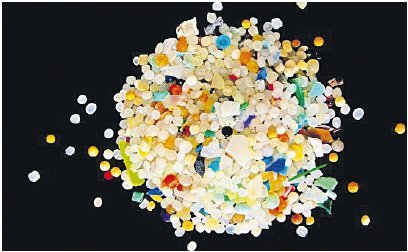
Plastic fragments collected on a European beach. Photo: Current Biology, Wright et al.
Plastic is everywhere these days. Just look around you – chances are you can spot something made of plastic. Much of the plastic found on land comes from the sea: think fishing nets, sweet wrappers, or drinks bottles. This lesson idea zooms in on plastic and looks at so-called microbeads – tiny plastic spheres that are deliberately added to all kinds of personal care products. In this practical, pupils independently investigate environmental pollution. Pupils can bring in their own care products, or you as the teacher can set them out in advance. Take a generous spoonful of a care product and dissolve it in a bowl of water. Stir well until everything has dissolved, then pour the water through a coffee filter. Can you see white or blue specks? If so, you’ve found microbeads!
This lesson idea was originally designed for Years 3 and 4 of primary school, but can also be adapted for Years 7 or 8. The full written lesson plan, including additional material for further exploration, can be found on the website natuurwetenschapentechniek.nl along with many other ideas for primary school!