


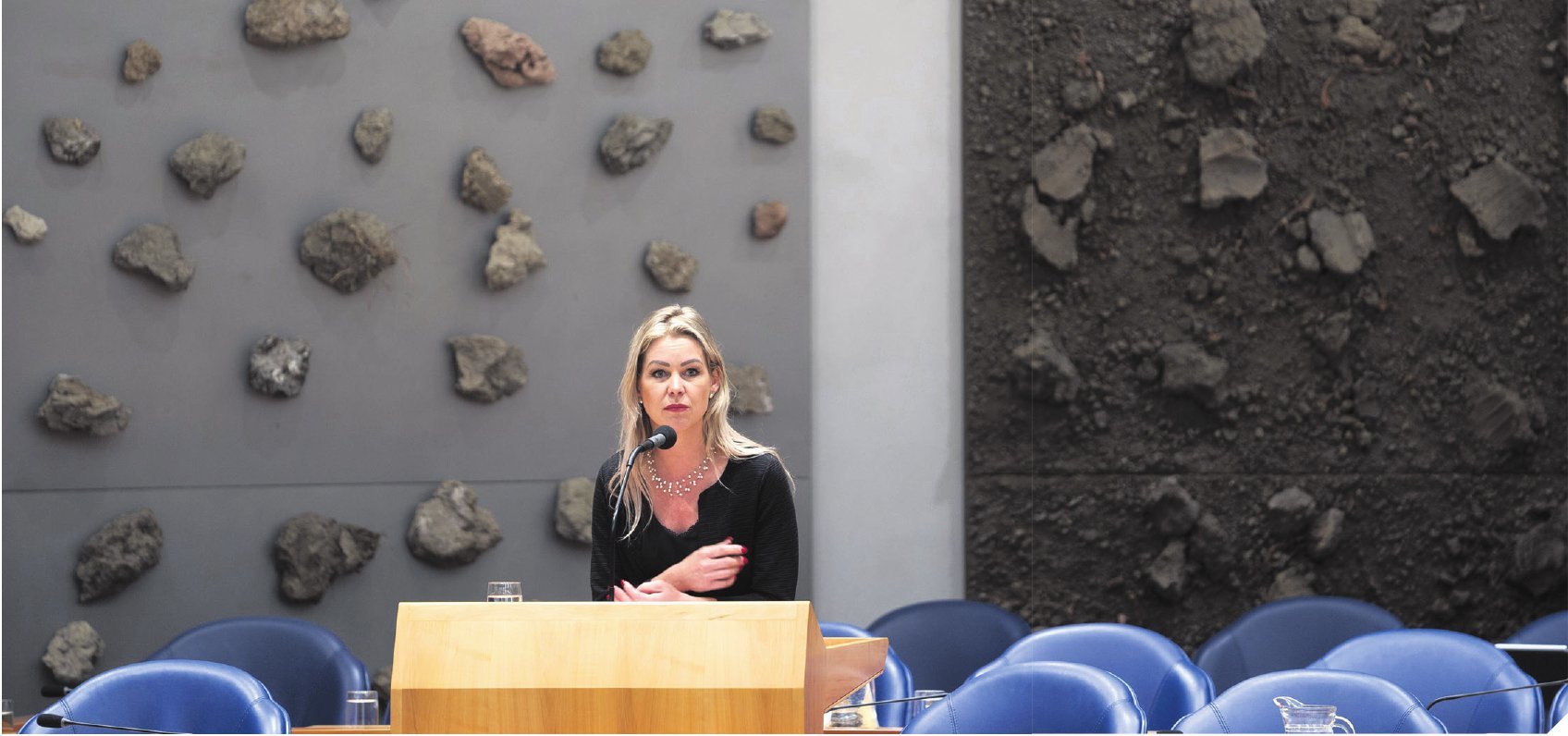
 Photo: ImageSelect / ANP Jeroen Jumelet
According to ‘new peer-reviewed research’, nitrogen emissions could be raised to 1 mole per hectare per year. BBB minister Femke Wiersma was jubilant, but it quickly became clear she had been cherry-picking the science.
‘Minister Wiersma breaks open the nitrogen lock. Hope dawns for thousands of farmers and construction projects’, the BoerBurgerBeweging posted on its website on 14 February. Armed with a new study, the agriculture minister believed she had sufficient grounds to raise the ‘arithmetic lower limit’ for nitrogen to 1 mole, or 14 grams per hectare per year. Thousands of businesses and projects would then no longer require a permit.
Wiersma briefly brandished the ‘peer-reviewed’ findings of Arthur Petersen, professor of science, technology and policy in London. But it quickly proved a damp squib: the RIVM and several scientists immediately distanced themselves from the claim that her proposal to relax the nitrogen rules was scientifically substantiated. ‘All in all, the cabinet gives the impression of selectively shopping in science, and steering towards the most favourable possible outcome for the plan Wiersma already had in mind’, summarised the newspaper Trouw.
It will not be the first time that individuals or organisations have selectively shopped – or cherry-picked – in science to bolster their own argument. From coronavirus and the workings of vaccines to the role of humans in climate change and biodiversity loss: ‘cherry-pickers’ insert themselves into virtually every public debate. Bionieuws takes a tour through a number of striking examples.

Rik Leemans, biologist, emeritus professor of environmental systems analysis in Wageningen and co-author of the IPCC reports of 2007 and 2014
‘This has all the hallmarks of cherry-picking – taking the conclusion of a single scientist that happens to suit you in order to ride your own hobby horse. Funnily enough, it reminds me of Michael Mann’s hockey-stick graph on climate warming, which appeared in the policy summary of one of the first IPCC reports. Climate sceptics went absolutely wild about it at the time, because back then it was still the first and only study. It has since been confirmed many times over. That is why the IPCC nowadays focuses on reliability and consensus. Research findings become increasingly reliable when more studies – ideally from different methods and disciplines – point in the same direction. A Forum for Democracy MP once went full throttle and quoted a sentence from an IPCC report stating that the weather had not become more extreme. This sentence came from a regional chapter and was surrounded by considerable uncertainties that the MP conveniently omitted. He ignored the chapter on extremes, which was full of studies pointing precisely to an increase in extreme weather events. Context matters! One desk study on uncertain lower limits does not refute a body of publications showing that nitrogen deposition harms nature. And what do they mean by peer-reviewed? As long as a study has not been published, it cannot be assessed or challenged.’

Lawrence Jones-Walters, programme director of nature-inclusive transitions at Wageningen University
‘Besides cherry-picking, you also see in the Netherlands that scientific findings are occasionally treated as subjective opinions in debates about biodiversity conservation. For example, around the Oostvaardersplassen, where public outrage arose over the high mortality rates among large herbivores during harsh winters. Although ecological studies argued for minimal human intervention, public protests and political pressure led to more management measures. Public sentiment and political influence thus appear capable of overshadowing scientific recommendations in biodiversity management.
‘Cherry-picking can be seen in governments, for example, such as the previous Bolsonaro government in Brazil. According to some researchers, setting aside large tracts of land for nature conservation can harm local economies and displace indigenous communities. Bolsonaro used those arguments to oppose international nature conservation commitments.
‘Despite the strong scientific consensus on the need for biodiversity conservation, opposition to the 30×30 target (30 per cent of land and sea protected by 2030) has also emerged in north-west Europe. The European People’s Party argued, for example, that nature restoration would be harmful to farmers and food security, despite evidence of long-term benefits for agriculture. The Netherlands voted against the Nature Restoration Law, whilst 75 per cent of Dutch citizens are in favour. There appears to be a gap between public sentiment, the scientific majority, and political action.’

Wieger Wamelink, ecologist and author of Het stikstofweb
‘I’ve just come back from a European nitrogen conference in Finland, and there was broad agreement among almost all the Dutch attendees: the minister used part of the report whilst leaving out other crucial information. I understand, for instance, that Arthur Petersen explicitly warned that if you opt for a lower threshold of 1 mol, you must then take substantial additional measures to reduce deposition. But Wiersma chose not to include that – a classic case of cherry-picking.’
‘Wiersma did indeed have the report reviewed; the full document has since been made public. This again shows that the stated lower threshold of between 1 and 35 mol cannot be scientifically substantiated, and that reviewers believe it would not hold up in court.’
‘And rightly so: the Dutch government has already taken many shortcuts in this dossier. It started with the PAS scheme in 2015, under the motto: we’ll issue nitrogen rights and compensate later. That went completely wrong. Courts have since become increasingly strict, in favour of nature. It is important that we now take action rather than continuing to delay. Everyone stands to benefit from that.’

Marc Veldhoen, professor of immunology in Lisbon
‘When the coronavirus pandemic broke out in 2020, the Netherlands suddenly had seventeen million virologists and immunologists. Cherry-picking was rife then, and still is today. Hordes of people seized on individual studies to cast vaccines in a bad light. Climate scientists regularly said to me at the time: now you know what we’ve been dealing with for years.’
‘In a sense, of course, everyone cherry-picks – scientists included. In the introduction to a publication, you discuss studies that support your own research. That’s perfectly logical. But in science you never rely on a single paper. In the public sphere it’s very different, and with the rise of open access – which I broadly support – anyone can suddenly read what is being published or is available as a preprint.’
‘I always set my students an assignment in which they have to find evidence for a nonsensical theory. They always manage it, and it’s a very instructive exercise. I myself try to explain complex immunological studies on social media – for instance those on vaccine injury, which I know people will run away with – in order to offer some counterbalance.’