


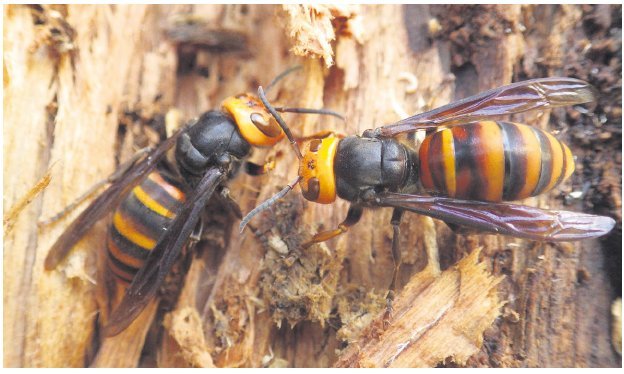
In the city, the hornet V. simillima consistently sticks to its rural diet: soft-bodied insects. Photo: Saga Tatsuya.
In Japanese cities, two hornet species coexist by having one switch to tough urban prey whilst the other sticks to soft-bodied insects.
In Japanese cities, two hornet species live together in striking harmony by specialising on different food sources (Entomologia Generalis, 4 November). Using DNA metabarcoding of larval gut contents – which reflects what workers bring back to the nest – Japanese biologists have for the first time mapped in detail what Vespa analis and Vespa simillima eat in urban and rural areas around the Japanese cities of Kobe and Itami. In total, they identified 334 prey species from more than twenty insect orders.
The analyses show that both species find less prey diversity in cities as the proportion of built-up land increases: within five hundred metres of the nest, a 25 percentage point increase in urban cover leads to a loss of around ten prey species. Yet the two species respond differently: V. analis switches in urban areas to beetles and other insects with a tough chitinous exoskeleton, whilst V. simillima continues to favour soft-bodied insects such as caterpillars and crickets.
Less energy-rich
Although V. analis is considered the dominant species, it is precisely in urban conditions that it settles for less nutritious prey. This shift points to a difference in behavioural flexibility: V. analis adjusts its diet even when those prey items are less energy-rich and harder to process, and will even eat conspecifics when food is scarce. In rural areas, by contrast, both species show largely overlapping diets. According to the researchers, this demonstrates that it is not competitive ability but adaptability that determines which predatory insects persist in the city: urbanisation acts as an ecological filter that admits only flexible predators.