


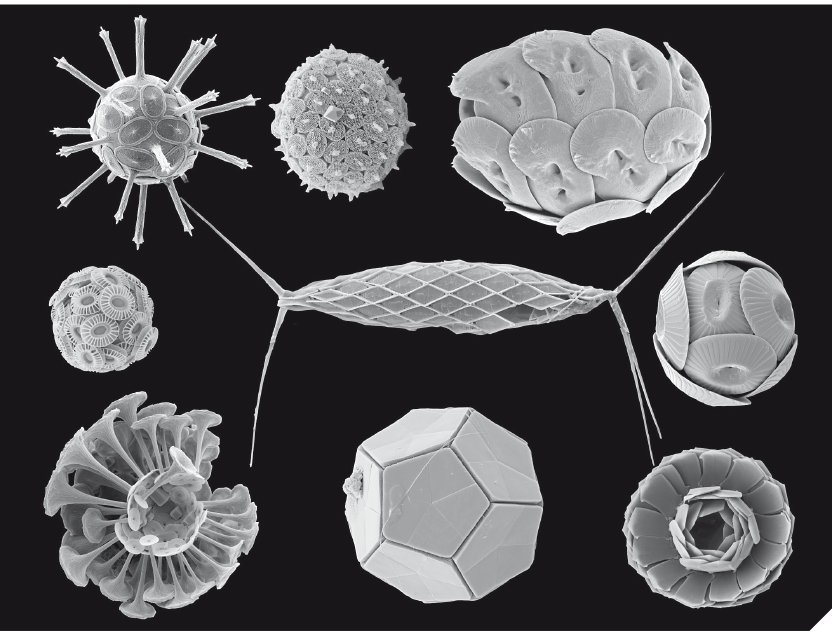
Microscopic images of various species of coccolithophores, which play an important role in the carbon cycle. Photo: Jeremy Young.
Tiny ocean organisms such as coccolithophores, foraminifera and pteropods are frequently absent from climate models, even though they are ‘the key to Earth’s carbon future’.
By leaving ‘calcifying plankton’ out of climate models, those models underestimate important processes in the global carbon cycle and the ocean’s capacity to respond to climate change. Plankton organisms such as coccolithophores, foraminifera and pteropods form a crucial part of the ocean’s carbon cycle by building minute shells from calcium carbonate (CaCO3). This is the conclusion of an international team of marine biologists led by Patrizia Ziveri of the Universitat Autònoma de Barcelona, in a review published in Science on 24 October. According to the researchers, these organisms exert a major influence on seawater chemistry and facilitate the transfer of carbon from the atmosphere to the deep ocean. It is a ‘carbon pump’ that affects virtually everything: ‘from ocean chemistry to the fossil record’.
‘Plankton shells are small, but together they determine the chemistry of our oceans and the climate of our planet’, says lead author Ziveri, who is also affiliated with the Catalan Institution for Research and Advanced Studies. ‘By leaving them out of climate models, we risk overlooking fundamental processes that determine how the Earth system responds to climate change.’
Dissolution
The reason these small calcifying plankton organisms are not included is that their calcium carbonate shells almost never reach the seafloor. A large proportion dissolves during descent, in the upper ocean layer – a process known as shallow dissolution. This has a profound effect on all manner of biological interactions, including predation, particle aggregation and the dissolving capacity of the oceans. Yet, according to Ziveri and colleagues, these insights remain largely absent from major Earth system models such as CMIP6, of the Coupled Model Intercomparison Project, on which the IPCC (Intergovernmental Panel on Climate Change) bases its climate assessments.
Sensitivity
Coccolithophores are single-celled algae that occur in vast numbers in the upper ocean layers and are therefore the principal producers of CaCO3. They are particularly sensitive to acidification because they lack specialised pumps to remove acid from their cells. Foraminifera (single-celled animals with an external calcareous skeleton) and pteropods (planktonic sea snails) do possess such pumps. Even so, these groups differ in their resistance to acidification, because the calcareous skeletons of foraminifera are generally composed of the more resistant calcite, whilst pteropod shells are made of the more vulnerable aragonite. Despite those fragile shells, pteropods survived two environmental crises of acidification and warming, 66 and 56 million years ago (PNAS, 2020).
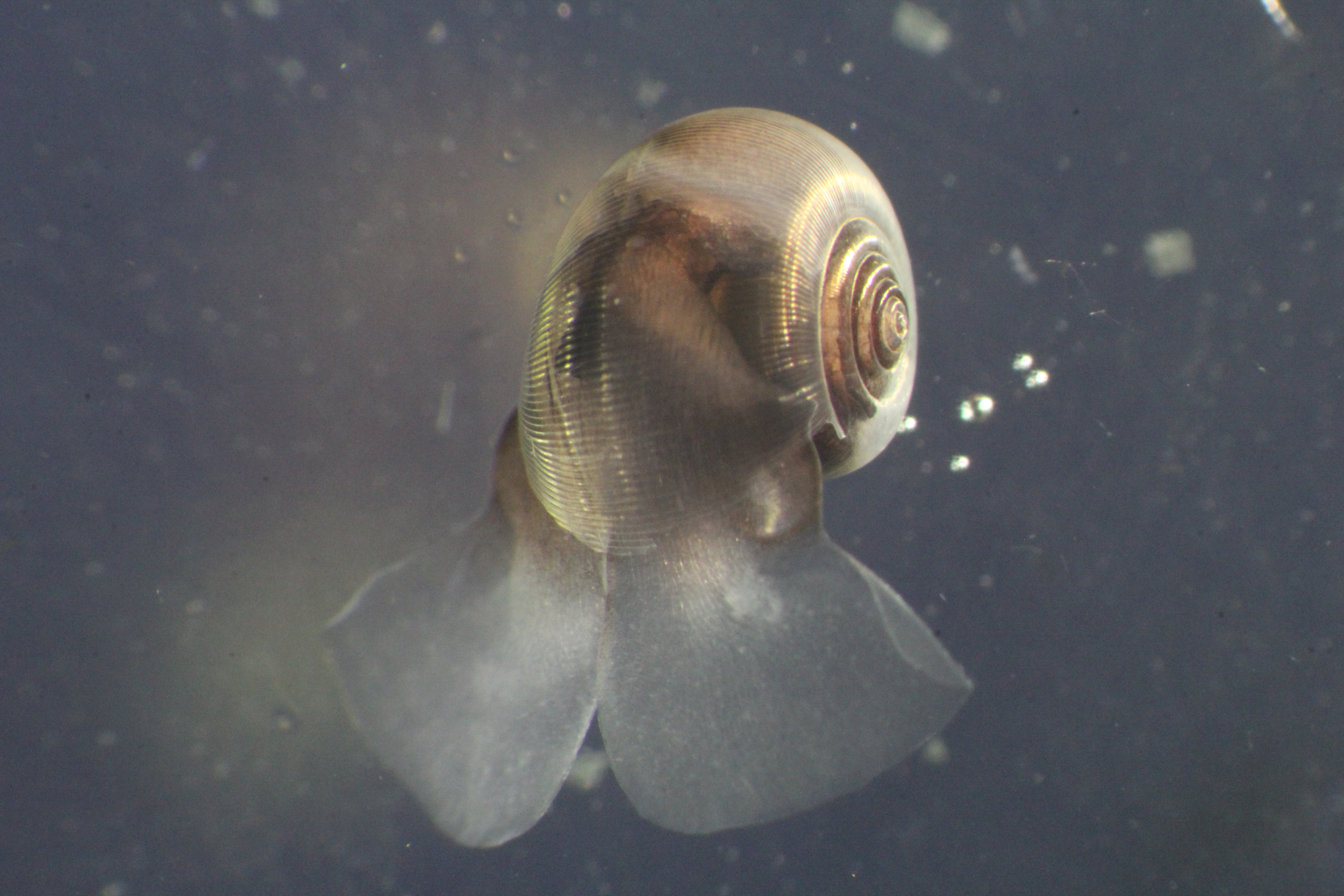
The sea butterfly, or pteropod Limacina helicina, collected off West Greenland. Photo: Alena Sakovich & Clara Manno.
The review provides an overview of many comparable recent scientific publications and insights concerning these three groups of marine organisms. The authors argue for better integration of this knowledge into model projections of global climate change.
It is a call that Katja Peijnenburg, a marine biologist at Naturalis, wholeheartedly endorses. ‘Not least because these are organisms that are particularly sensitive to acidification, and ones for which marine biologists have made considerable efforts over the past 20 years to better understand their role in the oceans.’