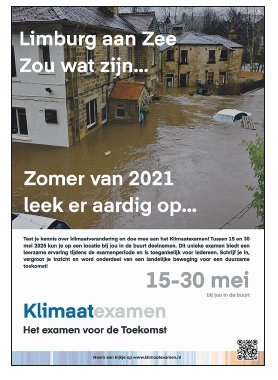
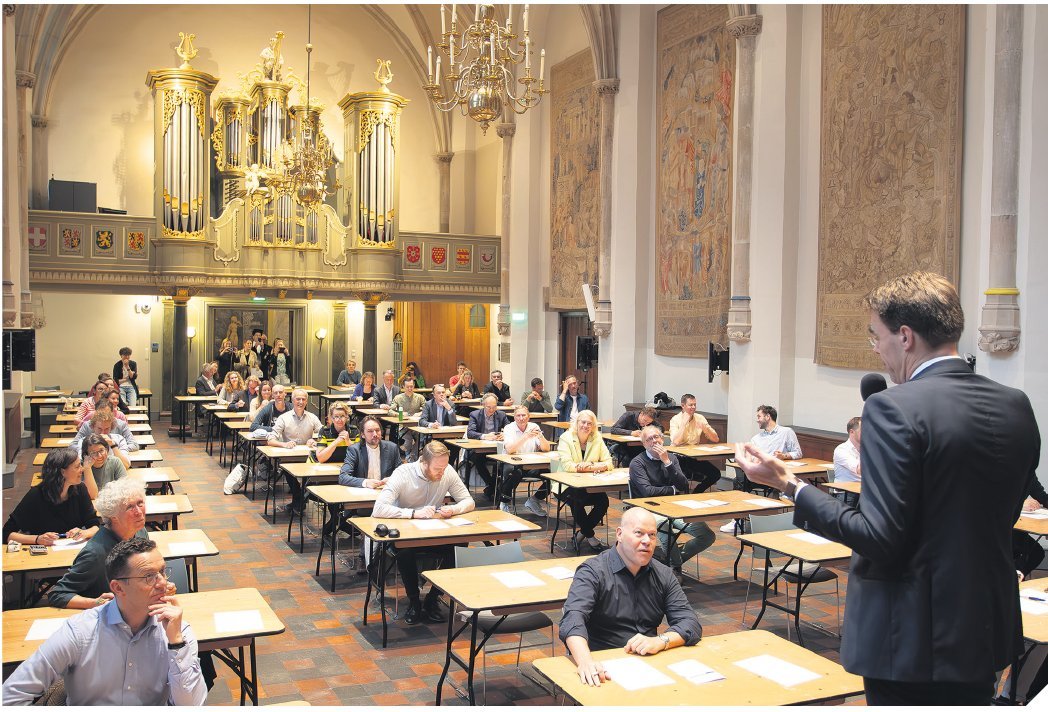
 Joost Brinkman leading a session of the Climate Exam 2024 in the Academiegebouw in Utrecht (left) and one of the campaign posters (below). Photo: Patrick Siemons
This year the Climate Exam is being rolled out nationally, with schools also being invited to test the climate knowledge of their pupils and parents.
‘If you ask pupils what was agreed in the Paris Climate Agreement, quite a few children still look completely blank. I think the amount of climate knowledge that pupils – and their parents, and indeed all citizens – actually possess is still greatly overestimated. That alone makes it worthwhile to organise the Climate Exam. It also sparks discussions about solutions, and of course the very last question is the most important of all: what are you personally going to do to make a difference on climate?’ says Joost Brinkman, founder and driving force behind the Climate Exam 2025, which takes place this year between 15 and 30 May. He is a nuclear physicist trained in Delft who regularly visits schools on behalf of the agency Darel Education, among others, with masterclasses and role-playing exercises on climate change and the energy transition.
‘In 2024 we organised the Climate Exam at eleven locations, with four hundred candidates, and the Academiegebouw of Utrecht University as the central main venue. Around ten thousand people also took the online climate test on their mobile phones at that time. This year we want to push ahead and reach more young people and schools’, Brinkman said on 16 April via Teams. ‘Our ambition is to hold the exam in at least a hundred locations. We’re already well on our way with 79 registrations, but in principle sign-ups can continue until mid-May. This year a special youth version of the Climate Exam will be available, aimed at young people between the ages of 14 and 18. Climate change affects us all, so we hope that teachers from multiple disciplines will warm to the idea. It calls for an energy transition and a circular economy, but it also touches on biodiversity, of course. We need nature itself urgently to absorb the consequences of climate change. The Climate Exam therefore fits well with the subject matter of physics, geography, and biology too’, said Brinkman.
Awareness
In the mailing calling for participation in the Climate Exam 2025, geography teacher Nicoletta de Jager of the Rembrandt College in Veenendaal describes their involvement as follows: ‘Climate change is a topic to which we at Rembrandt College devote a great deal of attention – not only in geography; we bring it back in every subject. We would also like to involve parents more in this, and what better way than to take part in the Climate Exam. It lets parents experience what it is like for exam pupils to sit an exam – perhaps taking them back to their own school days, or helping them share the feeling a little better with their child who is sitting exams this year. In this way we hope to create greater awareness of this important topic.’
Awareness and the enjoyment of working through it together are indeed the primary aims, according to Brinkman, but the Climate Exam also has an explicit focus on spreading knowledge. ‘It highlights the lack of knowledge in a light-hearted way. It gives teachers, pupils, and their parents the opportunity to discuss the causes and consequences of climate change. There is, for example, some calculation work on the implications of the fact that 40 per cent of the country is currently used for agriculture – and livestock farming in particular – and what it would mean for greenhouse gas emissions if 10 per cent of livestock farming were to disappear. Last year we saw that the prospect of an exam does prompt people to look into the subject and seek out reliable information. Because there is certainly no shortage of fake news circulating about climate too. On our website we offer background articles, videos, and other information that anyone can use to prepare for the exam. But even without preparation, you always learn something from taking an exam’, Brinkman believes.
An important message of the exam is that solutions exist and that you are not powerless in the face of climate change. ‘It is good to mark the exam immediately afterwards, because you learn something from that too and can perhaps get into a discussion with one another. Talking it over and providing good explanations is always worthwhile’, said Brinkman. ‘You can also award scores and draw up rankings, if you enjoy that sort of thing. But taking part in this exam matters more than scoring highly. It would be rather wonderful if the Climate Exam became an annual tradition. I am also one of the founders of Cycling4Climate, which organised the first Climate Classic in 2018. Fifty cycling enthusiasts took part then, but for 2025 we are expecting 3,500 participants. It really does feel good to get moving together for a cause.’
Checklist for taking part in the Climate Exam
The Climate Exam 2025 is for young and old alike, so anyone can take the initiative to organise it at school or elsewhere.
-Check klimaatexamen.nl to see whether any exam sittings are already taking place nearby
-Choose your own venue, date and time, and register the exam
-Invite participants (parents, local figures, etc.); draft texts and posters are available
-Print the exams and provide pen and paper
-Arrange a host who will coordinate the exam and see to coffee/tea or drinks.