


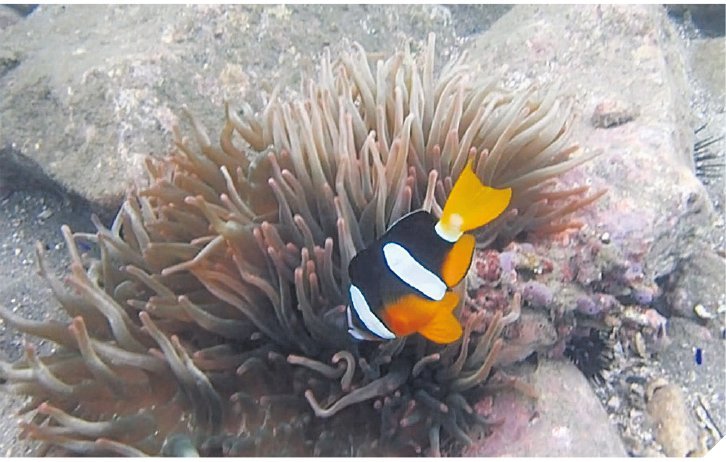
When pieces of krill, mussel, squid or fish are too large for them to eat themselves, Clark’s anemonefish serve the food to their host anemone.
When anemonefish cannot eat the food themselves, they pass it to their anemone.
Clark’s anemonefish actively feed the anemone with which they live in symbiosis. Rather than providing their host with nutrients by accident, they genuinely offer food in a proactive manner. This is the finding of field experiments by Japanese zoologists, described in Scientific Reports on 26 February.
The size of the piece of krill that researchers offer on a line determines whether Clark’s anemonefish (Amphiprion clarkii) eat the food themselves or pass it to their host (Entacmaea quadricolor). Smaller than 7 millimetres? The fish usually eat it themselves; larger pieces go to the anemone. For mussel, squid and fish, the threshold is around 3 millimetres. Green algae, brown algae and sponges are ignored entirely by the anemonefish – only small pieces of green algae are eaten by the fish themselves.
When Clark’s anemonefish are repeatedly offered fresh pieces of krill, they eventually pass those on as well. They presumably prioritise their own nutritional needs first. This could also mean that, in the wild, Clark’s anemonefish do not feed their anemones particularly often. Anemones that are fed do appear to grow more quickly, the researchers note. The fish may benefit from this: females, for instance, lay more eggs in larger anemones.