


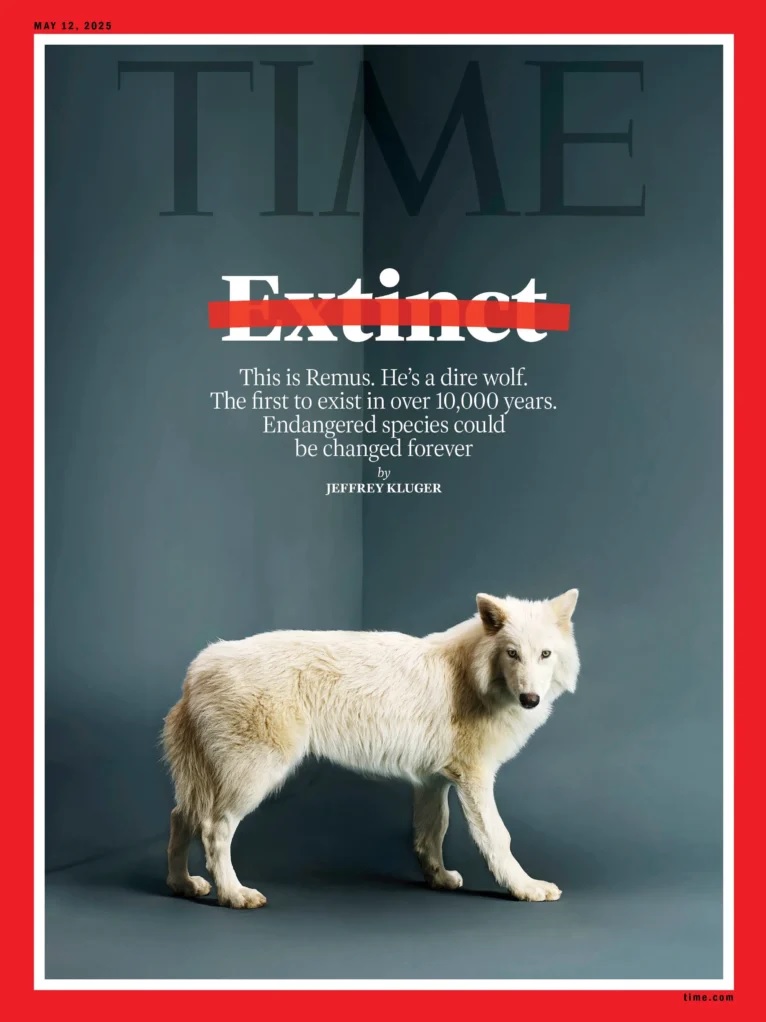
The American company Colossal Biosciences claims that three specimens of the extinct dire wolf are once again roaming the earth. De-extinction is controversial, because according to some scientists it is simply not possible to bring an extinct species back to life.
The media attention is reminiscent of Dolly the sheep, the ‘first cloned mammal’ of 1996. Once again, the first resurrected extinct animal species – the dire wolf (Canis dirus) – appears triumphantly on the cover of Time Magazine (7 April). The magazine’s extensive cover story is, for now, the principal source of the claim by the American company Colossal Biosciences that it has succeeded in bringing three specimens of the dire wolf – extinct for more than 10,000 years – back into the world. The scientists at Colossal have introduced genes identified in fossil remains of the dire wolf into the genome of the common grey wolf (Canis lupus). Domestic dogs were then used as surrogate mothers to give birth to the now seven-month-old pups Romulus and Remus, and their now two-month-old sister Khaleesi. ‘Effectively bringing back, for the first time, a lineage of animals whose living gene pool had long since vanished’, according to the article in Time. Romulus and Remus now live at a secret location within a fenced section of an American nature reserve.
HYBRID
The dire wolf – in English dire wolf, meaning ‘terrible wolf’ – was one of the most common and widespread carnivores in the Americas during the Pleistocene, ranging from Alberta in Canada to Brazil, with one fossil find (a lower jaw) in north-east China (Quaternary International, 2021). Relatively little is known about their extinction and evolution, but morphologically they closely resembled the grey wolf. Analyses of five genomes from subfossil remains (Nature, 2021) indicate, however, that they form a highly divergent lineage that split off some 5.7 million years ago. Nor has any evidence ever been found of hybridisation or gene flow between dire wolves and grey wolves or coyotes. The dire wolf thus appears to have originated early in the Americas, whilst grey wolves evolved in Eurasia and colonised North America only relatively recently. This raises the question of whether the genome of the grey wolf is at all suitable for recreating a dire wolf. For now, only the claim of a ‘hybrid’ appears tenable, and the presented dire wolves look above all like the dogs that played dire wolves in the popular television series Game of Thrones. They have a slightly broader head, a stronger jaw, and a lighter, thicker coat than grey wolves.
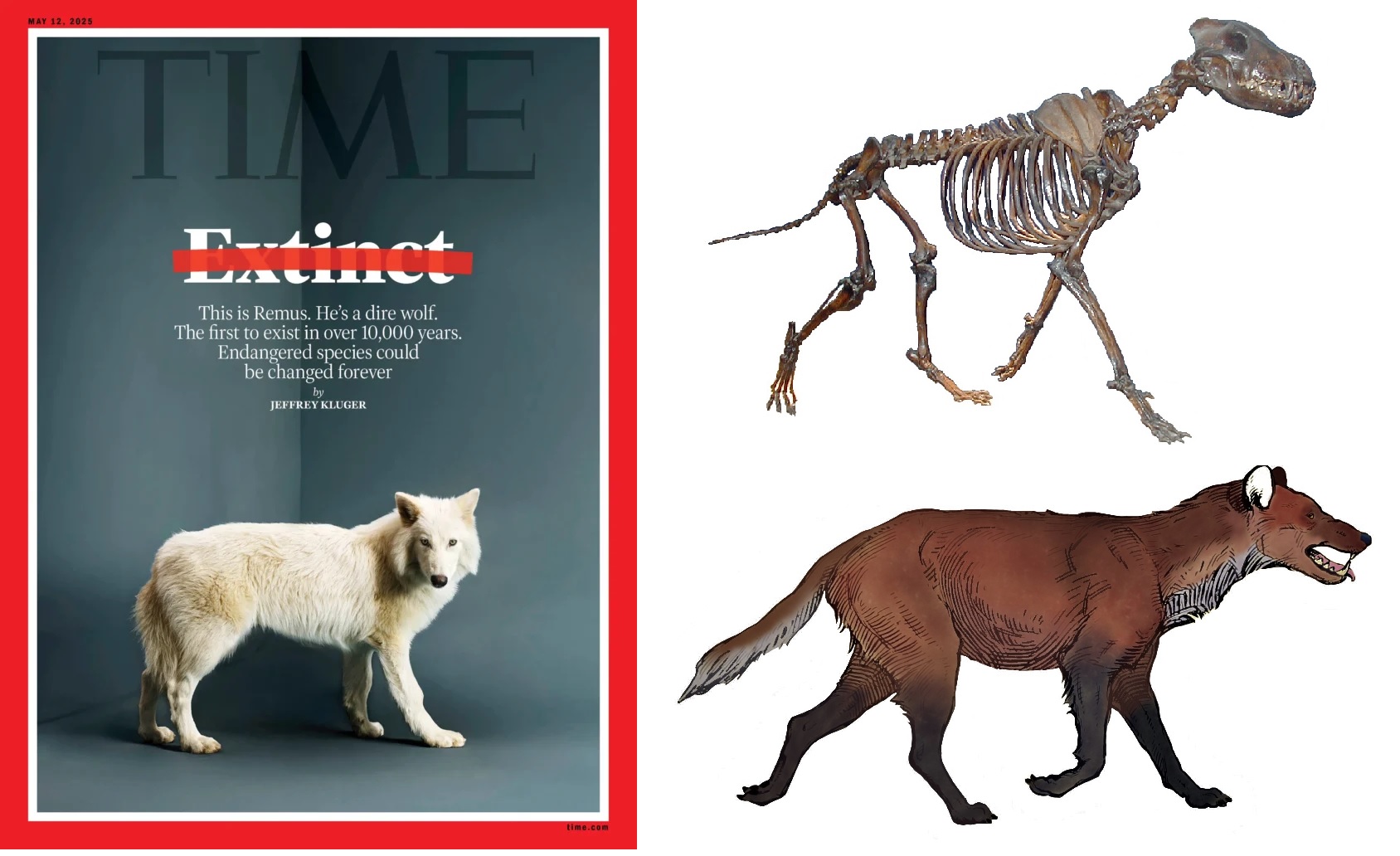
The cover of Time Magazine (left) featuring Remus as the ‘resurrected dire wolf’, a Canis dirus skeleton (top right) in the George C. Page Museum in Los Angeles, and a reconstruction drawing of the dire wolf (bottom right) from the American Museum Journal of 1916. Source: Colossal, WolfmanSF & Mariomassone.

The Dallas-based company Colossal Biosciences has been working since 2021 on the de-extinction of iconic species such as the woolly mammoth, Tasmanian tiger, dodo, and dire wolf, in order to ‘preserve and restore the declining biodiversity of the earth’. The well-known Harvard geneticist George Church (1954) is one of the founders of Colossal, which has 130 employees. The company aims, among other things, to have a woolly mammoth roaming the earth again by 2028, and in March presented a preliminary exercise: a genetically modified woolly mouse (Science, 4 March). Many scientists see major practical objections to reintroducing Lazarus species and regard it as an expensive alternative to preventing species from going extinct in the first place. ‘Ultimately, at best you achieve something like a pseudo-hybrid, a very superficial de-extinction, exciting science fiction that leads nowhere. You can never bring an extinct species back to life’, said Canadian biologist Britt Wray in 2019 in an interview with Bionieuws.
See also:
–‘Een uitgestorven soort kan nooit meer herleven’ – Interview with biologist Britt Wray, Bionieuws, 2019
–‘Is the dire wolf back from the dead? Not exactly’ – Science, 8 April
–‘No, the dire wolf has not been brought back from extinction’ – New Scientist, 7 April
–Can genetically engineered ‘woolly’ mice help bring back the mammoth? – New Scientist, 4 March