


For his master’s thesis, Lars Willighagen is searching for differences in leg segments, antennal hairs and other structures in beetle larvae.
‘Is this structure genuinely aberrant, or do other species have it too? Or does it only look unusual in this individual, and not in conspecifics?’ These are the kinds of questions Lars Willighagen asked himself whilst developing an identification key for the larvae of Cholevinae beetles. The result is written up in his master’s thesis. ‘In general, there is not much research on this group of small beetles, and collecting larvae is not straightforward either. If you find a larva, you have no way of knowing which species it is without an identification key. To find out, you have to collect adult beetles – which can be identified to species – and then rear larvae from them’, says Willighagen. Time to change that. Using a microscope, Willighagen photographs old preparations from the beetle collection at Naturalis and measures the length of various structures. ‘The length of the larva itself tells you little, because in those preparations they are completely compressed. But you can make reliable statements about the length of, say, a leg or antennal segment.’
Spreadsheet
Spotting differences turns out to be quite a challenge. ‘Based on a literature review I had some leads, and after that it was a kind of trial and error. I kept a spreadsheet: every time I thought I had found something, I added a new column. I would then fill it in completely. Sometimes the character turned out to be inconsistent after all; sometimes it really was a genuine difference.’ Quite an undertaking: in the end, Willighagen produces an identification key for all three larval instars of 27 species of Cholevinae larvae occurring in the Netherlands. Distinguishing between instars is essential: ‘After instar 1, the larvae acquire secondary hairs, for example. Sometimes you can distinguish a species by the number of hairs on the antenna in instar 1, but that turns out to be no consistent character at all for instars 2 and 3.’
The final key takes the form of a decision tree. ‘Think of it as: step 1, does the larva have this structure on the abdomen and is it relatively long – go to step 2. If it lacks that structure and is shorter, proceed to step 3. In this way you eventually arrive at the correct species’, explains Willighagen. To aid clarity, he produces schematic illustrations of important structures. ‘For those I used the computer programme InkScape to trace lines over the microscope photographs. In the thesis I then indicate, for example, how the shape of the mandible differs.’
Although species identification nowadays is often carried out using DNA, morphological keys such as the one in this thesis are, according to Willighagen, still important. ‘On platforms such as waarneming.nl you only have photographs, for instance. Moreover, in research it is by no means always standard practice to collect individuals, nor do you always have access to DNA methods. And the two approaches can reinforce each other: DNA research delineated a group of four beetle species, and I was also able to identify striking characters for that group.’ In total, Willighagen spends around a year and a half on the thesis. ‘That was a voluntary choice. The key for the first larval instar was finished at a certain point, but I wanted it to be more complete.’ Perseverance pays off for Willighagen: a publication based on the thesis has been submitted and accepted, and for the thesis itself he received the Uyttenboogaart-Eliasen Master’s Prize.
Postscript: the article in question has since been published in Tijdschrift voor Entomologie(12 March).
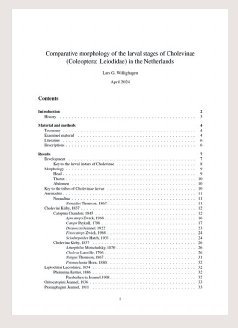
Title: Comparative morphology of the larval stages of Cholevinae (Coleoptera: Leiodidae) in the Netherlands
Author: Lars Willighagen
Category: master’s thesis
Degree programme: Biology at Radboud University
Examiners: Menno Schilthuizen and Henk Siepel
Grade: 9
Special distinction: winner of the Uyttenboogaart-Eliasen Master’s Prize
Submit your thesis
Is your master’s thesis, bachelor’s thesis or extended essay interesting reading for your fellow biologists? Send an e-mail to redactie@bionieuws.nl