


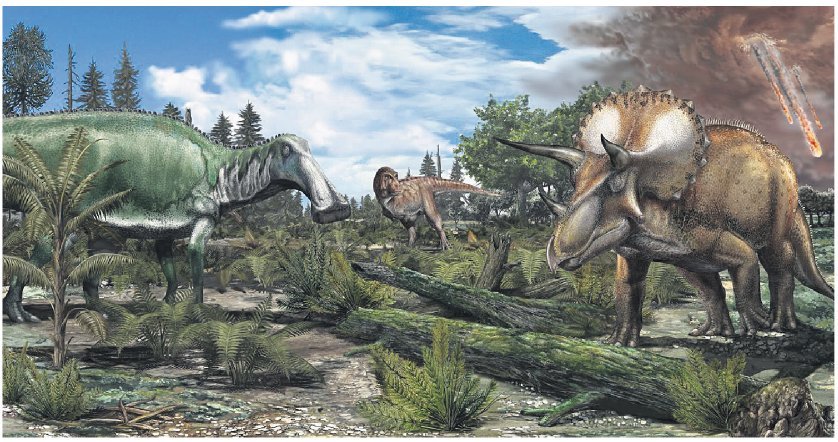
Reconstruction of the North American climate of around 66 million years ago, in which dinosaurs such as Edmontosaurus annectens, Tyrannosaurus rex and Triceratops prorsus were probably still thriving.
The idea that dinosaurs were already doomed to extinction well before the asteroid impact may be the result of a biased fossil record.
In the run-up to the catastrophic asteroid impact roughly 66 million years ago, dinosaurs on Earth may have been faring better than previously thought. The notion that their numbers were already in a downward spiral before the impact appears to be based on a bias: there are fewer exposed and accessible rock formations containing fossils from the very last part of the Cretaceous than from the millions of years preceding it. In other words, the chances of finding fossils from the period just before the asteroid impact are simply lower, conclude American and British researchers on 8 April in Current Biology.
They reached this conclusion after extensive analyses of the fossil record spanning 84 to 66 million years ago – the eighteen million years leading up to the extinction of the dinosaurs. The study covers more than eight thousand largely North American fossils, with the researchers focusing specifically on four clades: the armoured Ankylosauridae, such as the club-tailed Ankylosaurus; the horned Ceratopsidae, such as Triceratops; the duck-billed Hadrosauridae, such as Edmontosaurus; and the carnivorous Tyrannosauridae, to which T. rex belongs.
Coverage
The researchers make use of a statistical method from ecology: occupancy modelling. This approach estimates how likely it is that a species occurs in a given area, even when that species cannot always be observed. Here, the researchers use it to correct for the fact that some fossils are harder to find – for instance due to vegetation cover or a lack of exposed rock. They divided North America into a grid and estimated, for each cell, where the four dinosaur groups probably lived and how likely it was that their fossils could be found there.
Cosmic bad luck
The results show that the potential habitats of these four clades remained virtually stable throughout the final 18 million years of the Cretaceous. The likelihood that dinosaurs were present in those areas also remained constant over this period. The researchers do find that the probability of discovering dinosaur fossils decreases for the last 6 million years before the impact. This is probably due to geological changes driven by processes such as plate tectonics, mountain building and sea-level retreat. There appears to be no evidence of genuine fluctuations in biodiversity. The extinction of the dinosaurs was therefore more likely the result of sudden cosmic bad luck than of gradual decline.