


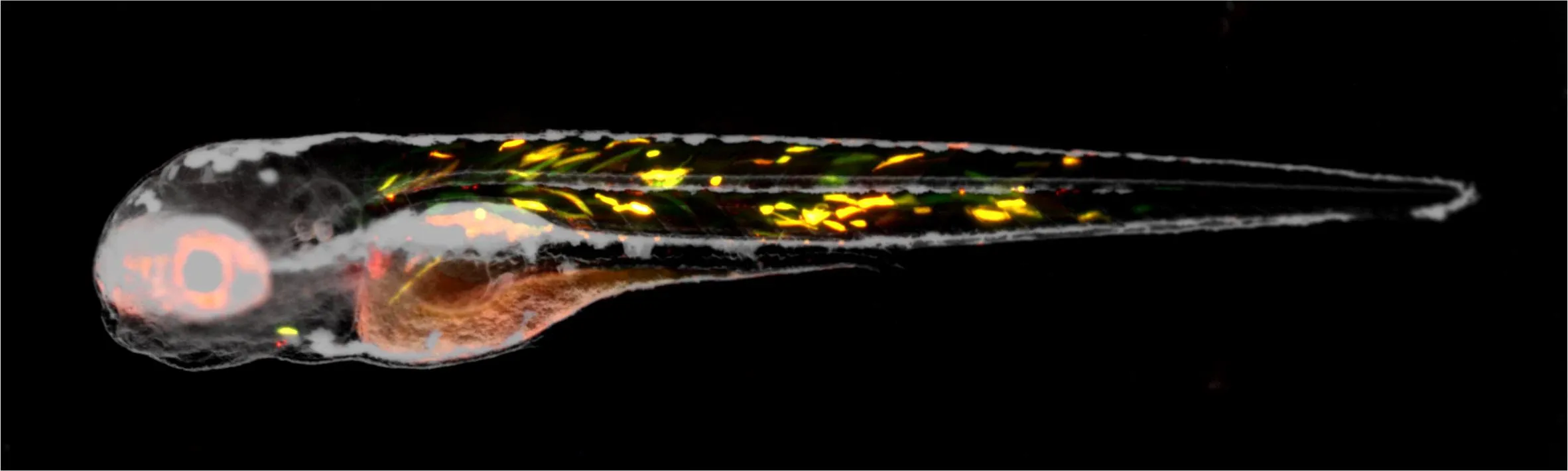
Zebrafish larva with individual muscle fibres labelled in separate colours. Source: King’s College London
Working nights disrupts the circadian rhythm of muscle cells and is linked to accelerated muscle deterioration.
Muscle cells have a circadian rhythm. At night, whilst the body is at rest, the cells replace damaged proteins, allowing the muscle to repair itself. New British research shows that disrupting this muscle clock is associated with the muscle deterioration that normally occurs with ageing (PNAS, 5 May). The study was conducted in zebrafish larvae.
In their experiments, the researchers disrupted the muscle clock in zebrafish larvae, which were then followed for two years and compared with healthy control animals. Initially, no difference was visible between the zebrafish: their muscle clock recovered and they ate and slept normally. After two years, however, the zebrafish larvae whose muscle clock had been affected turned out to have aged more rapidly. This manifested as shorter body length and lower body weight. The fish also swam less and more slowly. The study used zebrafish larvae because these animals share 70 per cent of their genes with humans and are moreover transparent. Their muscles can therefore be observed clearly under the microscope.
Regulation
At night, during rest, the body takes the time to clear away muscle proteins that have been damaged or displaced during an active day. Lead author Jeffrey Kelu explains in an email: ‘The regulation of protein clearance throughout the day is extremely important for muscle homeostasis. When these processes are disrupted, muscle function is impaired. Over time, this also accelerates ageing.’
The researchers draw a connection in their discussion with people who work night shifts
‘From earlier research in humans and mice, we already knew that protein breakdown is rhythmic, but its precise role remained unclear. We were able to follow the muscle growth of zebrafish larvae in real time throughout the day and observed that clearance activity peaked at night. Although we cannot continue to follow muscle growth in the same way in adult zebrafish, we do see that clearance continues to follow the circadian rhythm.’
The researchers draw a connection in their discussion with people who work night shifts. Because their muscle clock is disrupted, the muscles are unable to carry out their nocturnal clearance work, which may lead to accelerated muscle breakdown. As with the zebrafish, this could contribute to premature muscle ageing. In follow-up research, the British team will use biobank samples to investigate the effect of specific gene variants on muscle ageing. Senior author Simon Hughes said: ‘We will be looking specifically for genes associated with the muscle clock.’