


This is an episode from the predecessor of the column 5 vragen: QED. Each instalment centred on a single question.
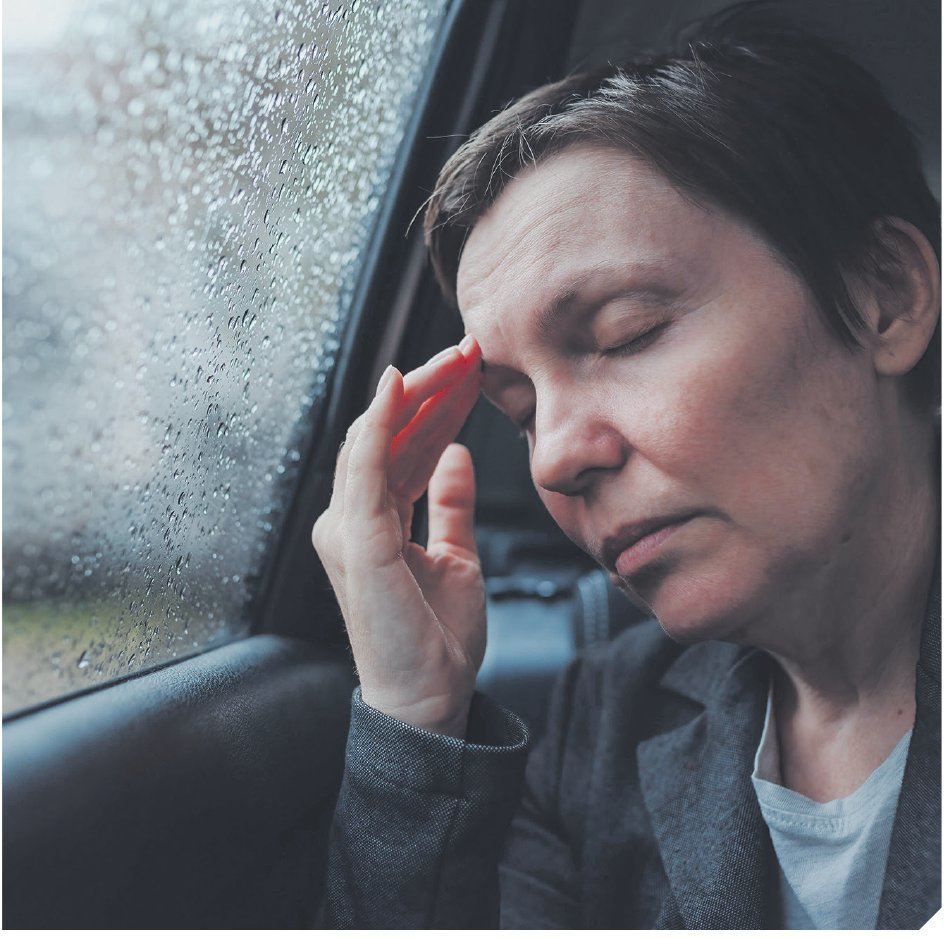
Photo: ImageSelect
Weather apps offer forecasts for migraine and rheumatic complaints, but what are these predictions actually based on?
Today: a sunny day, around 18 degrees on average. At the bottom of the weather app, a light-green dot appears: people with rheumatism may experience extra discomfort this afternoon. And people with migraines? Another dot turns dark red. This evening is set to be real headache weather. At least, according to the weather app. To what extent does the weather influence migraines and rheumatic complaints, and how reliable are these predictions on weather apps?
Anecdotal
Anecdotal evidence is plentiful: migraine patients frequently link headache weather to a change in air pressure. ‘People often report getting a migraine attack when the weather suddenly turns, or when they are at altitude’, says Professor of Neurology Gisela Terwindt of Leiden University Medical Centre (LUMC). ‘When they are skiing, for example.’
Rheumatologist Hanna van Steenbergen at LUMC sees similar patient experiences. ‘For people with rheumatoid arthritis and osteoarthritis, damp and cold weather in particular is very difficult’, she says.
What does the literature say about the influence of weather on migraines and rheumatic complaints? The Royal Netherlands Meteorological Institute (KNMI) cites a Japanese study from 2015. This showed that a quarter of participants experienced migraines during a sharp drop in air pressure – significantly more than at other air pressure levels.
Medication use
British researchers confirmed the link between weather and rheumatic complaints in the study Cloudy with a Chance of Pain. They analysed data from nearly 2,500 people with rheumatic conditions. The conclusion? On damp and windy days, the likelihood of pain rises by around 20 per cent. However, the study did not account for medication use, which according to Van Steenbergen has a strong influence on rheumatic complaints. Thorough research into the effect of weather on migraines and rheumatic complaints is therefore still lacking. Van Steenbergen wonders, for instance, whether the weather affects objective rheumatic inflammation or rather the patient’s perception of pain. ‘We see that inflammatory markers do not change across different weather types’, she says. ‘But people with rheumatism often report experiencing more pain in cold weather, for example, so that perception of pain does change.’
A quarter of participants experienced migraines during a sharp drop in air pressure
Neurologist Gisela Terwindt therefore considers it important to incorporate patients’ experiences. ‘There may be a kernel of truth in it, and that deserves rigorous investigation’, she says. Within her research group, clinician-researcher Nancy van Veelen is investigating exactly how a migraine attack can be predicted. Participants kept a headache diary, which AI expert Marieke Vinkenoog linked to weather data from the KNMI. Can the weather predict a migraine attack? ‘The short answer is not yet’, says Van Veelen. But, she continues, the weather data were coarse. In a follow-up study, LUMC and data scientists from LIACS Leiden are therefore using AI techniques alongside local weather data from individual participants. ‘We hope this will allow us to measure and predict the influence of weather on migraine attacks even more precisely.’
Question marks
The scientists have reservations about the migraine and rheumatic complaint predictions offered by weather apps. Van Steenbergen frowns at the sight of the rheumatic complaint forecasts. ‘What do they mean by rheumatism here?’, she asks herself. ‘It is such a diverse group’, she continues. ‘I don’t know whether they are referring to inflammatory rheumatism, fibromyalgia, osteoarthritis, or all of the above.’
Terwindt, too, raises an eyebrow. ‘The migraine predictions on weather apps are meaningless’, she says. Data scientist Vinkenoog nods in agreement. ‘It is not realistic to make predictions about migraine complaints on such a large scale’, she adds. ‘Our models are nowhere near that yet.’
Awkward questions from pupils?
Send your questions to redactie@bionieuws.nl.
PHOTO: IMAGESELECT