


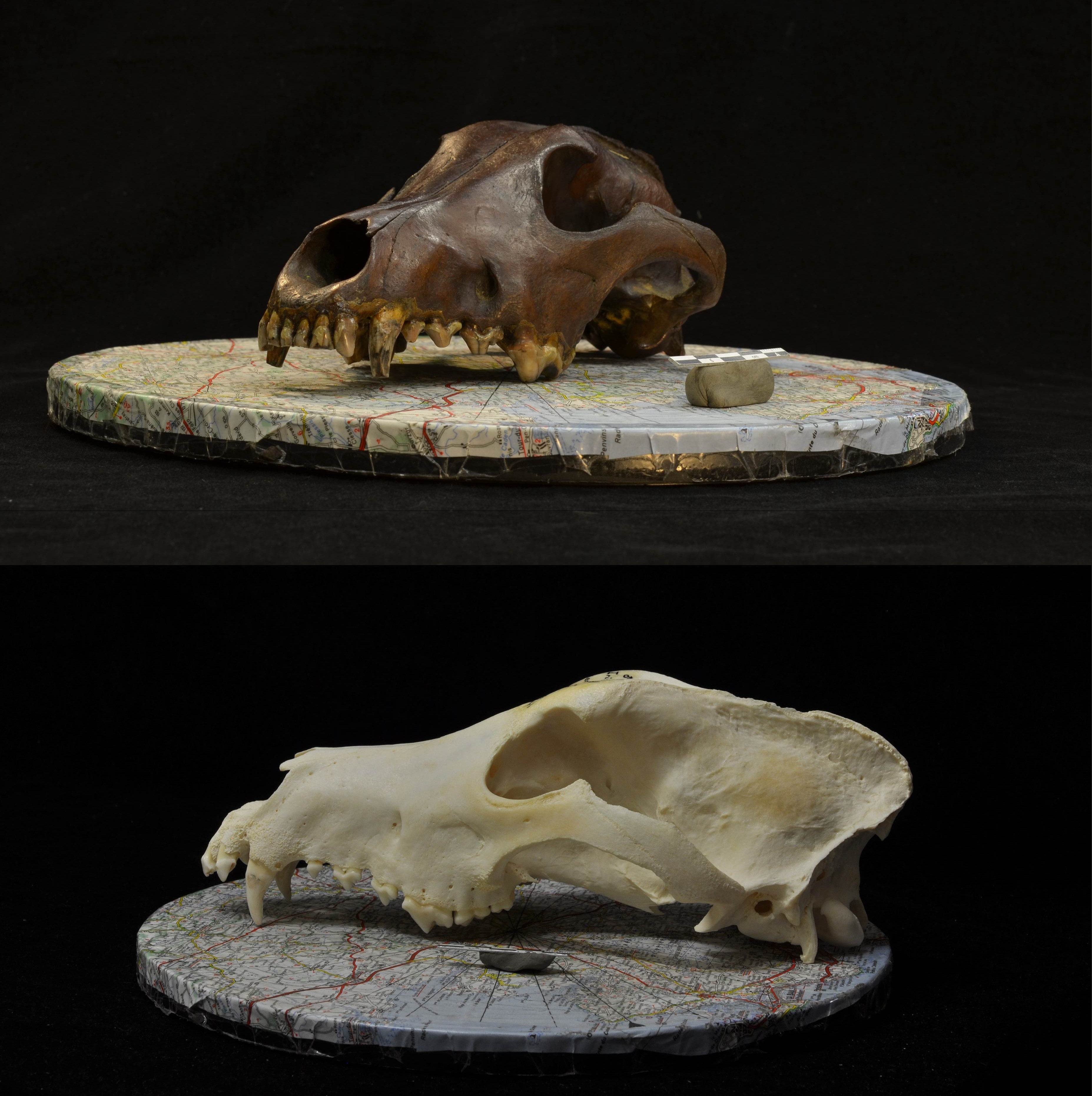
An archaeological (top) and modern (bottom) dog skull, used in the photogrammetric study. Photo: Carly Ameen (University of Exeter).
Dog skulls already show considerable morphological variation eleven thousand years ago: twice as much as those of wolves.
The domestication of dogs probably began during the late Pleistocene, yet the first visible signs of this only become apparent from eleven thousand years ago. Those earliest dogs immediately display a remarkable degree of variation in skull morphology, which calls into question the idea that selective breeding from the Victorian era – the mid-19th century – is the sole cause of the enormous diversity of dog breeds seen today. This is the conclusion of advanced 3D morphometric analyses of 643 canid skulls spanning fifty thousand years of evolution (Science, 14 November). An international team of archaeologists, zoologists and geneticists, led from Montpellier and Exeter, also included measurements from 86 modern wolf skulls from various regions as comparative material.
Siberia
There is considerable debate about the course of dog domestication. It is likely that it occurred multiple times and in different regions. Some archaeologists claim that people in Siberia kept domesticated dogs as long as 33,000 years ago, but most palaeogeneticists – as does the current study – date the divergence of dog lineages to approximately eleven thousand years ago.
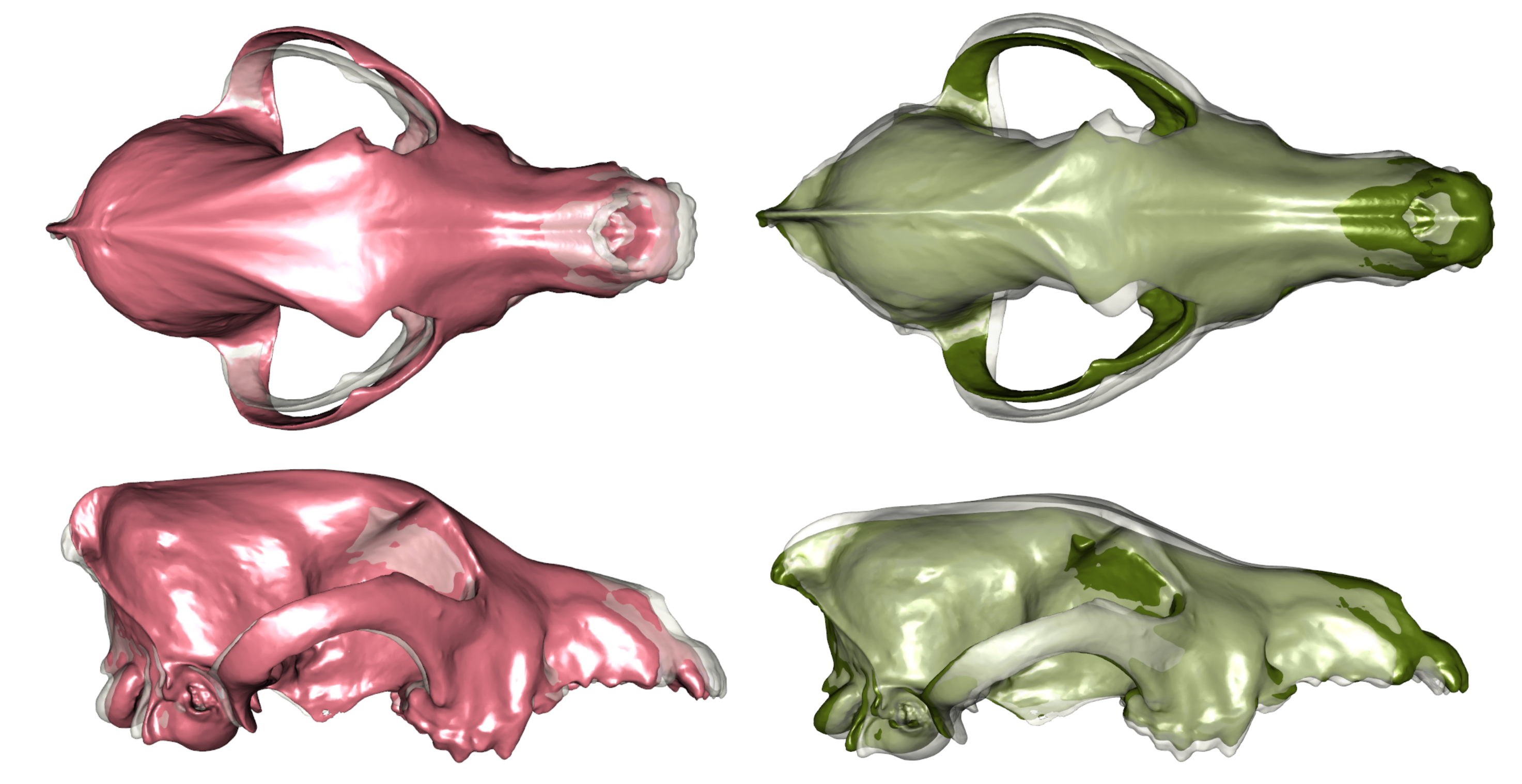
Visualisation of differences in skull shape between modern dogs (pink) and modern wolves (green), shown relative to a mean morphology. Photo: Colline Brassard (VetAgro Sup/Mecadev).
The oldest known dogs have skulls that fall within the size range of modern dogs, but are generally smaller and lack the exaggerated features of contemporary breeds, the researchers found. Even so, they describe the diversity as surprising: morphological variation is roughly half that of modern dogs, but twice as great as that of their ancestors – wolves. The Australian archaeozoologist Melanie Fillios argues in a simultaneously published commentary that this study prompts a reconsideration of the ‘timing and development’ of the relationship between humans and dogs. That the histories of humans and dogs have been closely intertwined for thousands of years is further illustrated by another article in Science of 14 November. Analyses of seventeen ancient dog genomes indicate that dogs and humans frequently migrated together through eastern Eurasia between 9,700 and 870 years ago.