


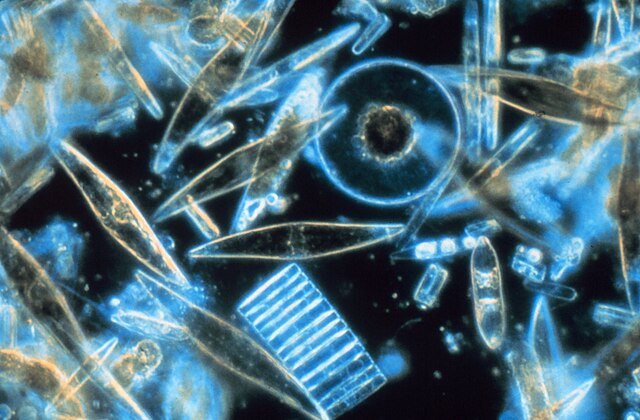
Photo: Prof. Gordon T. Taylor, Stony Brook University
Naturalis’s new biodiversity report brings sombre news, but above all reveals where the blind spot in research and policy lies: the smallest organisms.
Birdwatching and biodiversity policy invariably focus on the usual suspects: birds, mammals, and a small subset of insects (butterflies and dragonflies). Yet it is worth asking whether these species give a complete picture of the state of nature in the Netherlands. ‘We base our picture on that 6.5 per cent of all species that we know well, mainly vertebrates’, says Koos Biesmeijer, scientific director of Naturalis. ‘And that is actually rather odd, because the vast majority of biodiversity consists of much smaller, often invisible organisms.’ Those organisms receive particular attention in the first Status Report on Dutch Biodiversity that Naturalis presented on 22 May. Whereas the biennial Living Planet Report focuses on trends in well-studied taxonomic groups and the National Biodiversity Dashboard presents a selection of indicators, this report provides an overview of all taxonomic groups. The report draws on figures from the Compendium for the Living Environment, the Red Lists (where available), and conservation status assessments. That paints – aside from a handful of success stories such as those of the Eurasian otter and the white-tailed eagle – a far from rosy picture. ‘When you see those seventeen Red Lists side by side, it is actually quite shocking’, says Biesmeijer. ‘A far greater proportion of species in the Netherlands is threatened than anywhere else in the world. We are the world champions of biodiversity loss.’
Fan clubs
The Red Lists show that of the approximately 8,000 species assessed, 45 per cent are threatened or have disappeared. But very little is known about an even larger proportion of the estimated 47,000 species found in the Netherlands. ‘Red Lists only exist for groups with active fan clubs and well-developed monitoring networks’, says Biesmeijer. ‘At the same time, fungi, nematodes, diatoms, microalgae and beetles remain structurally underrepresented. Yet these are precisely the groups that are crucial for ecosystem processes such as water purification, carbon storage and soil quality.’ Small species also play a key role as early indicators of change. ‘You see that changes in water quality or soil condition often affect the small organisms first, and only later the fish or birds. If you really want to steer recovery, you need to look at those early signals.’
Monitoring networks
For most taxonomic groups, however, standardised monitoring systems are lacking; well-organised monitoring networks exist only for the popular and often somewhat easier-to-survey groups. Many counts depend on volunteers. ‘For butterflies, De Vlinderstichting does that well, and Sovon takes care of the birds. But if you want to know whether a local measure – such as a nature-inclusive redesign of a residential area – has had an effect, you need to measure at a smaller scale and across more taxonomic groups. And there simply are not enough volunteers for that’, says Biesmeijer.
Arise
It is no coincidence that Naturalis specialises in new techniques for mapping those species. In the Arise project, among others, scientists use artificial intelligence to automatically recognise species in photographs or sound recordings, and to determine which species live in an area from small samples using eDNA analysis. Naturalis also contributes to the ObsIdentify app, with which thousands of people in the Netherlands identify species via automatic image recognition. ‘The ObsIdentify app is fed with tens of millions of photographs and now delivers 70 per cent of the biodiversity data on waarneming.nl‘, says Biesmeijer. ‘You could never do that with experts in the field. The experts can review all those photographs and improve the system.’ This technological leap makes it possible to develop monitoring networks for many more taxonomic groups, and at a far finer spatial resolution. ‘On every building site, every farmyard, in every park: with cameras and microphones you will soon be able to build a robust network’, says Biesmeijer. ‘Then experts can focus on the difficult cases, and citizens and machines do the rest.’
If more becomes known about the still underrepresented groups, it could cast a very different light on the state of biodiversity in the Netherlands. But Biesmeijer himself does not expect that. ‘There is little reason to think things are going much better in other groups’, he argues. The new knowledge can, however, help in restoring biodiversity. ‘A European Nature Restoration Law is coming, along with the New Deal for Pollinators. These stipulate that by 2027 all countries in Europe must monitor pollinator populations and be able to demonstrate that they are improving. The same applies to the marine environment. The new technology is going to help us enormously to measure that and to discover whether we are taking the right measures to reverse biodiversity loss.’