


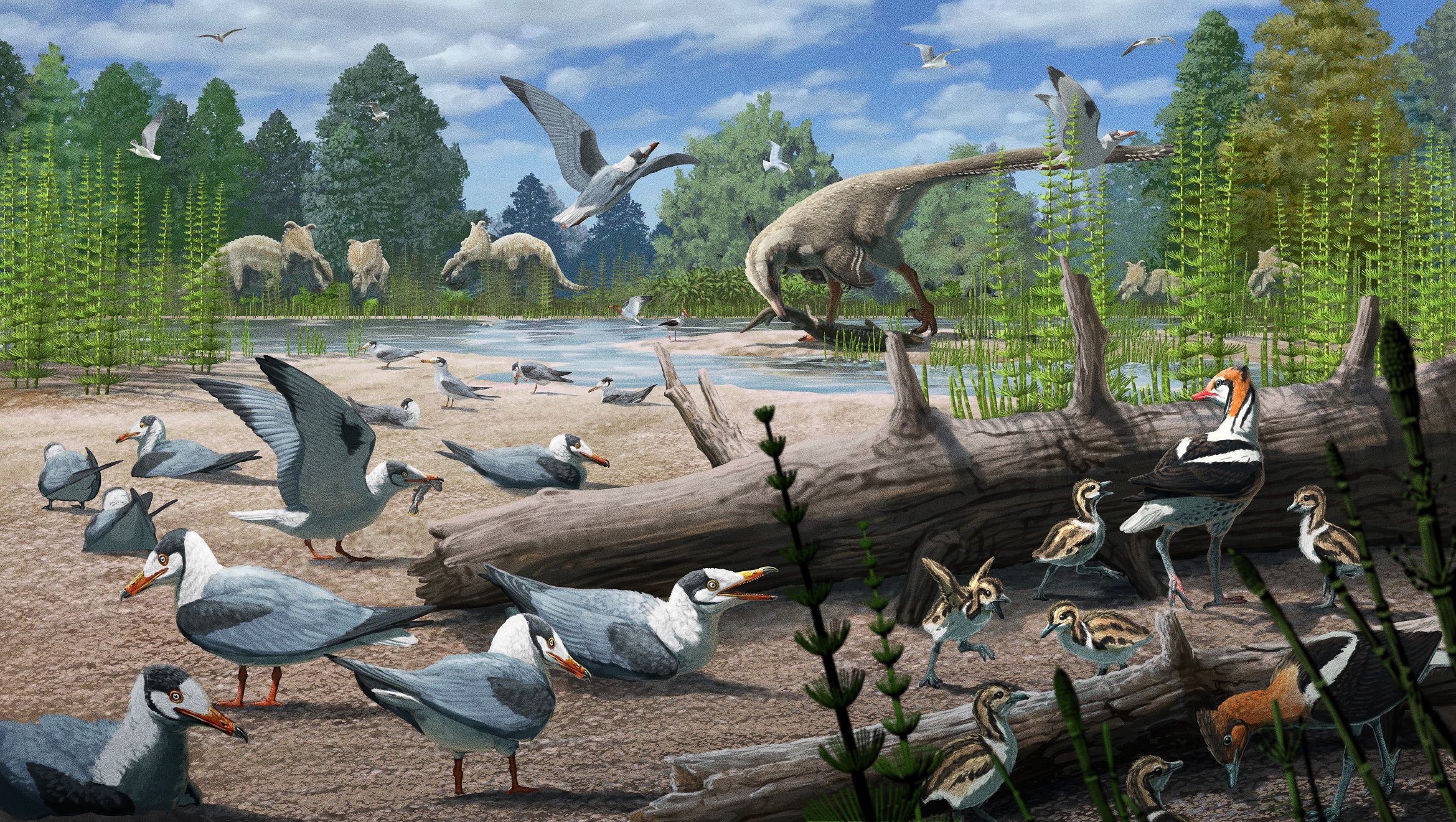
Reconstruction of a Cretaceous landscape with birds and (in the background) dinosaurs. Illustration: Gabriel Ugueto.
As long as 72.8 million years ago, birds were already breeding in the Arctic, as shown by fossils of newly hatched chicks from the Prince Creek Formation in northern Alaska (Science, 30 May). They belong to early relatives of modern birds, including the diving Hesperornithiformes and early Neornithes. The polar climate of the Late Cretaceous featured months-long winters of darkness, cold and snow, followed by short, food-rich summers with non-stop daylight. The fact that these particular birds were able to breed there – in contrast to the absent Enantiornithes, a slow-developing, extinct bird group – points to their adaptability. That flexibility may have contributed to their success after the Cretaceous–Palaeogene boundary. (SvS)

Reconstruction of a diving Hesperornithes. Illustration: © N. Tamura.
See also:
–Scientists Find the First Evidence of Birds Nesting in the Arctic Alongside Dinosaurs – Smithsonian magazine, 2 June 2025