


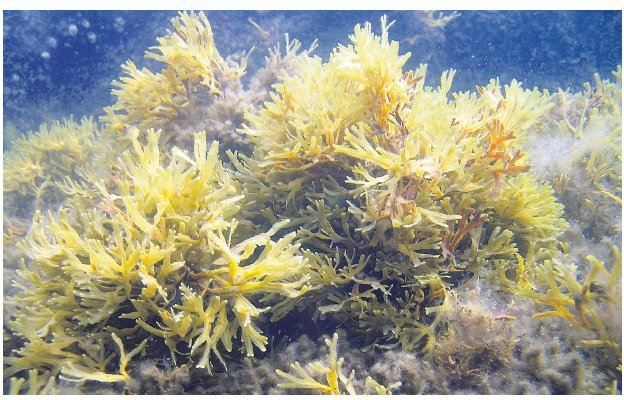
 The female clonal form of bladderwrack (Fucus vesiculosus), previously considered a separate endemic species of the Baltic Sea.
A small brown alga in the Swedish Gulf of Bothnia turns out to be a gigantic female clone of bladderwrack (Fucus vesiculosus).
It was known as the only endemic species in the Baltic Sea, found nowhere else: the brown alga Fucus radicans. But Swedish marine biologists have discovered, following genome sequencing, that it is in fact a female clonal form of the far more widespread bladderwrack (Fucus vesiculosus). This is reported by the University of Gothenburg on 4 March in a press release based on a publication in Molecular Ecology (online 17 February).
Fragments
Bladderwrack normally has separate male and female plants that form new individuals following sexual fertilisation. The female clone has probably spread rapidly by forming new populations from fragments of an original female plant. The clone now lives along more than 500 kilometres of coastline in the Gulf of Bothnia, between Sweden and Finland. It thrives in brackish water and grows in large beds down to a depth of 10 metres.
Dominant
It may be the world’s largest clone of any organism, the press release claims. ‘This clone consists of millions of individuals. In some areas it is completely dominant, whilst in others it grows alongside sexually reproducing individuals of bladderwrack’, says lead author Ricardo Pereyra. ‘The female clone in the Swedish Gulf of Bothnia is by far the largest clone – a true superwoman.’
The research also yields a possible new species of brown alga: a small alga, closely related to bladderwrack, that reproduces sexually and has only been found off the Estonian coast.
PHOTO: LENA BERGSTRÖM