


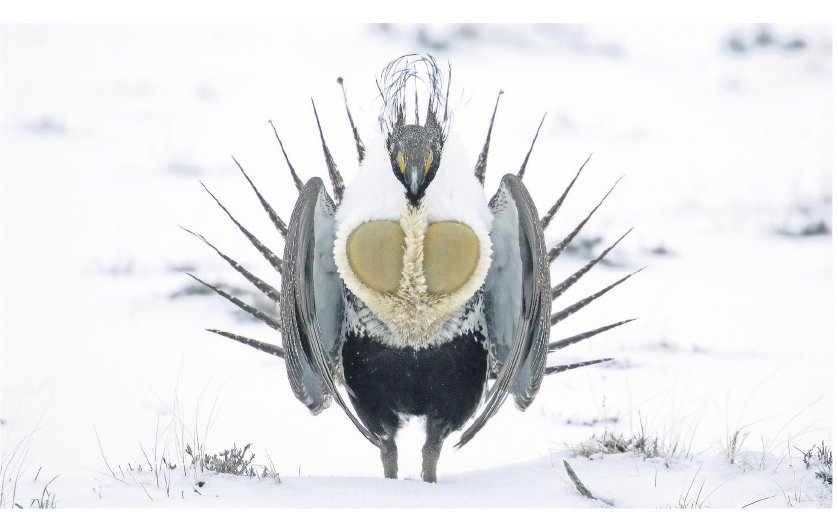
 A displaying greater sage-grouse (Centrocercus urophasianus), which still lives in large populations in Wyoming. Photo: Andrew Spencer, Cornell Lab of Ornithology
North American birds are disappearing fastest in the places where they are most abundant.
‘Our most alarming finding is that for the vast majority of species, the steepest declines are occurring in areas where populations were most numerous’, state researchers from the Cornell Lab of Ornithology and the University of St Andrews, who produced detailed population trends for 495 bird species in North America, Central America and the Caribbean (Science, 2 May). These trends are based on 36 million bird observations submitted to the popular birding app eBird over the period 2007–2021.
This citizen-collected data makes it possible to analyse changes in bird observations at high spatial resolution and with high statistical reliability. By using a specialised machine-learning model, the researchers say they can distinguish genuine shifts in bird populations from differences in observer behaviour. There is admittedly a complex patchwork of local population dynamics, with virtually every species (97 per cent) showing both gains and losses depending on location within its range. Nevertheless, for as many as 83 per cent of bird species, populations are declining fastest in the places where they are most abundant. The researchers suggest this indicates that ‘even the strongholds of bird populations are no longer safe’. This appears consistent with previously identified trends showing that 75 per cent of bird species are declining within their ranges and that North America has lost 3 billion birds – 25 per cent of all breeding birds – since 1970 (Science, 2019).
The decline is particularly severe among birds that breed in grasslands and arid areas. The analyses suggest that the downturn is also more closely linked to local population size than to geographical position within a species’ range. This points to ecological stress, driven by climate change and habitat loss, as the primary cause of the decline. A significant negative association has been found between the rate of change in local populations and the size (abundance) of those populations. The Williamson’s sapsucker (Sphyrapicus thyroideus) is one of the species showing such a steep decline in its remaining strongholds. This medium-sized woodpecker is already considered threatened or vulnerable in more than half of the states or provinces where it breeds. The yellow-billed cuckoo (Coccyzus americanus), by contrast, is a notable example of the 17 per cent of species that are faring well in areas where they were already abundant.
Photo: Andrew Spencer, Cornell Lab of Ornithology