


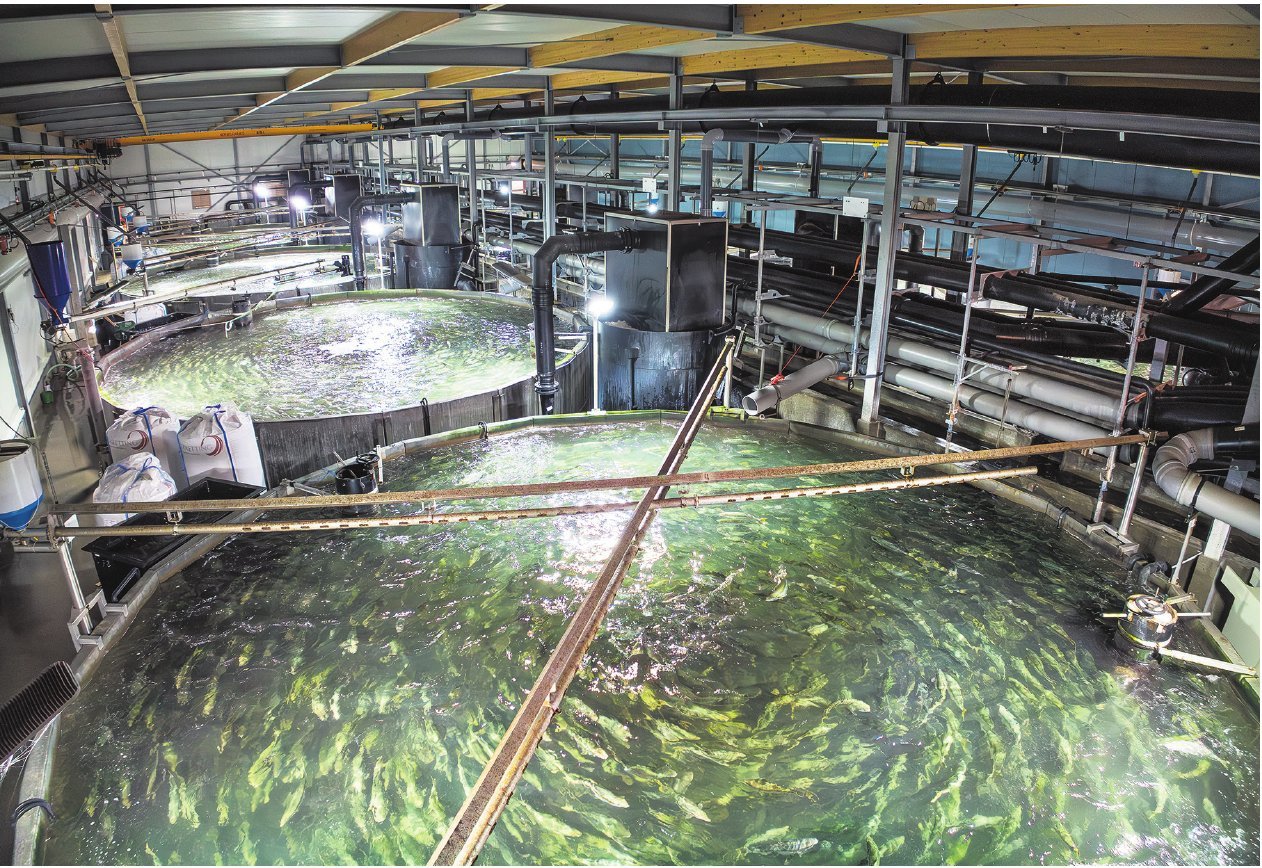
 A section of the yellowtail rearing tanks at Kingfish Zeeland.
From milt and roe, larva to full-grown fish, and – if required – delivered to market as fresh-that-day fillets or whole fish. Kingfish Zeeland supplies marine fish according to the farm to fork principle.
‘Yes, these are the athletic ladies and gentlemen of our breeding department – our prize assets and our capital. You can see how active they are, swimming around with real energy. These fish naturally swim in schools, so they like to stay close together. You won’t get to see the fertilisation, because that happens in the dark. Even fish are entitled to their privacy’, smiles Sander Ruizeveld de Winter, head of the hatchery and R&D at Kingfish Zeeland in Kats. A great commotion of splashing erupts as he tosses some feed into the tank, where around twenty sexually mature fish of nearly a metre in length are swimming about with fierce energy. ‘The nets around the tanks are there for a reason’, says Ruizeveld. This tank holds subtropical marine fish – yellowtail kingfish (Seriola lalandi) – which in the wild range through the Pacific Ocean around Australia and New Zealand, as far as Chile and South Africa. Pelagic fish of the jack family, they are prized for eating worldwide: steamed, fried, or raw as hamachi in sushi. For the Asian market, these fish are farmed at sea, including in Australia. The Kingfish Company serves primarily the European and North American markets with land-farmed yellowtails, at Kats in Zeeland at the foot of the Zeeland Bridge and – on a more limited scale – in Jonesport, Maine.
‘We are situated right next to the old sea dyke and draw our seawater from the Eastern Scheldt. A major advantage is that we are in a temperate climate on the other side of the world from these fish’s native range, and that we farm them indoors. Thanks to advanced water filtration, and because the specific parasites and pathogens do not occur in the immediate environment, we can do this entirely without antibiotics or medication’, says Ruizeveld. As a precaution, the hatchery – which itself covers around 1,500 square metres – is situated well over a hundred metres from the production and processing halls, which span nearly one and a half hectares. Visitors can in principle only observe from behind glass.
‘I was already running a small Tilapia farm in my student room’
HATCHERY
Ruizeveld studied animal sciences and aquaculture in Wageningen, where he developed his passion for fish farming. ‘I was already running a small Tilapia farm in my student room.’ He arrived in Kats as early as 2010, when the site was still potato fields, for the Zeeuwse Tong project, which aimed to farm common sole in ponds. Ruizeveld moved to Kingfish in 2016 to set up year-round yellowtail farming. In the hatchery, he speaks enthusiastically about all the challenges that have been overcome to make this farm to fork approach to marine fish farming possible. ‘We use wind energy, have an excellent recirculation system, and a year-round reproduction system.’ To ensure this, the broodstock population is kept in six tanks under three different regimes of climate and light–dark cycle. ‘Running through the seasons is enough to bring them to natural reproduction, and because the eggs float, they can be harvested using an ingenious system. In another part of the hatchery, those eggs pass through the stages from larva to juvenile fish in smaller tanks – carefully counted and size-graded to prevent cannibalism of smaller individuals by larger ones. In collaboration with Ghent University, Ruizeveld and his team developed a tailored feed: from plankton paste to brine shrimp and pellets containing plant proteins, fishmeal and fish oil. ‘An entirely plant-based diet does not work, and you want fish that contain omega-3 fatty acids and have a genuine fish flavour. For this we use mainly fish waste, and with the production fish we have already managed to reduce the proportion of fish in the feed to around a quarter’, says Ruizeveld. In terms of sustainability, he considers fish farming a sound alternative to wild-caught fish such as tuna. ‘The fish grow faster, have a higher feed conversion ratio, and wild catches are unpredictable. Whereas we can deliver the required quantities of fish tomorrow: fresh, clean, and as fillets or – as they prefer in Italy – with everything still intact.’
COMPANY: Kingfish Zeeland
PRODUCT: farmed yellowtail kingfish, whole, as fillets or sushi
STRUCTURE: The Kingfish Company NV (listed on the stock exchange), with subsidiary Kingfish Zeeland BV
LOCATION: Kats (Noord-Beveland) and Jonesport (Maine, USA)
NUMBER OF EMPLOYEES: 143
FOUNDED: 2016
REVENUE: €22 million (2023); currently operating at a loss due to investment costs
WEBSITE: thekingfishcompany.com
NOTABLE FACTS: the only marine fish farmed on land without antibiotics or medication, with growing production capacity (1,500 tonnes in 2023, now 4,000 tonnes capacity)