


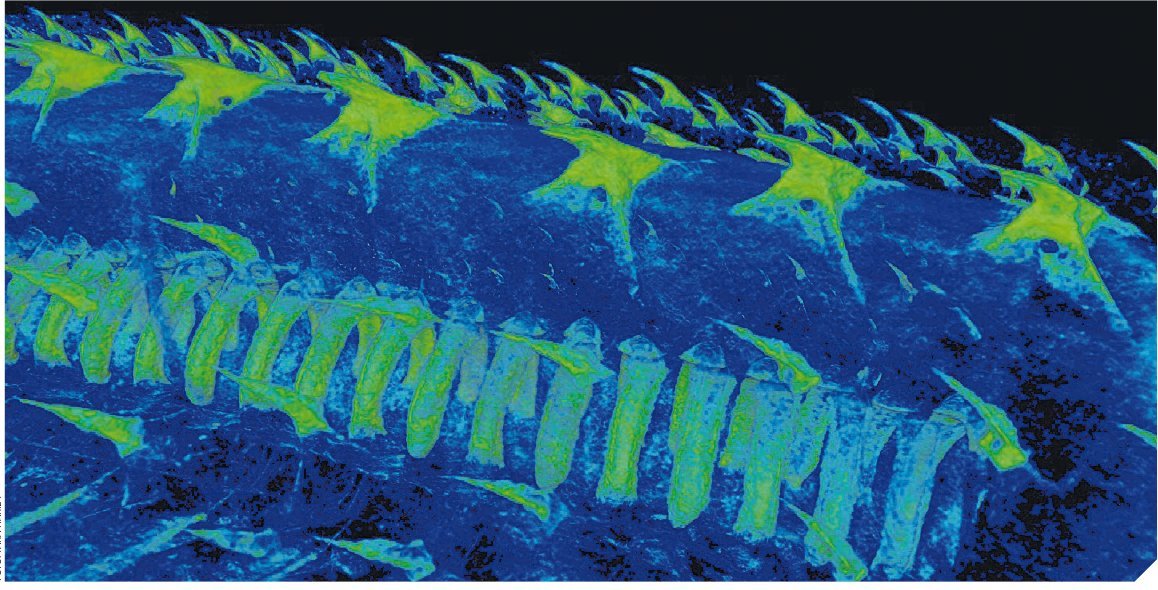
In CT scans of various animals, such as this chain catshark (Scyliorhinus retifer), researchers compared armour tubercles. Dermal denticles are visible here in green.
Research confirms the evolution of dental sensitivity and pushes back the origin of fish by tens of millions of years.
Over-sensitive teeth during a scale-and-polish or a bite of ice cream: tooth sensitivity to pressure, temperature and pain is, according to researchers in Chicago, a remnant of sensory structures in the exoskeleton of ancient fish. Dentine – the inner layer of teeth that transmits sensory information to nerves in the pulp cavity – arose as sensory tissue in the armour of an early vertebrate, but turns out to be absent in what scientists had considered the earliest fish (Nature, 21 May).
Insights
That teeth evolved from bumpy structures on the external skeleton of armoured fish has been known for some time, says vertebrate palaeontologist and researcher at the Vrije Universiteit Brussel, Koen Stein. The recent study in Nature confirms that such armour tubercles in Eriptychius – a vertebrate fish from the Ordovician, approximately 465 million years ago – contain dentine and probably helped the animal to sense the conditions of the surrounding water. ‘An interesting study that provides deeper insights thanks to remarkable technology’, says Stein.
Dentine
Yara Haridy, who leads the research, was not looking for the origin of teeth when she began the project. Instead, she hoped to answer a different long-standing palaeontological question: what is the earliest vertebrate in the fossil record? Using a particle accelerator, Haridy produced hundreds of high-resolution CT scans, ranging from fossil specimens from the Cambrian (485–540 million years ago) to modern animals such as beetles, barnacles and rays. The presence of dentine in the external armour is here characteristic of vertebrates.
Protrusions
In a Cambrian fossil of the genus Anatolepis, a group of jawless fish, the team observed clear features of what appeared to be dentine. Comparison with a known fossil of an arthropod, however, led the researchers to realise that the armour tubercles of Anatolepis contain no dentine at all and more closely resemble the sensory hairs on the exoskeleton of crabs. ‘People thought this Cambrian animal was a vertebrate, but it was actually an arthropod’, says Haridy in a press release. The fact that the sensory protrusions of both armoured fish and fossil and modern arthropods show striking similarities is, according to the authors, the result of independent evolution: vertebrates and invertebrates happened to adopt the same strategy in response to comparable environmental pressures.
Particle accelerator
According to Stein, palaeontologists have been debating since the 1990s whether Anatolepis belongs to the vertebrates or the arthropods. In 1996, a paper appeared in Nature in which scientists argued, on the basis of histology, that it was a vertebrate. ‘The use of a particle accelerator now allows researchers, years later, to examine the finest anatomical details. The community long regarded Anatolepis as the earliest fish. This new insight therefore means we must push back the age of the oldest fish fossil: the origin of fish turns out to be 30 to 40 million years later than previously thought.’