


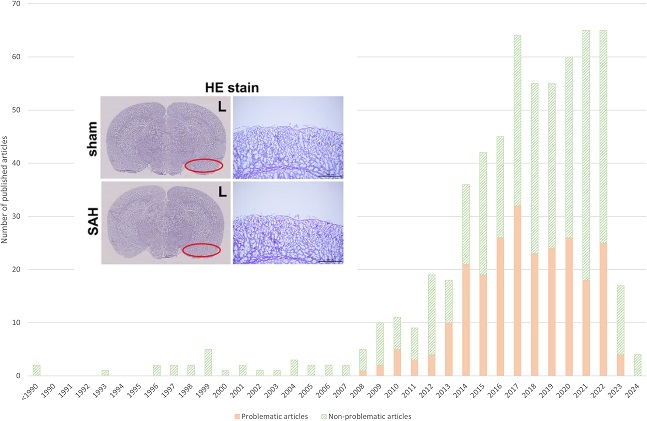
Bar chart showing the sharp increase in problematic articles (orange) since 2008 in animal studies on cerebral haemorrhage (inset shows a random example of an image that led to the retraction of such an article). Chart source: René Aquarius et al., Plos Biology, 30 October 2025.
A Radboudumc team has found that nearly half of the animal studies on cerebral haemorrhage examined contain duplicated or manipulated images.
What began as a systematic review of animal studies on cerebral haemorrhage led researchers at Radboud University Medical Centre to an unexpected discovery: no fewer than 40 per cent of the analysed articles contained suspicious or manipulated images. The study was published on 30 October in Plos Biology.
‘It was not at all what we were looking for’, says biologist Kim Wever, last author of the study. Together with colleague René Aquarius, she set out to determine which experimental treatments could limit brain damage following a cerebral haemorrhage. But during the analysis it became apparent that countless therapies had shown positive results in animal models, whilst they had almost never been tested clinically. ‘That pattern was so unusual that we had to abandon the original research question’, says Wever. ‘When we looked more closely at the images in the articles, I was absolutely horrified.’
ImageTwin
Using the AI tool ImageTwin, the researchers checked 608 publications for problematic images. ‘We manually verified everything the programme found’, explains Wever. In the end, 243 articles proved problematic; only 55 have been corrected and 19 retracted. Publishers responded inconsistently to the reports. ‘Sometimes one and the same image was corrected in one journal, retracted in another, and ignored in a third’, she says.
The majority of the suspect studies came from institutions in China – around 88 per cent. According to Wever, this may be linked to commercial paper mills that sell ready-made articles to researchers under intense pressure to publish. ‘But we do not know whether the authors themselves realised the articles were fake.’
Unreliable
According to Wever, the problem strikes at the heart of scientific integrity. ‘Many researchers are now realising that what they have been citing for years may not be accurate. That is alarming, because it means we are sometimes building on unreliable data – with all the consequences that entails for follow-up research, funding, and the use of laboratory animals. Hopefully this will serve as a wake-up call to look more critically at what we read and cite.’