


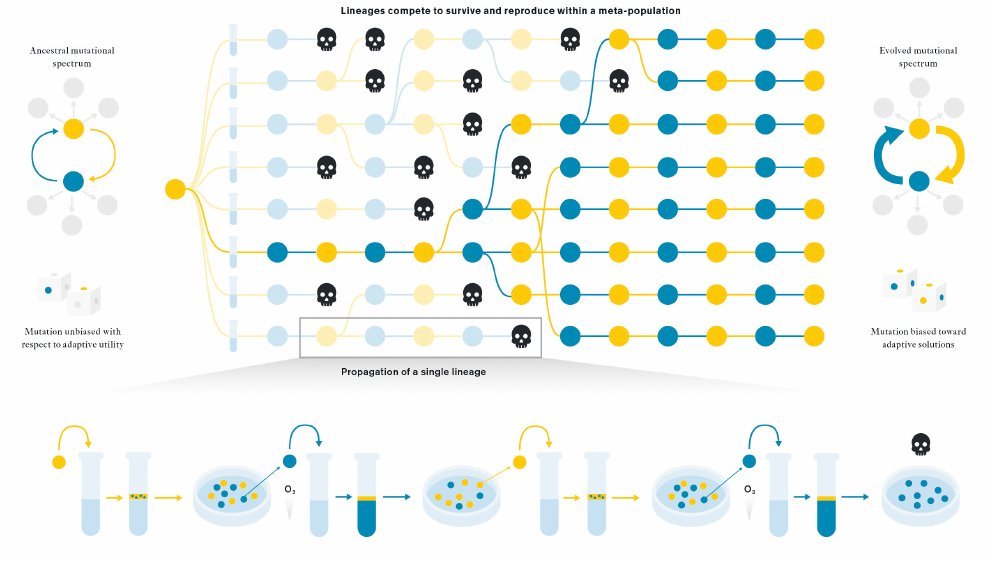
A schematic representation of the selection experiment with P. fluorescens that ultimately leads to mutations in a key gene enabling rapid transitions between phenotypes. Illustration: Paul B. Rainey / Michael Barnett, MPI EvolBio.
Selection pressure not only favours beneficial mutations, but also promotes the capacity to evolve itself, as a study on Pseudomonas fluorescens bacteria has shown.
In a three-year experiment, researchers force eight cultures of Pseudomonas fluorescens bacteria to repeatedly adapt to fluctuating conditions. Evolutionary biologists at the Max Planck Institute for Evolutionary Biology in Plön thereby demonstrate that the evolvability of this bacterial species itself evolves in response to selection (Science, 20 February).
Selection process
The soil bacterium must alternate between two phenotypes in a strictly controlled selection process. One bacterial phenotype produces a cellulose-like substance, enabling these bacteria to form a thick biofilm layer of cells at the interface between the oxygen-poor liquid medium and the air. Once this layer has formed, cells that do not produce cellulose (phenotype two) can also colonise it. These cells benefit from access to oxygen without having to bear the energy costs of cellulose production. One culture cycle in this selection regime consists of six days during which the biofilm-forming bacteria grow, followed by a selection step in which only biofilm-colonising mutants proceed. The selection process is then reversed. If a bacterial lineage fails to undergo the appropriate mutation in time, it goes extinct, whereupon the researchers replace it with cells from a randomly chosen culture carrying the required phenotype. The team repeats this process dozens of times, creating a situation in which bacteria that can rapidly develop useful mutations gain the upper hand.
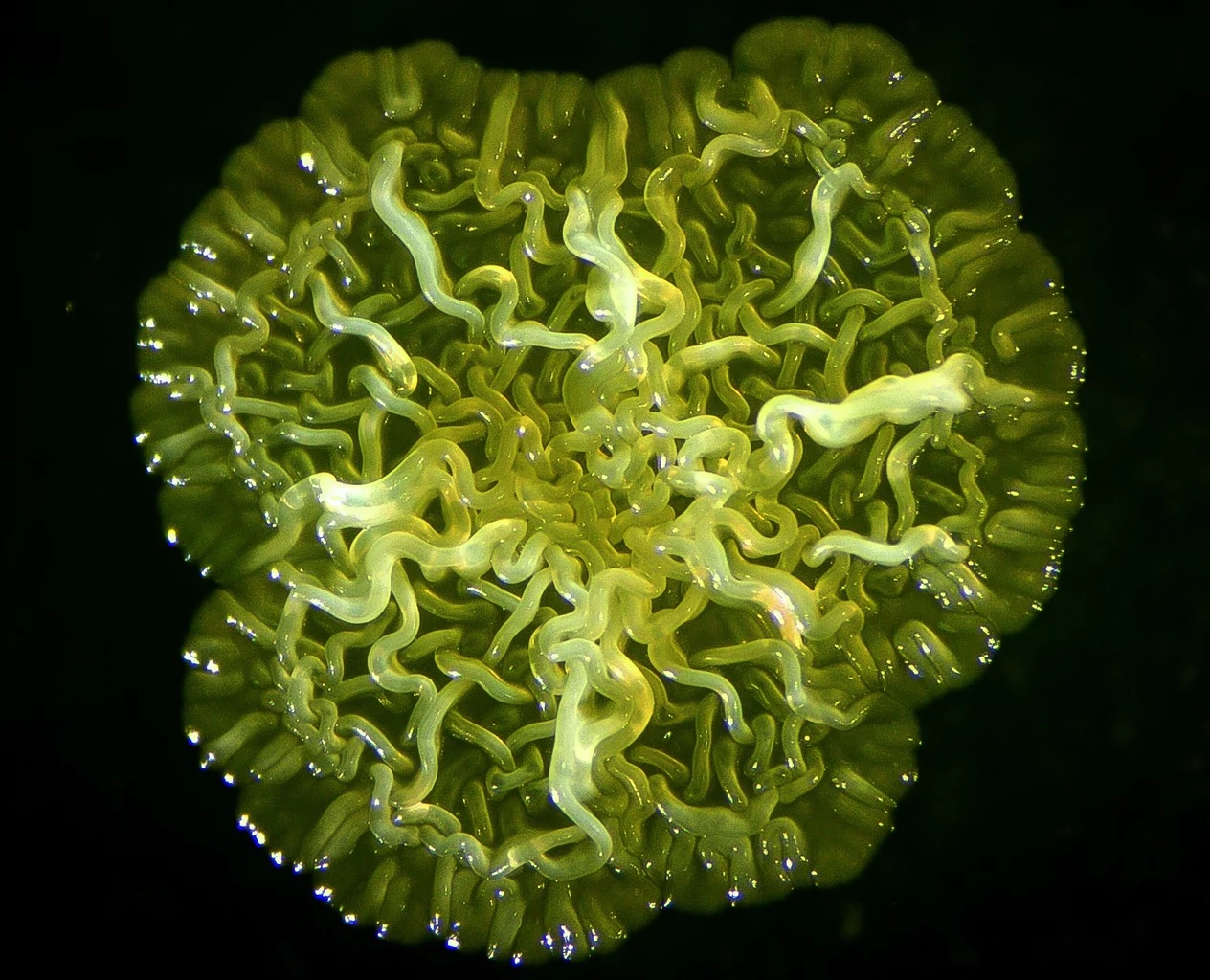 The soil bacterium Pseudomonas fluorescens – shown here with an adaptive wrinkled colony type – is a model organism for evolutionary research. Photo: © M. Schwarz, MPI Evolutionary Biology
By sequencing the complete genome of the soil bacterium, the authors discover that mutations in a specific regulatory gene are responsible for many of the observed phenotype switches. This regulatory gene developed a repetitive stretch of DNA seven nucleotides long, which is highly susceptible to insertions and deletions during DNA replication. Lengthening and shortening of this DNA sequence allows P. fluorescens bacteria to switch rapidly and repeatedly between phenotypes.
Selection pressure
‘What the authors demonstrate – namely that you can select for bacteria that respond adaptively more rapidly under fluctuating selection pressure – is not surprising in itself. Others have shown this previously using digital selection experiments, and this research group demonstrated it years ago in experiments with the same bacterial strain. Moreover, pathogenic bacteria in particular possess comparable genes with elevated mutation rates, encoding the surface proteins by which a host’s immune system recognises them’, says evolutionary geneticist Arjan de Visser of Wageningen University. ‘We know that this kind of gene with enhanced evolvability can evolve’, says De Visser. ‘What is elegant about this new study’, he argues, ‘is that the authors show this happens more readily when selection occurs between bacterial lineages (and not only between cells within bacterial lineages).’ In that case, bacteria are judged not only on the presence of mutants with higher fitness, but also on the production of such variants. ‘Furthermore, the authors show in molecular detail how a mutant with enhanced evolvability arises stepwise through a series of mutations. There are quite a number of ideas about the evolution of evolvability, but relatively little experimental data. This new study is therefore very welcome and makes these ideas concrete’, De Visser concludes.