


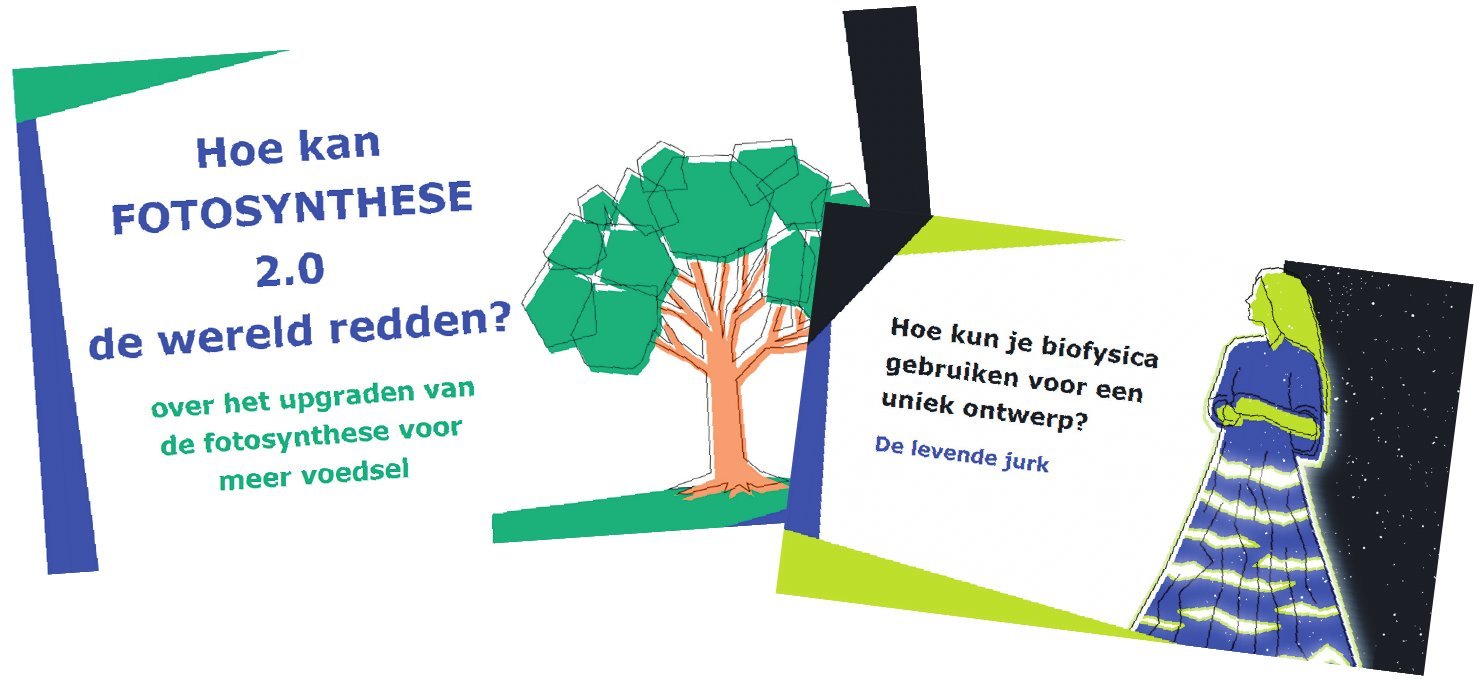
Covers of lesson guides at the intersection of biology and technology, developed for the 4TU.Schools platform.
A dress made of living algae, a seal tracked using artificial intelligence, and young people tinkering with photosynthesis: these are not projects from a university lab, but lessons for secondary school pupils. Through the 4TU.Schools platform, the four technical universities are bringing science and technology into the classroom, with the primary aim of showing what you can do with your knowledge of science and technology.
4TU.Schools operates within the 4TU federation – the collaborative partnership of Delft University of Technology, Eindhoven University of Technology, the University of Twente and Wageningen University – and has been working for some time on a platform designed to bridge the gap between university and secondary education. Since April 2025, the lessons have been available online for everyone: free of charge, ready to use, and focused on connecting technology, science and societal challenges.
Many lessons begin with a familiar or surprising example drawn from current affairs
‘We had been watching the number of pupils choosing science subjects decline for years, as had enrolment at the technical universities’, says Heleen Bot, a former biology teacher and now a lesson developer at 4TU.Schools. ‘And yet we need more engineers than ever to tackle the great challenges of our time. It was that concern that gave rise to the idea of creating inspiring lessons through which pupils can experience how relevant their knowledge is to the world around them.’
Algae dress
Many lessons begin with a familiar or surprising example drawn from current affairs. ‘I cut out everything I find interesting and put it in a pile’, says Bot with a laugh. ‘Sometimes from NRC or Trouw, but also from Bionieuws of course – that’s always on the table here. That’s how a lesson came about on the algae dress by fashion designer Iris van Herpen. The dress contains living, bioluminescent algae: a wonderful hook for discussing bioluminescence and biophysics with pupils. Science meets art, and sustainability too. That is exactly the cross-pollination we are looking for.’
Offering
For biology teachers, there is now a growing range of material available. A Zoo Full of Love invites pupils to think about genetic diversity in zoos, whilst What Use Is AI to a Seal? shows how artificial intelligence is being used in seal research. More challenging topics are also covered, such as in Photosynthesis 2.0, an upper-secondary lesson in which pupils investigate how the efficiency of photosynthesis could be increased to help solve the global food problem.
That lesson was piloted by biology teacher Jeffrey Paijmans of the Maurick College in Vught. ‘Photosynthesis is an abstract topic for many pupils’, he says. ‘In this lesson it suddenly becomes tangible, because they are thinking about applications. They work in expert groups, each exploring one aspect of photosynthesis, and then consider which technology holds the most promise for improving food production. That leads to excellent discussions about sustainability and the limits of biotechnology.’
Barrier
Paijmans watched his pupils discover ‘with fresh astonishment’ that photosynthesis is not nearly as efficient as they had assumed. ‘They realised that you can genuinely tinker with it, and that doing so could have global consequences. That makes an impression. But it does demand something of the teacher: the preparation took me about an hour the first time. It is worth it, but for some colleagues that can be a barrier.’
Pilot teachers
It is precisely those kinds of experiences that help Bot to refine the lesson materials further. ‘We want pupils to see that science is not something remote from their lives. That with knowledge from biology, mathematics or physics you can design something that makes a difference. And that a great deal is happening at universities that you, as a school pupil, could one day contribute to.’ The developers work closely together and review each other’s draft lessons. Pilot teachers provide feedback from the classroom. ‘We try to run every lesson in a class first, so we know what works and what doesn’t’, says Bot. ‘Teachers are busy, so that isn’t always possible, but the responses are enthusiastic and help us move forward.’ A key principle is that the lessons take the burden off teachers. ‘Everything is ready to use’, says Bot. ‘A teacher barely needs to prepare anything. We know that time is the biggest obstacle, so we make it as straightforward as possible.’ All lessons are freely available via www.4tuschools.nl and LessonUp, a digital platform already used in many schools for interactive assignments.
Visibility
Feedback remains welcome, she emphasises. ‘We are still very much in the process of building. Teachers can register via the website to test lessons or share their views – we really need that. Only by working together with schools can we tell whether the material is landing well.’ Since the official launch in April, the number of lessons has grown to over fifty, a large proportion of which are well suited to biology classes. 4TU.Schools is visible at education conferences and organises workshops to raise awareness of the initiative more widely. ‘The challenge now lies in visibility’, says Bot. ‘We want every teacher looking for something at the intersection of biology and technology to be able to find us.’
New lessons appear regularly; teachers can also suggest topics themselves. ‘We hope that more and more schools will start working with our lessons’, says Bot. ‘The more pupils experience what science can mean, the greater the chance that they hold on to that curiosity – even outside the classroom.’