


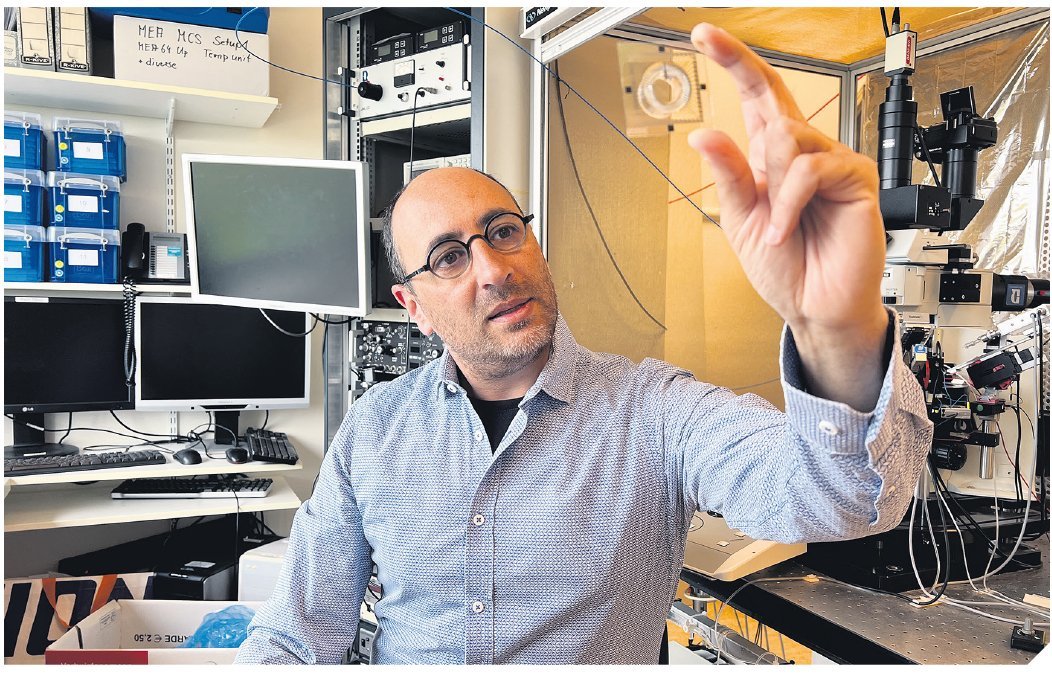
 Neurobiologist Nael Nadif Kasri: ‘It is fascinating that stem cells in a culture dish develop at exactly the same pace as in an embryo.’ Photo: Lisa Rahm
Neurobiologist Nael Nadif Kasri investigates how the human brain develops – not inside the head itself, but in a culture dish. ‘It is the most complex biological system we know.’
Although it has been possible for nearly twenty years, neurobiologist Nael Nadif Kasri still looks with wonder at what he and his team regularly bring into existence in a laboratory at Radboud university medical centre in a Petri dish: a brain-like clump of cells that grows slowly, cell by cell. ‘What I find so fascinating is that stem cells in a culture dish develop at exactly the same pace as in a human embryo. Over 120 days you see precisely the same sequence of cell differentiation. That never stops feeling magical.’
At the NWO Life conference in Egmond aan Zee on 27 and 28 May, Kasri will speak about his research into brain organoids – and in particular about the impact this has on research into neurodevelopmental disorders (NDDs): rare conditions affecting brain development, such as Down syndrome, but also hundreds of lesser-known disorders that often arise at the moment of conception. ‘Up to a hundred spontaneous mutations can occur in every embryo’, Kasri explains. ‘If such an error falls in an important gene – for example, one required for the formation or function of brain cells – it can lead to a serious developmental disorder.’
Mutation
As a group, these rare NDDs represent a considerable societal challenge: 2 to 3 per cent of all children are born with one. Many of them remain dependent on care for their entire lives. ‘The healthcare costs for this group, calculated over a lifetime, are enormous, which means the societal impact is greater than that of cancer, for example’, says Kasri. Yet the underlying causes are often poorly understood. ‘We are trying to map out how a mutation in a gene can lead to a neurodevelopmental disorder. To do that, we need to understand precisely what goes wrong in the development of nerve cells.’ For many years this was done using laboratory animals – mice in particular. Convenient, because you can study behaviour, remove brains or introduce genetic errors. ‘But translating findings to humans remains difficult’, says Kasri. ‘The human brain is unique. It develops far more slowly, contains many more nerve cells, and has a longer period of plasticity. Moreover, humans have neuronal cell types that mice and other animals simply do not have. As a result, promising mouse models often break down in the translation to therapy.’
‘Sometimes two patients carry the same mutation yet have a different outcome’
Kasri is looking for the solution in stem cell technology. Since Japanese researchers discovered in 2006 how to reprogramme ordinary body cells into pluripotent stem cells, it has been possible to grow new brain cells from someone’s blood or skin cells. In three dimensions, these can form brain organoids: simplified versions of the brain containing multiple cell types. ‘Note: these are not mini-brains’, Kasri emphasises. ‘But they are structures with the same genetic background as the patient, including the unique combination of mutations that causes someone’s disease.’
This makes it possible to follow the early brain development of an individual in the laboratory. ‘The clock of differentiation is incredibly precise. In an organoid you see nerve cells emerge at the same pace and in the same sequence as in a real brain. That gives us an unprecedented model for studying neurobiological processes.’ But Kasri goes a step further: with his team he places such organoids on a chip fitted with electrodes to measure the activity of the nerve cells. ‘In this way we can see whether the cells are truly functioning as neurons: whether they generate action potentials, communicate with one another, and form networks.’
This also opens the door to testing medicines in an environment far closer to the patient than animal models. ‘We can look, for example, at whether a particular compound helps restore the neuronal network or influences excitability. In some forms of epilepsy we have already achieved promising results: we see that certain mutations lead to hyperactive networks, and that this activity can be normalised using existing drugs.’ Although Kasri’s research is still largely confined to the laboratory, the translation to the clinic is drawing ever closer. His collaboration with clinical geneticists at Radboud university medical centre – which has an international reputation for its expertise in the genetic diagnosis of NDDs – is accelerating this process. ‘We can group genes with great precision on the basis of their function – for example, whether they are involved in the unfolding of DNA within the cell. Many NDDs turn out to involve errors in proteins that regulate this unfolding. As a result, genes cannot be read correctly, leading to developmental problems.’
Yet it is not always so straightforward. ‘Sometimes two patients have exactly the same mutation but a different outcome. That phenomenon – genotype to phenotype – we only partly understand. Other genes and the genetic context probably play a role. And that is precisely what we can take into account with organoids.’ His sense of wonder at the brain has never left him. ‘It is the most complex biological system we know. And the fact that from a single drop of blood you can create something that behaves in the laboratory like a developing brain – I still find that one of the most beautiful things in science.’