


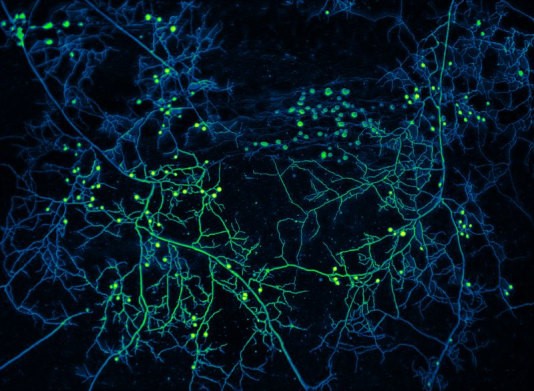
 Microscopy image of a mycorrhizal fungus forming a symbiotic relationship with plant roots. Contrast colours added. Credits: Loreto Oyarte Galvez (VU/AMOLF).
Mycorrhizal fungi grow in predictable, wave-like patterns.
Underground fungal networks grow in a predictable and efficient manner: with relatively small carbon investments, mycorrhizal fungi bridge nutrient-poor patches of soil through so-called ‘waves of growth’. In this process, the tips of the fungal threads grow in pulses, with mycelium that absorbs phosphorus following in their wake. This is reported by an international group of researchers – including biologists from Vrije Universiteit Amsterdam and AMOLF, led by evolutionary biologist Toby Kiers – on 26 February in Nature. The fungal networks thus appear to generally favour exploration over local growth, increasing the likelihood of finding new sources of phosphorus and plants to collaborate with.
Trade and barter
The symbiosis in which fungal threads transport nutrients to plant roots in exchange for carbon is at least 450 million years old. Although around 70 per cent of all plants and trees worldwide enter into such a symbiotic relationship with arbuscular mycorrhizal fungi, it remains largely unclear how these underground networks grow and form complex structures.
Robot
The biologists aim to change this by tracking the construction of a mycorrhizal network in real time. To this end, they designed a robot that photographs the growth of three fungal strains in the laboratory every two hours – Rhizophagus irregularis A5 and C2 and R. aggregatum 1– around the roots of wild carrot (Daucus carota). This resulted in a time-lapse of roughly five hundred thousand growing fungal thread tips. The researchers also measured around one hundred thousand plasma flows within the network – the intercellular movement of cytoplasm. These flows form the highways along which the network transports nutrients.
The latter findings reveal that, during the construction of their network, the fungi support or enhance the transport of nutrients to and from their host in several ways. On the one hand, they widen their fungal threads, analogous to broadening a motorway; on the other, they increase the speed of the plasma flows themselves. Finally, the networks also continuously create new routes to shorten the distance to host plants.
Energetically favourable
‘The wave-like movement with which mycorrhizal fungi grow is energetically favourable for both fungus and plant’, explains lead author and AMOLF biologist Corentin Bisot. ‘The amount of carbon that the fungi invest in the infrastructure for acquiring phosphorus is generally lower when they prioritise exploration over increasing local density. Moreover, the risk of nutrient shortages decreases, because they tap into new sources of phosphorus more quickly. They also come into contact with new plants to collaborate with sooner. A win-win situation, in other words.’
1: Correction made (14 March 2025): the text previously and erroneously read ‘three fungi – Rhizophagus irregularis, R. irregularis and R. aggregatum‘. (ed.)