


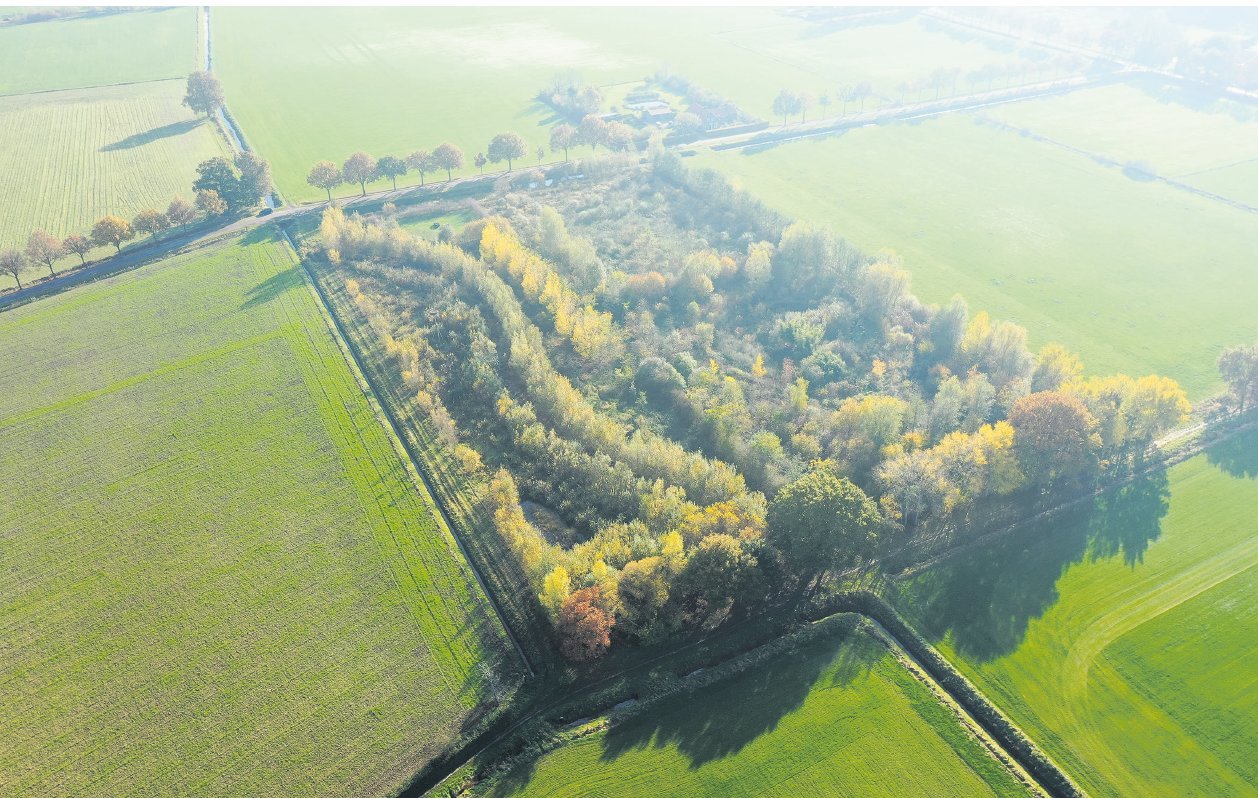
 Ketelbroek Food Forest is a biodiverse island, surrounded by a bare sea of pastures and maize fields. Photo: Tim van de Griend
Food forests are an enjoyable and profitable way to produce delicious food, as food forest pioneer Wouter van Eck has discovered. ‘Sustainable and rich in biodiversity.’
‘We mainly do a great many things we don’t do: we don’t fertilise, we don’t mow, weed or hoe, and we don’t do pest management. That’s a deliberate part of the business model: we’re not slaves to the banks but simply lazy farmers. Once a food forest is established, you’re mostly busy harvesting. You can enjoy your surroundings and make a decent living from it’, says food forest pioneer Wouter van Eck (1965). ‘A well-developed food forest yields around €4,000 per hectare per year – roughly ten times the net surplus of €400 that many a farmer pockets annually from a hectare of forage maize or grassland. Do the maths.’
Van Eck is sitting in the cluttered kitchen of a farmhouse in the Gelderland border village of Groesbeek, just south of Nijmegen. ‘Like every farmer, I run my office from the kitchen table’, he jokes. Within walking distance, just outside the village, Van Eck and Pieter Jansen started Ketelbroek Food Forest in 2009 on 2.4 hectares of bare maize field – the oldest and best-known food forest in the Netherlands. Van Eck is also the founder – and now chair of the steering committee – of Stichting Voedselbosbouw, an umbrella organisation of around seventy food foresters dedicated to ‘knowledge sharing, lobbying and winning over sceptics’.
Van Eck, who trained as a political scientist, is familiar with every prejudice against – and every advantage of – food forests. ‘Our claim is not that we can replace all agriculture, but we are an interesting alternative system for growing plant-based food. Compared with monocultures, a food forest is far more sustainable, resilient and climate-proof. It is a farming method that emits no nitrogen compounds or greenhouse gases. A 30-year-old food forest sequesters at least 180 tonnes of carbon dioxide per hectare per year, whereas grassland and arable fields manage at most 6 tonnes. And monitoring shows that food forests are extremely rich in biodiversity.’
The woodland plot also contains a wetland nature zone to retain seepage water
Flower buds
The secret, he believes, lies in the layered structure of a food forest, in which trees, shrubs and (climbing) plants are brought together in a perennial system. ‘Well-known woody crops such as apple, plum, walnut, medlar or gooseberries, but also lesser-known ones such as oleaster, nashi pear, bladdernut and Asian hawthorn. At Ketelbroek we have planted around four hundred species, of which roughly a hundred are good to eat – and that includes not just fruits but also nuts, leaves, shoots and flower buds’, says Van Eck. Ketelbroek Food Forest delivers its harvests directly to regional buyers, such as restaurant De Nieuwe Winkel, catering company De Rode Comcommer and cider maker Het Hamerstuk. The Nijmegen restaurant De Nieuwe Winkel – holder of two regular Michelin stars and one green Michelin star – sees the food forest as a catalyst for its botanical gastronomy. The seed of Van Eck’s interest in food forests was sown back in the 1990s, when a graduation project in Kenya introduced him to the layered polyculture of crops grown by local communities on hillside forests: avocados, bananas, papayas, coffee and tea bushes, and smallholdings with annual crops. That idea lodged somewhere in the back of his mind when, in 2009, while working as director of the species organisation Floron and cycling through Groesbeek, he spotted a plot of land for sale. After purchasing this bare maize field, with its views over Berg en Dal and the Reichswald, he and Jansen set about pioneering the creation of Ketelbroek Food Forest.
During a guided tour of the food forest – which is not open to the public – it immediately strikes you how it stands out like a green island against a bare sea of surrounding maize fields and pastures. And how abundantly birds are singing and insects buzzing. A row of nitrogen-fixing alders serves as a windbreak; one section is laid out as a ‘romantic food forest’ with winding paths, and at the entrance there is also an educational garden maintained by pupils from the local primary school Op De Horst. The woodland plot also contains a wetland nature zone to retain seepage water, where a complete family of beavers has now established itself, lodge and all. ‘Without causing any nuisance to the productive part’, Van Eck notes with satisfaction. ‘Living proof that nature and food production are not mutually exclusive, and that even a bare maize field can grow into an edible paradise.’
 Photo: Herman van Eck
BUSINESS: Stichting Voedselbosbouw Nederland & Ketelbroek Food Forest
PRODUCT: development of food forests, nature experiences and knowledge
STRUCTURE: foundation (public benefit organisation) & partnership
LOCATION: Lelystad & Groesbeek
NUMBER OF EMPLOYEES: 70 & 2
YEAR FOUNDED: 2016 & 2009
TURNOVER: €425,000 (2023) & €68,000 (2024)
WEBSITE: www.voedselbosbouw.org
SPECIAL NOTES: Over five Monday evenings in June, the Introduction Course in Food Forests is held at village hall De Slenk, with practical visits to Ketelbroek Food Forest.
Photos: Tim van de Griend & Herman van Eck