


 A classroom activity for first-year secondary pupils: give students egg cartons, straws, paper, beads, glue and paint, and ask them to recreate a tulip or daffodil as accurately as possible.
Genetics game
Take a men’s sock (the father) and a women’s sock (the mother), and fill each with either only green beads, only red beads, or an equal mix of green and red beads. A sock containing only green beads represents a healthy individual, a mixed sock represents a carrier, and only red beads indicates a double carrier. Pupils then take turns drawing a bead from each sock to determine whether the offspring is healthy, affected or a carrier. With recessive inheritance, two green beads produce a healthy child, two red beads an affected child, and a mix a carrier; with dominant inheritance, a mixed result also produces an affected child. Continue until a substantial number of offspring have been generated, then count how many are affected, healthy or carriers.
For a creative variation, pupils can craft offspring from small paper plates with a face drawn on them, adding, for example, pink ears (for healthy offspring), blue ears (an affected variant), or pink ears with a blue border (carriers). An alternative is a pre-printed set of cards with different images for each type of offspring.
With enough offspring, this game naturally makes clear what the probability of affected or healthy offspring is under recessive and dominant inheritance.
Comparative anatomy
Using a set of plastic mammal figures, pupils can compare the anatomy of different animals. Focus, for example, on the difference between even-toed and odd-toed ungulates, and ask pupils to count the number of hooves and toe segments on the fore and hind limbs of various animals. Proefjes voor een betere wereld includes an example of a table that pupils can fill in. The activity becomes even more engaging if pupils can also examine a few real mammal bones; these are often available in loan boxes from natural history museums, for instance.
Another option: explore which animals are plantigrades, digitigrades or unguligrades. Make this distinction tangible by asking pupils to draw an imaginary giraffe that walks as a plantigrade.
Botanical crafting
Buy or pick a few tulips and daffodils and ask pupils to examine them carefully. How many petals and sepals are there, for example? How many pistils and stamens? Is there an ovary? In what ways do tulips and daffodils differ from one another?
Having pupils draw the flowers makes details visible and teaches them to look at flowers in a different, more attentive way. Even better is to have pupils build an actual model. Using egg cartons, cardboard herb-growing trays, pipe cleaners, straws, paper, beads, glue and paint, it is perfectly possible to recreate a tulip or daffodil.
Inspiration for experiments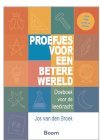
PROEFJES VOOR EEN BETERE WERELD – DOEBOEK VOOR DE LEERKRACHT – Jos van den Broek Paperback, 240 pages, €29.95
Spending half a year carrying out experiments, demonstrations and other activities with children at a local primary school prompted emeritus professor of science communication Jos van den Broek (Leiden University) to document his teaching materials. Proefjes voor een betere wereld is the result. Van den Broek developed the lesson ideas in his attic study, with the United Nations’ seventeen Sustainable Development Goals in mind, alongside his own educational manifesto Give them ACES – a framework whose ‘core values for 21st-century education’ each begin with an A, C, E or S; examples include autonomy, creativity and enthusiasm. The scheme is set out in the book. The experiments and other activities are aimed at primary school and first-year secondary pupils, but are by no means limited to biology; the other science subjects are also covered extensively. The book is intended as a source of inspiration, Van den Broek notes in the introduction, and has therefore ‘not become an instruction manual from A to Z’. That is accurate: although the book regularly includes clear boxes listing materials and concrete tasks, these are not fully worked-out lesson plans. Each topic is accompanied by extensive background information, on the basis of which teachers can devise additional activities of their own. As a result, it is quite a busy book, with a great deal of text and a great many illustrations – plenty of inspiration, in other words. Using a special code, teachers can download teaching materials (such as the cards for the genetics game, see above) via proefjesvooreenbeterewereld.nl.