


This is an instalment from the predecessor of the column 5 vragen: QED. This column centred on a single question.
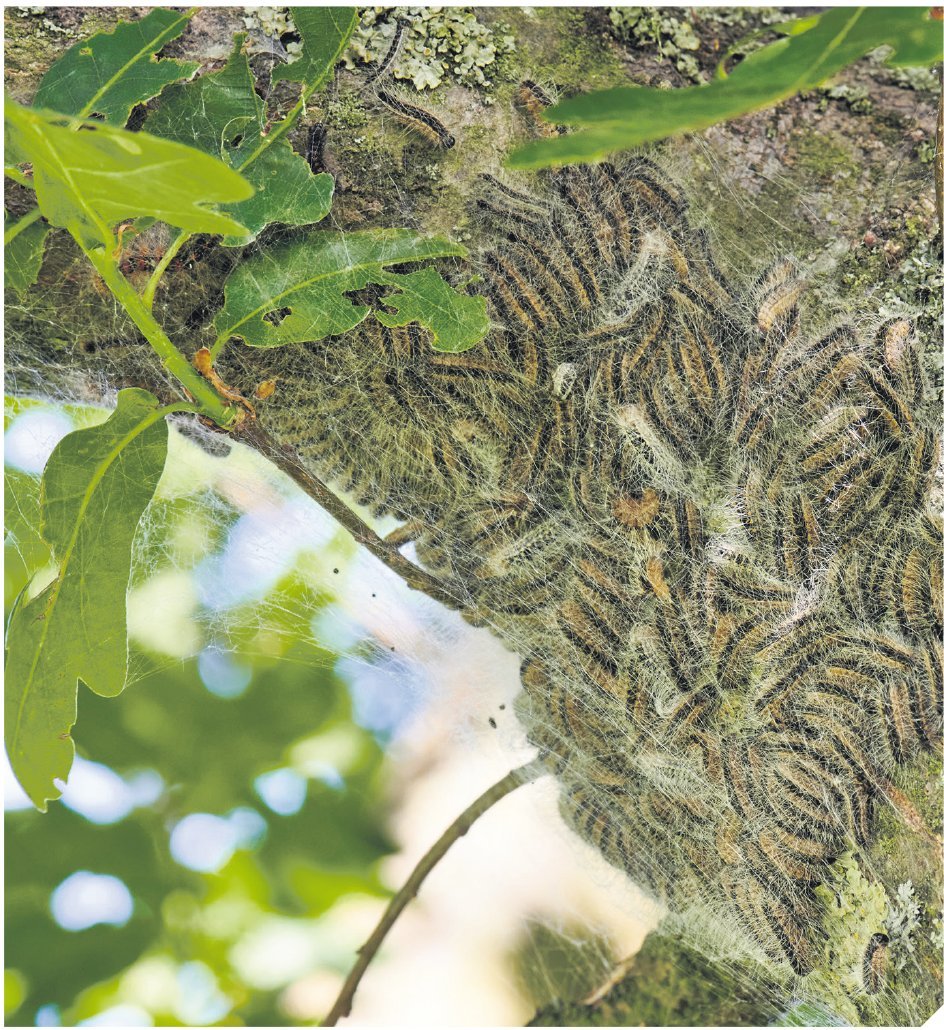 Photo: ImageSelect
Cordoned-off trees and itchy red welts: some five years ago, this was a daily reality in summer. The culprit? The oak processionary moth. The plague caused considerable consternation, but has since all but died down. The creature seems to have almost disappeared from the Netherlands. How can that be, and are we rid of the oak processionary moth for good?
The pest pressure from the oak processionary moth has indeed decreased enormously in recent years. Whereas in 2019 a caterpillar nest could be found on 53 per cent of oak trees, by 2024 that figure had fallen to just 5 per cent, according to data from the Kenniscentrum Eikenprocessierups (Oak Processionary Moth Knowledge Centre).
During the peak years of 2018 and 2019, conditions were particularly favourable for the oak processionary moth, explains phenologist Arnold van Vliet of Wageningen University. The warm weather allowed the caterpillars to develop rapidly. ‘And on top of that it was often windy, so the irritating hairs were easily carried onto people. Warm weather also simply means more people outdoors, wearing short sleeves and thus exposing more skin to the hairs’, says Van Vliet.
In 2021, observers found larvae of a bronze chalcid wasp in egg masses
In the years that followed, conditions were less favourable, but that does not appear to be the only factor. Control measures also seem to be bearing fruit. Municipalities combat the oak processionary moth by vacuuming out nests, spraying oak trees preventively, and encouraging natural enemies. ‘For example by putting up nest boxes’, Van Vliet explains of that last measure. The birds are then expected to consume the caterpillars. ‘We don’t systematically track what municipalities are doing, but we do see that they are investing in this.’ The oak processionary moth has also encountered a new natural enemy in the Netherlands. In 2021, observers found larvae of a bronze chalcid wasp in egg masses of the oak processionary moth. Further investigation revealed the species to be Anastatus bifasciatus, a species that parasitises primarily pest caterpillars and is new to the Netherlands. None of this means that the oak processionary moth will never form a plague again. There is, after all, a major uncertain factor at play, Van Vliet explains. ‘The life cycle of oak processionary moth caterpillars is far more complex and varied than we initially thought. Hatched caterpillars can pupate in the same year, but they can also burrow into the ground and remain as caterpillars. The following year, or even later, they then re-emerge to complete their cycle. At that point, they already have their irritating hairs.’
Diapause
This may also be what happened around 2019. ‘In 2019 we saw far more caterpillars than in 2018, yet afterwards there were considerably fewer moths. Control measures alone cannot explain that difference, so we think that some of those caterpillars went underground. We have no insight into what exactly determines whether they emerge from their diapause. Nor do we know why they burrow into the ground. There are theories: perhaps they do so when there is too much competition, when there are too many natural enemies, or when it is too hot. They then receive some environmental cue that causes them to decide to come back up. It is actually somewhat more complex still, because we have indications that the caterpillars can also enter extended diapause in trees’, says Van Vliet. ‘A new peak in the future is therefore certainly possible.’
Tricky questions from pupils? Send your questions to redactie@bionieuws.nl.