


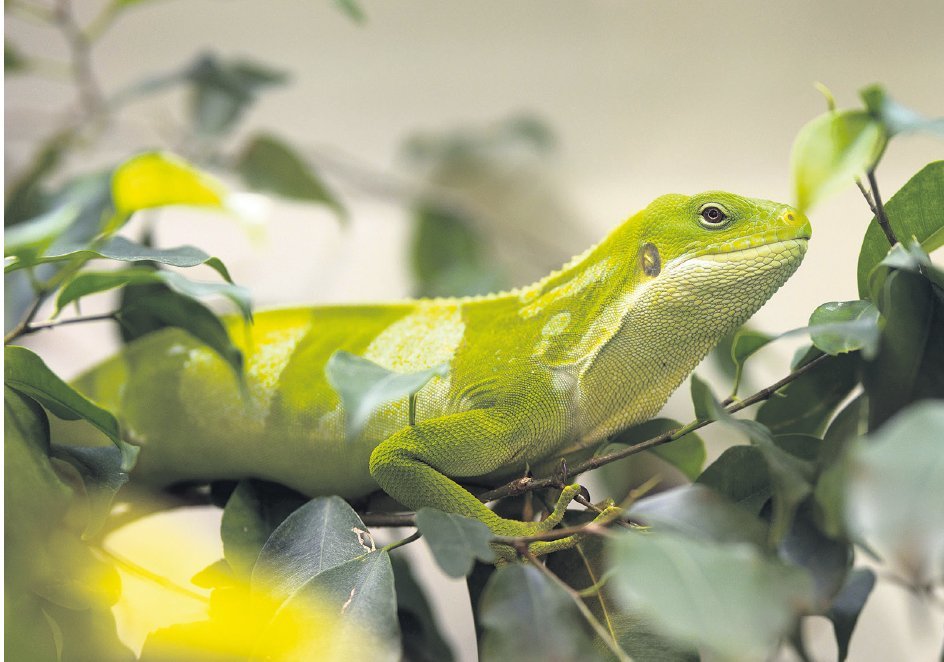
The Fiji banded iguana Brachylophus bulabula holds – at 8,000 kilometres – one of the records for transoceanic dispersal among terrestrial vertebrates. Photo: ImageSelect.
Fiji banded iguanas probably arrived on the Fiji Islands more than thirty million years ago, after a record-breaking raft journey of over 8,000 kilometres.They surpass Columbus’s crossing in distance by roughly 25 per cent – and did so more than 30 million years earlier. North American desert iguanas probably rafted across virtually the entire Pacific Ocean between 31 and 34 million years ago, washing up as castaways on or near the then newly formed volcanic islands of the Fijian archipelago. The ancestors of four species of Fiji iguana, including the Fiji banded iguana Brachylophus bulabula (pictured), set a new record for transoceanic dispersal among terrestrial vertebrates at 8,000 kilometres – a fifth of the Earth’s circumference – according to calculations by American biologists (PNAS, 17 March).
CROSSING
The idea that Fiji’s endemic iguanas survived a substantial raft journey was first proposed fifty years ago (Australian Natural History, 1974). At the time, however, the assumption was that these iguanas were descended from the green iguana (Iguana iguana), and that the (shorter) crossing from South America had taken place ‘only’ 13 million years ago. Phylogenetic analyses now show that the Fiji iguanas are in fact most closely related to North American desert iguanas, represented by a single living species: the omnivorous desert iguana Dipsosaurus dorsalis, which inhabits the Sonoran and Mojave deserts near the Gulf of California. The estimated divergence time is approximately 31 to 34 million years. The researchers believe that alternative migration routes – partly overland via the Bering Strait, South America–Antarctica, or Eurasia – are logistically even less plausible than a months-long, 8,000-kilometre voyage on a raft.
GREETING
The genus name of the leaf- and fruit-eating Fiji iguanas refers to the small crests on their necks: from the Greek brachys, meaning ‘short’, and lophus, meaning ‘crest’. The species epithet of the Fiji banded iguana Brachylophus bulabula was chosen by the Australian taxonomists who described the species (Philosophical Transactions of the Royal Society B, 2008) in reference to the doubled ‘bula’ with which Fijians greet close friends. It means ‘hello’ and, literally, ‘life’ – a rather fitting greeting for a desert dweller that has just completed an enormous sea voyage.