


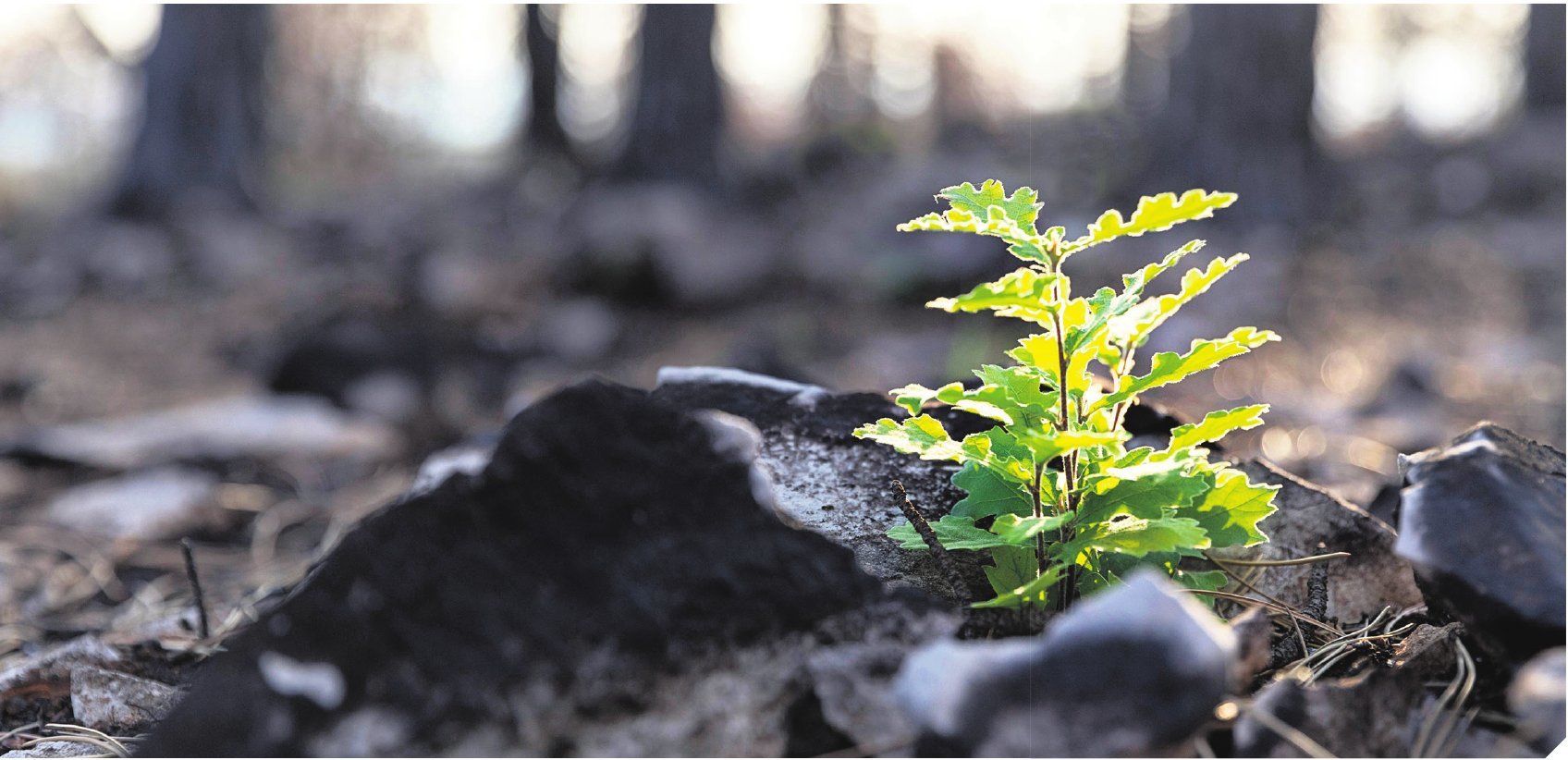
The world is on fire. As wildfires, floods, melting glaciers and vanishing species dominate the headlines in what seems like an endless cycle, geopolitical developments are causing many people’s hearts to sink still further. Teachers have noticed that hope for a sustainable future can be hard to find among pupils and students too. At the Conference on Sustainability Education on 11 April in Utrecht, teachers and subject educators will work together actively towards a hopeful future. Bionieuws spoke in advance with several speakers and asked: how do you deal with pupils who are excessively anxious, or who remain completely indifferent?

‘Many teachers turn out to begin their lessons with climate problems for which no solutions are sought. If you keep hammering away at those problems, pupils disengage and develop eco-anxiety – the fear that nothing you do makes any difference because the world is doomed anyway. But there are no hopeless situations, only people without hope. Education has a responsibility to give the next generation hope again, by helping pupils and students realise that they are more capable than they think and can discover for themselves what they can contribute.
‘That is why, at ICLON, I focus on hopeful climate education. I offer teachers concrete teaching methods built around the four ingredients of hope: setting goals, exploring pathways towards those goals, building trust in others, and taking climate action. For each of those goals, specific teaching methods can be deployed. For example, you can foster trust in others by using good examples of what is already being done, rather than focusing solely on what is going wrong. By setting goals and devising their own pathways, young people can also discover for themselves how they can actively contribute to a sustainable world.
‘With my student teachers training to become biology teachers, I set similar assignments – because you cannot teach about hope if you have no hope yourself. Teachers have a role to play here as educators.’

‘My research into the effectiveness of sustainability education highlights three important aspects that improve pupils’ motivation and hope. First, it is important that teachers give young people autonomy and ownership. In other words: pupils must be given the space to test self-chosen actions, rather than simply carrying out activities prescribed by the teacher. Second, it helps enormously if they connect such an assignment to the real world, so that they genuinely experience its relevance. They might, for example, take part in a neighbourhood project or carry out an assignment in a woodland or beside a ditch next to the school. Finally, it is important that teachers acknowledge and open up discussion about the emotions that arise – such as despair or indifference. Offer coping strategies, and show that you can draw strength from what others are doing to make the world a better place, and that you too – together with others – can make a difference.
‘The general picture is this: young people who know more about nature and climate are not necessarily more hopeful, nor are they quicker to take action. That is a genuine misconception. If anything, it is the other way round: by acting and getting involved, pupils become curious and hopeful. That is something teachers really need to bear in mind.’

‘Some pupils think the entire world is on the verge of collapse, whilst others assume that technology will solve all our problems. There are also pupils who are not particularly preoccupied with major issues such as climate change and biodiversity loss. With the Pedagogy of Hope, we try to address these issues without triggering feelings of despair. On the contrary, the six interdisciplinary teaching methods contribute to feelings of hope.
‘We look, among other things, at so-called moments of transformation in recent history. Such as the enormous number of cycle paths in the Netherlands: these came about through activists who refused to accept the number of road deaths. We also ask pupils to imagine different futures, based on existing scenarios. We also have them think about desirable futures, what steps are needed to get there, and what role they themselves can play in that process.
‘Reducing the ecological footprint does come up, but it is not central. In fact, it is a troublesome concept. Pupils who are already concerned about the environment are left feeling only that they are not doing enough. That is why we introduce the term ecological handprint, which stands for the influence you have on others. It is very motivating for young people when they notice that they can influence those around them and break through certain patterns. Moreover, that is a good remedy against eco-anxiety.’

‘My colleagues and I notice that there are generally two – admittedly relatively small – groups. Students who are seriously concerned: these are often vocal students who express themselves in an activist way and do a great deal of (self-directed) research. And students who are not engaged with the issue at all. The large group in between is sometimes referred to as the “silent middle”. When you probe them – for instance by initiating a dialogue in the classroom – you notice that students need the conversation in order to form their perspective. Dialogue is an excellent means of approaching an issue such as climate change through a multi-perspective lens.
This allows students to form a considered opinion of their own, without the two poles of the (public) debate gaining the upper hand. ‘My advice to teachers: take the time to explore dialogue as a conversational form. In a dialogue, do not discuss empirically established matters (such as whether climate change is real), but instead address, for example, questions of responsibility in such an issue. When you as a teacher are passionate about a topic, it can be a pitfall to want to convince your pupils or students. From the perspective of dialogue methodology, it is also often an enormous challenge for teachers to be genuinely willing to discuss and listen to other perspectives. This requires practice in the ability to suspend judgement – a teachable professional skill that still receives insufficient attention in teacher training programmes.’