


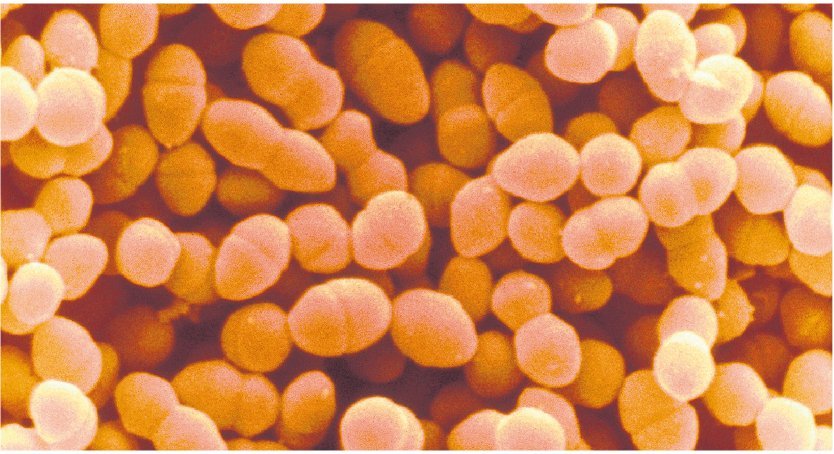
Of the hospital bacterium E. faecium, mutual competition has left just two dominant strains.
As different strains of antibiotic-resistant bacteria make life difficult for one another, their diversity can decline rapidly.
Enterococcus faecium hospital bacteria are engaged in such intense conflict with one another that the number of strains fell from eight to two between 2017 and 2022. The surviving strains proved to be bombarding their relatives with self-produced bacteriocins – antimicrobial compounds that bacteria deploy to eliminate each other. This was first discovered by American researchers at a local hospital in Pittsburgh, who then concluded that it is a worldwide phenomenon (Nature Microbiology, 21 March). The remaining antibiotic-resistant bacteria do not appear to be more pathogenic than their predecessors, and drug development can now focus on two strains rather than eight.
Detection
The hospital bacterium in question, Enterococcus faecium, is resistant to the antibiotic vancomycin and is particularly dangerous for patients with a weakened immune system. Around 40 per cent of patients infected with vancomycin-resistant E. faecium (VREfm) die. For this reason, hospitals such as the one in Pittsburgh have a detection system that can rapidly identify infections in patients through genetic analysis. Clinicians can then intervene quickly and counter outbreaks in real time. The same system also makes it possible to access historical data on hospital bacteria, and thus to track their evolution.
That is precisely what the researchers did: they analysed genetic sequences from 710 VREfm samples taken from patients admitted to the hospital between 2017 and 2022. They found that in 2017 eight strains were present in roughly equal proportions. But in 2018 two dominant strains suddenly emerged, which by the end of 2022 were responsible for four in every five infections. The researchers then compared their data with 15,631 publicly available VREfm genomes from around the world – samples collected between 2002 and 2022. This revealed that the pattern they had identified occurs globally.
Elimination
Finally, the dominant strains proved to deploy bacteriocins to eliminate their competitors for food. This gives those strains a strong advantage: both in vitro and following colonisation of mouse intestines, the other strains are outcompeted by them. ‘The diversity of E. faecium appears to be declining. (…) This means we may soon have just one target for the development of antibiotics or phage therapy’, said last author Daria Van Tyne in a press release. ‘It also suggests that bacteriocins are extremely potent and that we may be able to harness them for our own purposes.’