


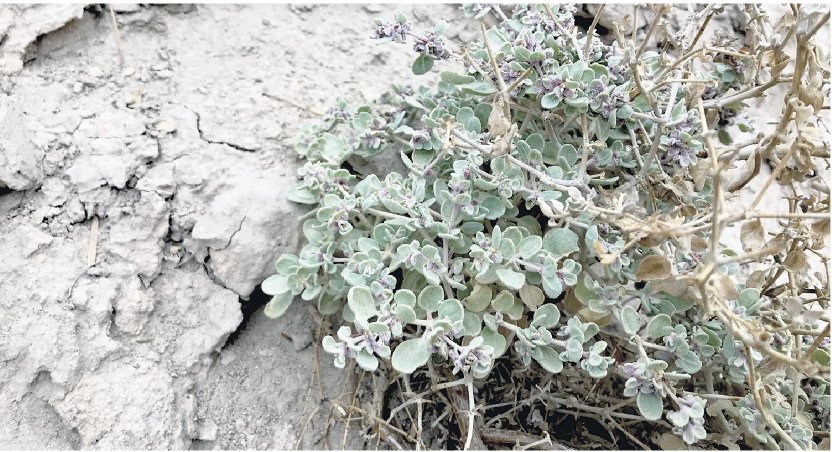
In the heat, the mitochondria of Tidestromia oblongifolia position themselves next to the chloroplasts, which change shape. Photo: Karina Prado.
Thanks to a range of adaptations, a small plant is able to flourish in Death Valley.
Once obscure, the desert plant Tidestromia oblongifolia is now revealing how it thrives in extreme conditions – and offering a possible blueprint for developing crops that can adapt to a changing climate (Current Biology, 7 November).
Although life seems almost impossible in Death Valley, California – where temperatures regularly reach 50 degrees Celsius – T. oblongifolia withstands that relentless heat remarkably effectively. To investigate the plant’s survival strategies, scientists at Michigan State University brought seeds back to the laboratory. Only once they succeeded in simulating Death Valley conditions in specially designed growth chambers did the seedlings begin to grow vigorously.
Biomass
The biomass of T. oblongifolia triples in just ten days. Within as little as two days, the plant raises its photosynthetic comfort zone, allowing energy production to continue. Within two weeks, T. oblongifolia reaches an optimal photosynthetic temperature of 45 degrees Celsius, making it – as far as is known – the most heat-tolerant plant ever recorded. Closely related species, also known for their tolerance of heat stress, stop growing altogether in response to the intense fluctuations in light and temperature.

The habitat of Tidestromia oblongifolia in the Death Valley desert. Photo: Sue Rhee.
The researchers found that the remarkable resilience of T. oblongifolia stems from coordinated changes within the plant’s cells. In response to extreme heat, the mitochondria position themselves directly alongside the chloroplasts. The chloroplasts themselves change shape, forming cup-like structures that scientists had never previously observed in higher plants. Such cup-shaped chloroplasts may help to capture and recycle carbon dioxide more efficiently, stabilising energy production under stressful conditions. Meanwhile, within 24 hours, the activity of thousands of genes shifts to protect proteins, membranes and the photosynthetic machinery from heat damage. In addition, T. oblongifolia increases the production of a specific enzyme that appears to facilitate photosynthesis at high temperatures.
Prospects
Global temperatures are expected to rise by as much as 5 degrees Celsius by the end of this century, and heatwaves are already causing yields of major crops to fall. ‘Desert plants have spent millions of years solving the very challenges we are only now beginning to face’, one of the authors said in a press release. If those mechanisms can be replicated in crops, it offers real prospects for agriculture in a warmer world.
See also:
–Death Valley plant reveals blueprint for heat-resilient crops – Michigan State University website, 13 November 2025