


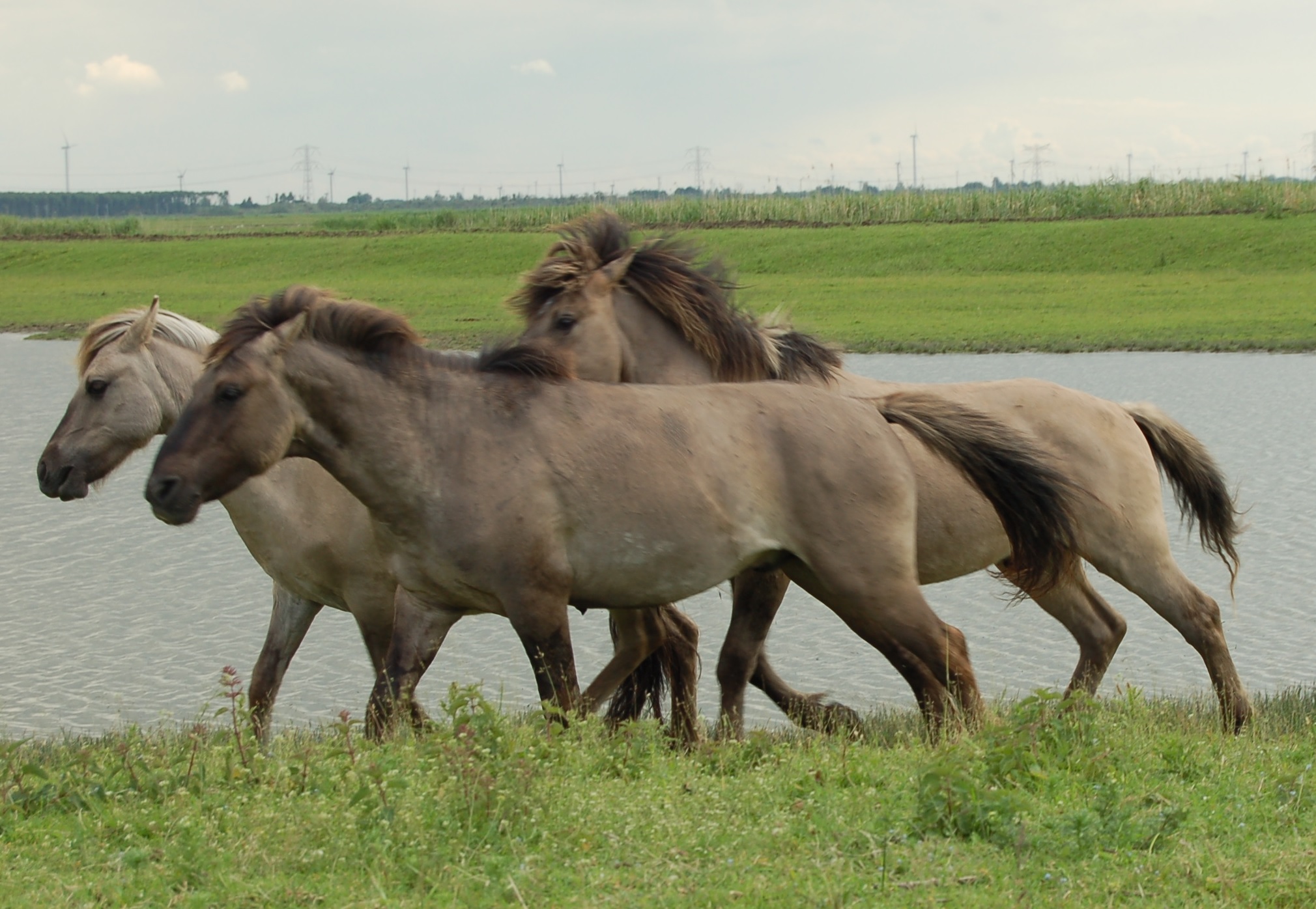
Three semi-wild konik horses, roaming freely in Oostvaardersplassen National Park near Lelystad. Photo: Moebius.
Horses owe their extraordinary stamina to a mutation that promotes ATP production whilst simultaneously protecting against oxidative stress.
American researchers have revealed an important molecular mechanism underlying the outstanding endurance of horses: a mutation in the so-called KEAP1 gene boosts mitochondrial energy production whilst simultaneously protecting against oxidative stress. The mutation also occurs in donkeys and zebras, pointing to an early evolutionary innovation, the biologists write on 28 March in Science
The maximum oxygen uptake of modern racehorses, corrected for body weight, is more than twice that of elite human athletes. This supports the enormous energy demands of the skeletal muscles, which are packed with mitochondria for enhanced ATP production. However, this comes at a cost: oxidative stress – that is, the production of reactive oxygen species as a by-product of oxygen metabolism, with the attendant risk of tissue damage and impaired cellular function.
OXIDATIVE STRESS
To identify the molecular mechanism by which horses protect themselves against this, the researchers focused on the KEAP1 gene, which is known to be involved in the antioxidant system. The gene suppresses production of the protein NRF2, which counteracts oxidative stress. Suppression of NRF2 is nonetheless necessary, as an excess can also cause damage. As a result, KEAP1 is a popular subject of research in both exercise science and clinical studies into conditions including cancer and the lung disease COPD. Genetic analyses of 196 mammalian species revealed that the KEAP1 gene in horses, donkeys and zebras contains a stop codon in the wrong position – a so-called premature stop codon. Normally this leads to incomplete, and therefore shorter, proteins that are often harmful to the cell. In the genus Equus, however, this turns out not to be the case, as a series of biochemical analyses has shown. Instead, the stop codon causes KEAP1 to suddenly encode cysteine, which results in the suppression of NRF2 production being partially lifted. The consequence: oxidative stress remains under control, whilst aerobic respiration and ATP production in the mitochondria increase.
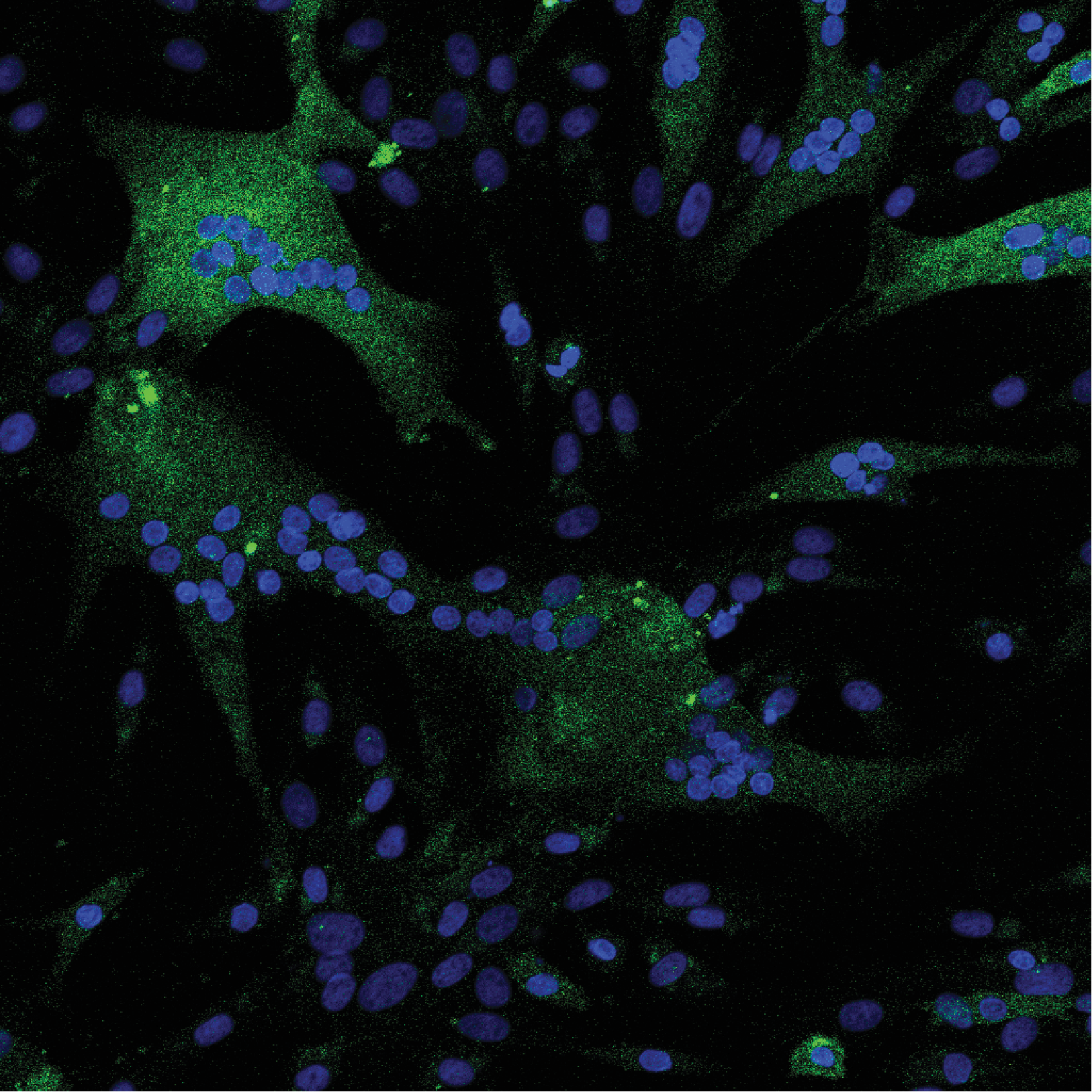
Developing muscle fibres from a thoroughbred racehorse reveal adaptations for energy production. Photo: Lingli Zhou and Gianni Castiglione, Vanderbilt University, Nashville, Tennessee.
‘Although we cannot exclude the possibility that the evolution of the KEAP1 mutation in horses has adverse side effects (…), our results suggest that this single recoding event on the one hand maintains redox balance and on the other improves mitochondrial respiration and ATP production’, the authors state.
As far as is known, a mutation in the KEAP1 gene arose at least twice earlier in evolution. At the transition of vertebrates from water to land, it provided additional protection against ultraviolet radiation. And more recently during the evolution of birds, a mutation arose to compensate for the oxidative stress caused by the high energy demands of flapping flight.
See also:
–Castiglione Lab Discover Horses Run Faster by Ignoring an Ancient Mutation that Says ‘Stop’ – Website of Vanderbilt University, Nashville, Tennessee, 28 March 2025
–Pure paardenkracht: een toevallige genetische afwijking maakt paarden zo sterk – de Volkskrant, 27 March 2025