


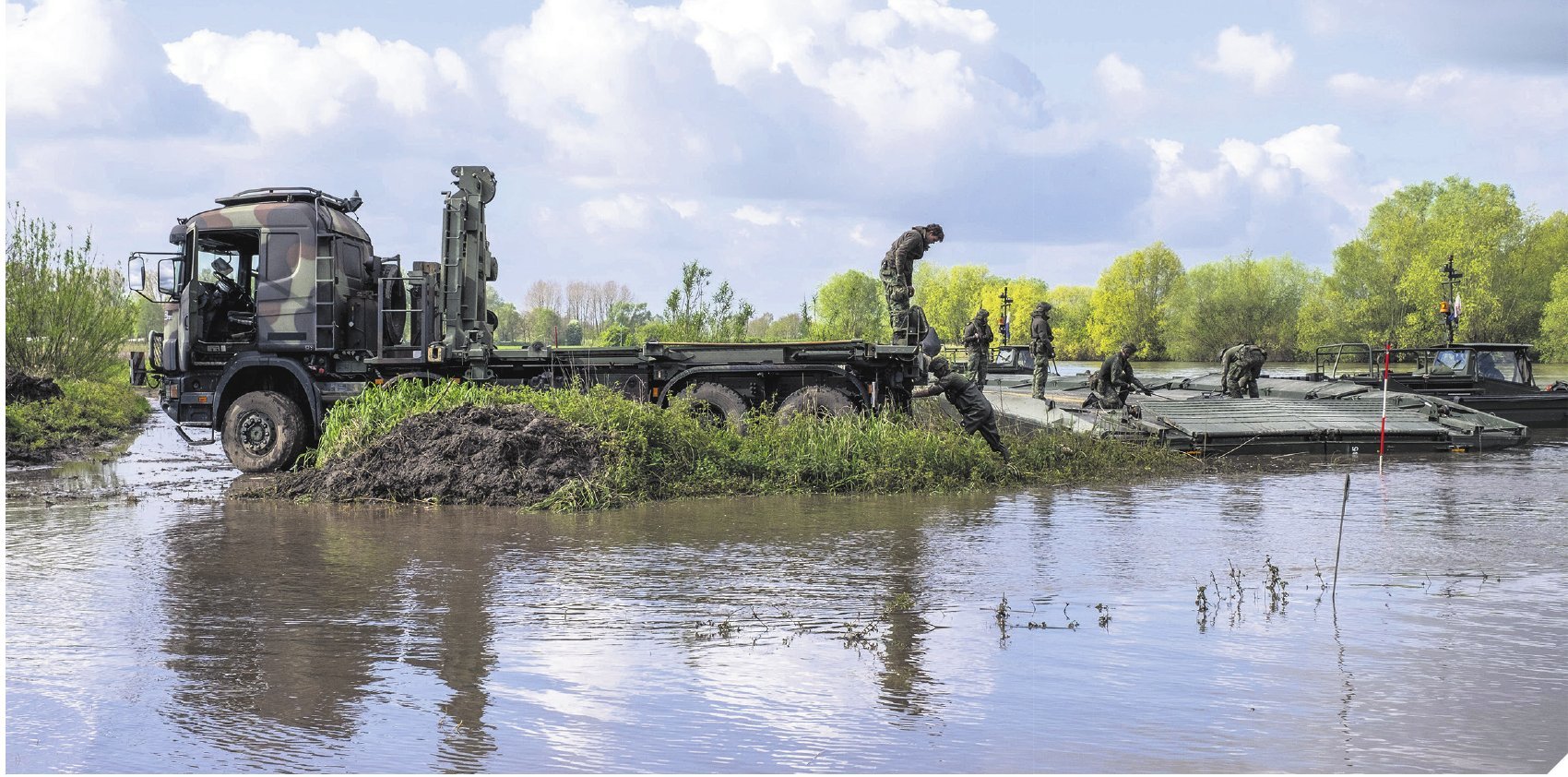
 Photo: ImageSelect
The Ministry of Defence is actively searching for new training grounds, with its sights set on protected nature reserves. Terletse Heide and part of the Rozendaalse Veld on the Veluwezoom are already earmarked as sites for exercises involving heavy explosives. Natuurmonumenten has therefore launched the petition ‘Keep the Veluwezoom bomb-free‘. At the same time, the Ministry of Defence maintains that its exercises and nature can in fact go hand in hand, and may even enhance the ecological value of an area. So how harmful is a military training ground – closed to cyclists and walkers – actually for nature?

Ecologist and wildlife filmmaker Ruben Smit made the nature film De Nieuwe Wildernis and is co-initiator of the petition
‘The petition was launched just before Christmas and we will present it to the House of Representatives on 11 March. The proposed exercises on Terletse Heide and the Rozendaalse Veld will lead to the destruction of nature. The military will conduct exercises there using very heavy explosives of 20 kilograms, at an intensity that cannot be compared with other sites. The area will be turned into a moonscape contaminated with fine particulate matter and heavy metals.
‘I have walked around many military training grounds to assess their ecological value. This value can only remain high with less intensive use and less powerful explosives. On sites where controlled burning is frequent, you find rare grasshopper species, and where vehicles drive through sand, juniper establishes itself. But this does not apply to Terletse Heide and the Rozendaalse Veld. These will have to be closed to recreational visitors. The plans for these preferred locations cannot be compared with other military training grounds. I would even call this greenwashing, and I hold those involved responsible for it.
‘These sites are undisturbed, with original heathland development on meltwater valleys from the ice age. Military exercises will disrupt the soil layers. They bring fire risk, noise pollution and vibrations. The impact on fauna will also be enormous. Given the vulnerability of Dutch and European nature, it simply makes no sense to carry out heavily polluting military exercises on nature reserves. If we insist on doing so, agricultural land might be more suitable for the purpose.’

Wieger Wamelink, ecologist at Wageningen University & Research
‘There are many military training grounds that are closed to recreational use because live firing takes place. These are sometimes magnificent heathland sites. The military fires over them, but they must not catch fire. The soldiers therefore burn the area themselves under controlled conditions – a good way of maintaining the heathland. On the Edese Heide, the tracks created by armoured vehicles actually provide a good habitat for insects and a varied landscape. But whether military exercises are beneficial for nature ultimately depends on what activities are carried out and what type of terrain is involved. That really has to be assessed on a case-by-case basis. The fact that part of the military training grounds is closed to the public also helps, of course. Tourists and day-trippers generally cause more disturbance than soldiers.
‘A thorough survey of the ecological value of the Rozendaalse Veld and Terletse Heide will be needed to determine whether a military training ground can protect or instead damage these areas. Both suffer from nitrogen deposition, and the military with its polluting tanks must also comply with legislation.’

Theo Linders is senior ecologist at the Government Real Estate Agency and co-author of the report Natuurwaarden op Defensieterreinen
‘Military training grounds are surprisingly rich in wildlife. In terms of species diversity, the heathlands on military training grounds are a match for those managed by other land managers. Indeed, they often support a number of very rare species that depend on the dynamics of military use. The wart-biter, an extremely rare grasshopper, is found in the Netherlands and Germany only on sites with craters left by heavy artillery. Around these intensively used areas there are often large buffer zones where military personnel rarely venture and nature is left to its own devices. These serve as important refuges for many animal species, not least because recreational visitors are absent. Experience shows that animals quickly become accustomed to the predictable background noise of military exercises, precisely because it has no consequences for their own survival. For instance, the grasslands at Volkel Air Base, where F-35s take off and land daily, support more than a hundred pairs of breeding skylarks – densities you rarely encounter outside military training grounds. For them, good mowing management matters far more than ambient noise. Although military use and nature conservation can go hand in hand, establishing a new training ground within an existing nature reserve is by no means straightforward. This decision must be taken with great care, with other options also considered.’

Friso van der Zee, ecologist and senior researcher in biodiversity and policy at Wageningen University & Research
‘During the ten years between 1992 and 2002, when I worked as an ecologist at what was then the Ministry of Agriculture, Nature and Food Quality on nature at Defence sites, a great deal improved. Alongside a better understanding of nature and its management, I think the most important achievement was that Defence appointed ecologists with the specific aim of mapping the natural values on Defence sites. As a result, they came to understand and manage their own natural environment far better.
‘Much of the nature found on Defence sites has come about more or less unintentionally, shaped by low-intensity use, different management practices, and the relative tranquillity of, among other things, the firing ranges. Where they are acting more deliberately is in the management of species-rich grassland on the air bases in the Netherlands. Nutrient-poor, herb-rich grasslands are good for wildflowers and insects, but less attractive to large birds. Here they combine flight safety – birds in an engine pose a serious hazard to jet aircraft – with biodiversity.
‘But the fact that Defence manages its sites well and takes good care of their natural values cannot simply be turned around as an argument for the reverse. The Rozendaalse Veld and the Terletse Heide are largely managed by Natuurmonumenten, and their natural values are currently being protected to the highest standard. A new explosives training ground within this existing nature reserve could well cause damage. Combined with the need to address the nitrogen problem, an agricultural area with zero biodiversity seems to me, in any case, a far more obvious candidate for a training ground.’