


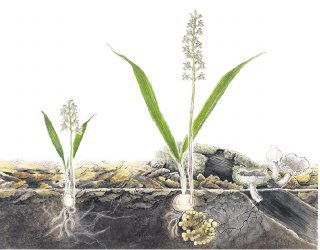
Semi-parasitic orchids of the species Oreorchis patens growing near rotting wood form coral-shaped roots and surround themselves with different fungal symbionts. The orchid then grows considerably larger and produces more flowers (see illustration), opening an evolutionary pathway towards full parasitism (The Plant Journal, 19 February). The orchid continues to use photosynthesis, but the accumulation of symbiotic wood-decomposing fungi leads to a substantial increase in the amount of nutrients available. This offers a plausible ecological explanation for why a photosynthetic plant takes the path towards parasitism when decomposable material happens to be available. (GvM)
See also:
Some orchids turn parasitic when conditions allow – Earth.com, 20 February 2025