


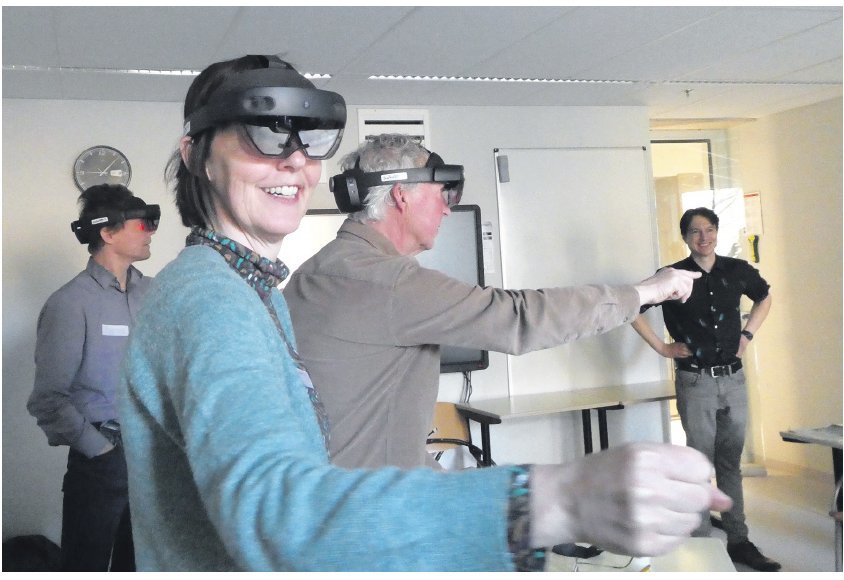
AR headsets offer alternatives for anatomy education.
Schools are lagging behind when it comes to the use of animal material in the classroom. It is time to start working with alternatives.
High spirits prevail on Thursday 6 March at the University of Applied Sciences Utrecht. Teaching laboratory assistants, teachers and teacher educators are getting to grips with what is already reality in higher education and research: animal material is increasingly being replaced by alternatives. They are thoroughly enjoying themselves. The event, The Future of Anatomy Education, is organised by Bètapartners. ‘Researchers in the life sciences have been working for decades on the three Rs: replacement, reduction and refinement of animal use, and developing alternatives to go with them,’ says Marianne Lubbers, who took the initiative for this event. ‘But that has barely – if at all – filtered through to secondary education.’ She speaks from experience: after studying biology she worked as a team leader in animal care at the Netherlands Cancer Institute. A few years ago she entered teaching as a career changer and now teaches at the Goois Lyceum in Bussum. ‘I was astonished to find that, in terms of animal use, absolutely nothing had changed since my own school days.’
There is genuine interest in alternatives. One teaching laboratory assistant explains that he uses, among other things, chicken hearts, lamb hearts and cow eyes, but would rather not: he has ethical objections, finds it unhygienic, and notices that more and more pupils are unwilling to take part. Like the other attendees, he gets to try out the augmented reality headsets that Bo van Leeuwen has brought along; Van Leeuwen is a lecturer in veterinary anatomy and physiology at the Faculty of Medicine at Utrecht University and is researching new techniques for developing spatial understanding in anatomy education. Such an AR headset projects an animal three-dimensionally into the room. You can walk around it and grab and peel back the skin, or select and highlight specific systems – the circulatory system or the nervous system, for instance. It is not long before the participants are wandering around waving their arms.
PLASTINATES
They then examine the plastinates that Van Leeuwen has also brought with him: animals and organs preserved using the now almost fifty-year-old method developed by Gunther von Hagens. Plastinates can replace specimens preserved in formalin or fresh material, and last a lifetime. Everyone is struck by the minute structures visible in dissected rats, toads and hearts. Plastinates turn out to be far more impressive than plastic models or 3D prints. Van Leeuwen explains that the Faculty of Veterinary Medicine has its own preparator on staff. There is an enormous collection, and schools can borrow or purchase specimens.
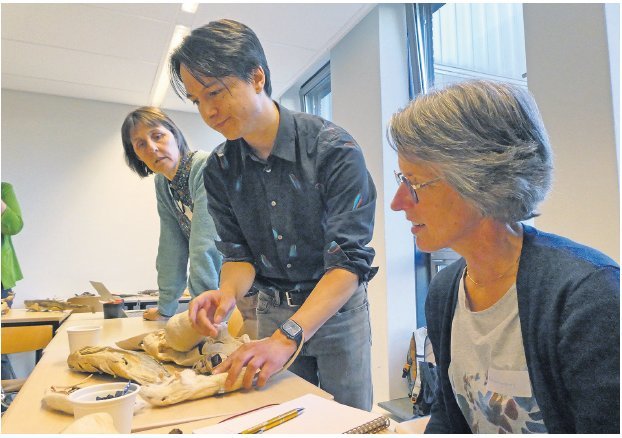
Everyone is struck by the minute structures visible in dissected rats, toads and hearts.
In another room, Ronald Vlasblom, a lecturer in life sciences at the University of Applied Sciences Utrecht, demonstrates alternatives to animal experiments that he and his colleagues use in the training of laboratory analysts. There is an earthworm model with which students can test the effects of toxic substances. They can do the same with cultured muscle cells and intestinal cells. And under a microscope, nematodes wriggle about – the well-known model organism Caenorhabditis elegans. When a particular gene is switched off, these tiny animals develop their version of Alzheimer’s disease, which becomes visible as they begin moving in circles. In this way, aspects of the disease can be studied.
Lubbers, who initiated the event, has also devised a new method of her own, which she demonstrates here: a ‘clay eye practical’ in place of the eye dissection practical. She sets the attendees to work with ten different colours of modelling clay, with which they must construct an eye complete in every detail. ‘I did this yesterday with one of my first-year secondary classes. After they had modelled an eye, they had to cut it in cross-section, draw it and compare it with an illustration from the textbook. That worked perfectly well. For another first-year class tomorrow I have ordered fifty cow eyes to do it in the usual way, but I now regret that. The clay alternative is more enjoyable and just as educational.’
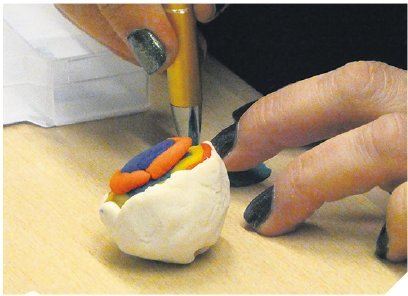
In a ‘clay eye practical’, participants work with ten different colours of modelling clay to construct an eye complete in every detail.
Today, Lubbers wants to reflect on the question: should we do something with these alternatives to the use of animals? ‘We are preparing pupils for further study and must therefore respond to developments in higher education and research, including with regard to the use of animals’, she believes. ‘We owe that to our pupils. Besides: once someone is accustomed to using animals, it is not easy to move away from that. We need young scientists who think out of the box: not from the perspective of animal use, but from that of animal-free methods. Particularly when it comes to replacing animals in research, there is still progress to be made.’
From the literature she knows that models are equally effective – and often even better – for teaching anatomical knowledge than real material. But teachers also want to inspire a sense of wonder, not merely transfer knowledge. Can that be a reason to use real material? Working with animals in secondary education is never compulsory. For pupils with ethical or emotional objections, good alternative practicals must be available. On the other hand, says one teacher, there are also pupils who see a future for themselves in medicine or veterinary science. They find it wonderful to be allowed to dissect: gloves on, safety goggles in place, scalpels and forceps in hand.
The participants at the meeting are, in any case, enthusiastic about the possibilities they have seen today. They will certainly bring these to the attention of their schools.
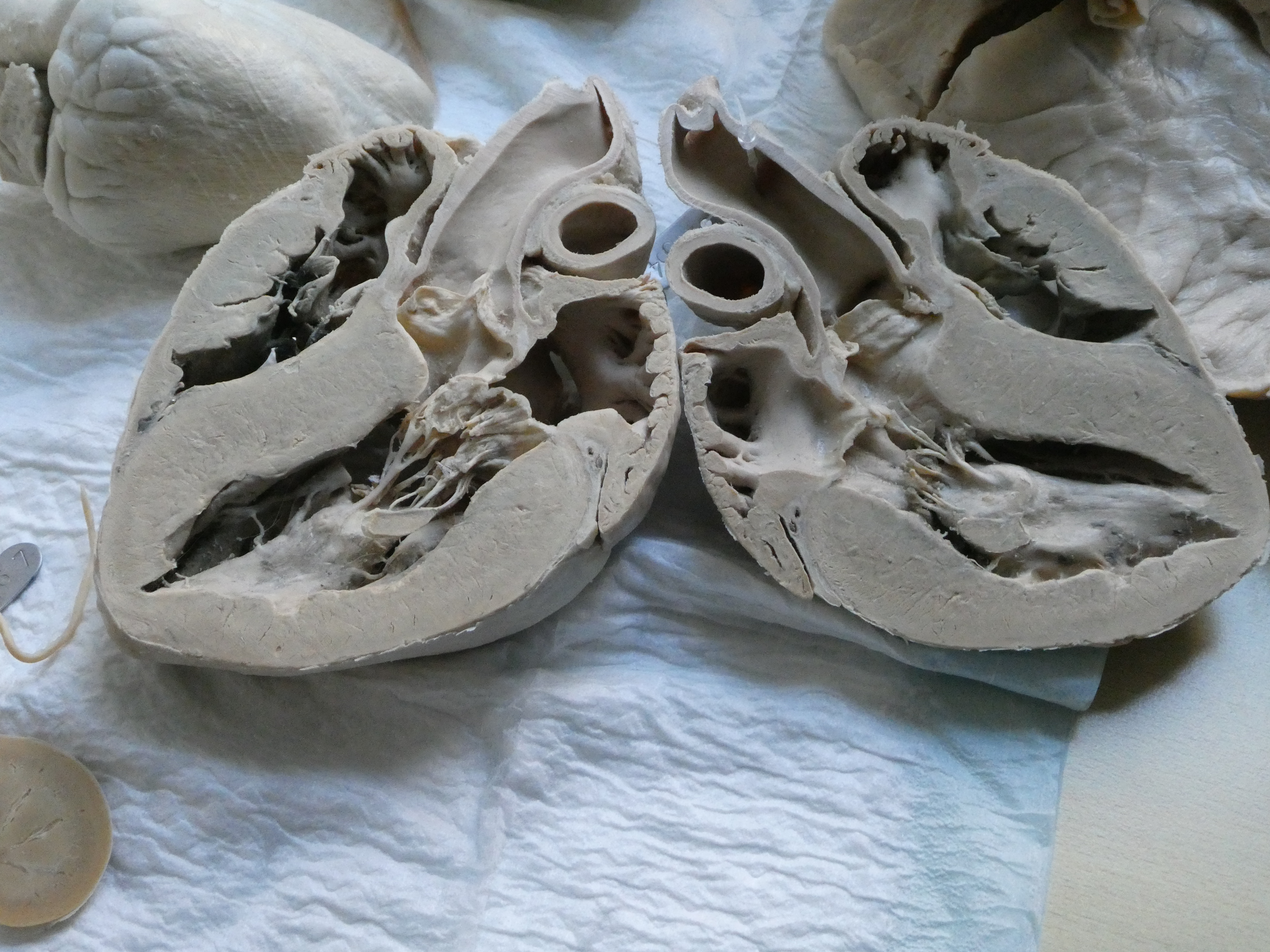
Plastinates, such as those of the heart, can replace specimens preserved in formalin or fresh material, and last a lifetime.