


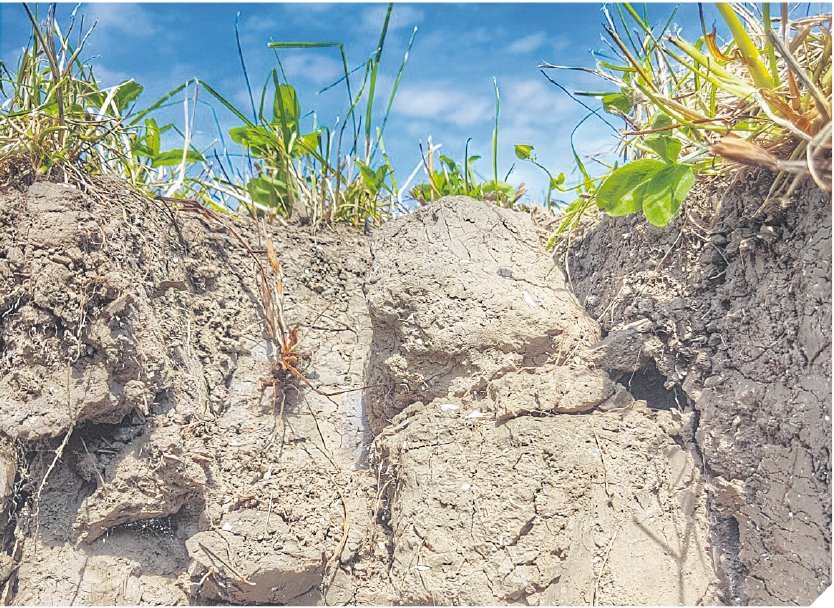
A healthy soil is the foundation of sustainable food production. Photo: Ron G. M. De Goede
Soil functionality and health deteriorate as fields are managed more intensively, in both conventional and organic farming operations.
‘It may be received differently, but our positive message is that less intensive land use is correlated with greater soil multifunctionality, and that holds for both conventional and organic farming’, says soil ecologist Wim van der Putten of the Netherlands Institute of Ecology (NIOO-KNAW), who also holds a special chair in functional biodiversity at Wageningen. He is one of the senior authors of a paper published in Science on 25 April that measures the influence of seven management practices on soil functionality across 53 Dutch arable farms. ‘These include both conventional and organic farms on sandy and clay soils, which are compared per soil type as a kind of non-identical twin farms’, explains co-first author and soil biologist Guusje Koorneef. The sampled conventional and organic twin fields have very similar growing conditions and grass-like crops: wheat, barley, spelt, rye or grass-clover.
Soil samples were taken from all farms and analysed for properties including structure, organic carbon and bacterial biomass, in order to derive a multifunctional soil score via a standardised protocol, as an indicator of soil health. In addition, management practices were documented through interviews, covering aspects such as crop rotation, application of organic manure, and ploughing depth and frequency.
‘Our measurements show that it is primarily the intensity of land use that matters, rather than the distinction between organic and conventional farming. Less frequent ploughing and the use of grass-clover mixtures correlated positively with soil multifunctionality’, Van der Putten summarises. ‘Both organic and conventional farmers showed a wide spread in this score, although conventional farms tend to cluster towards the lower end’, Koorneef adds.
Satellite imagery
The study was not designed to compare complete farming systems, but to gain greater insight into the processes that ultimately determine soil health. For instance, economic viability and yields were not examined, but a measure of plant productivity was determined by using satellite imagery to measure the Normalised Difference Vegetation Index (NDVI). ‘NDVI indicates the greenness of a plot and is at best a rough indicator of yield’, says Van der Putten. The increase in multifunctionality observed on the study farms therefore does not appear to come at the expense of NDVI. ‘Our results are interesting in the context of the move towards reduced tillage. Completely inverting the soil is devastating for soil life. We looked at a maximum of five years without ploughing, so for longer periods without inversion tillage you would need to collect additional data’, says Koorneef. The current study appears to point in a clear direction for making agriculture more sustainable: by extensifying soil management, it should be possible to increase soil multifunctionality. ‘The current buzzword is sustainable intensification, but our results show that intensification is not sustainable when you look at soil multifunctionality. That is why we advocate productive de-intensification – less intensive, but with yields preserved as far as possible.’