


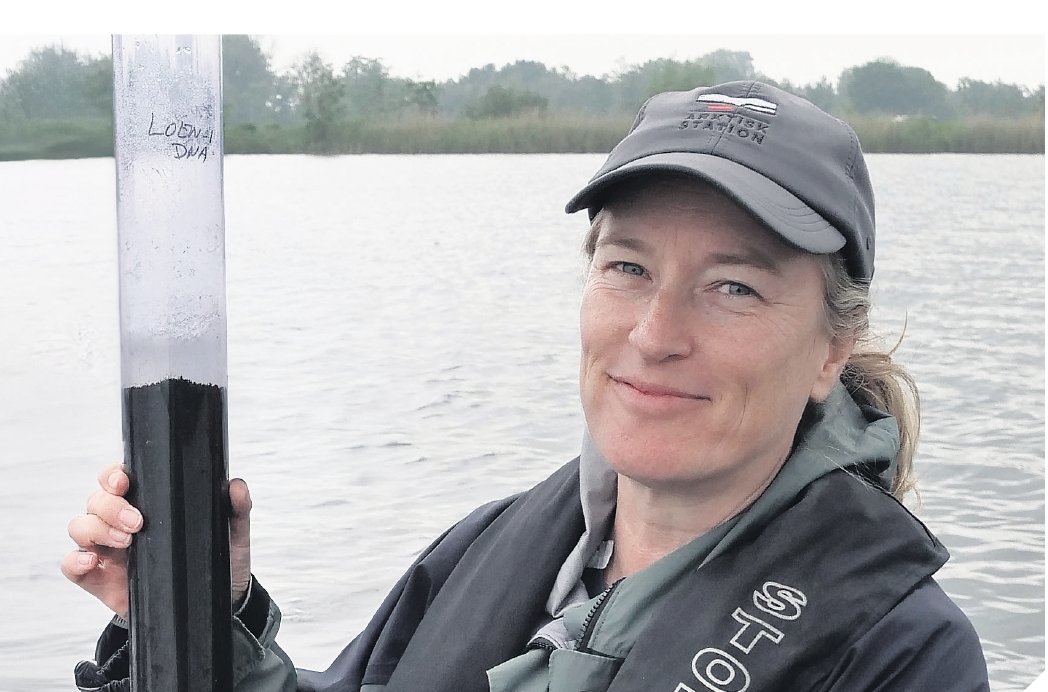
 Limnologist Suzanne McGowan at the Loenderveense Plas: ‘Thanks to sediment cores from lakes, we can sometimes look back centuries at eutrophication events.’ Photo: Johan Hazekamp/ NIOO-KNAW
She has a fascination for ecological research on lakes and discovered in pristine Greenland how lakes turned from clear blue to brown in a single year. ‘If we don’t address the climate crisis, we won’t be able to stop it’, says limnologist Suzanne McGowan.
‘We had our first shock about the lakes in West Greenland during our annual fieldwork in the summer of 2023. We knew that a record drought and record rainfall had occurred in the autumn of 2022, but it was only then that we truly saw the consequences. The ground around the lakes was very waterlogged and the lakes had turned brown instead of blue. We had never seen anything like it before, and our analyses indicate that the lakes have been pushed past a tipping point. It is above all the abruptness of the changes and the enormous scale that make it so shocking’, says Suzanne McGowan, head of aquatic ecology at the Netherlands Institute of Ecology (NIOO-KNAW) and professor of aquatic ecosystem dynamics at Utrecht University. She will deliver her inaugural lecture in Utrecht on 18 February, followed the next day by the symposium Aquatic ecosystems in a dynamic world, and recently published on the transformation of Greenlandic lakes (PNAS, 21 January). Meanwhile, Greenland is also confronted with territorial claims from US president Donald Trump.
Contentious issue
‘Greenland has suddenly become a political hot-button issue. I find it appalling that so much attention is being paid to colonialist ideas that have no place in the modern world. It diverts attention from the global issue of climate change. I would like to focus on the science’, McGowan says via Teams from her family home in England. ‘Personally, I prefer to describe myself as a limnologist, because limnology also encompasses the physical aspects of the study of inland waters and their interaction with the land. It is precisely the integrated interplay between biotic and abiotic factors that plays an important role in the dynamics of lakes’, McGowan explains. ‘That dynamic is fascinating because it operates across multiple timescales. Lakes go through different seasons every year, but they are also subject to variation in the inflow and outflow of water from the surrounding environment. That makes them vulnerable to pollution and climate change, and this is reflected in changes in the communities of plankton and other aquatic plants and animals living in lakes. Over the course of decades, lakes also record those changes in the sediment that accumulates on the lake bed. In that respect, lakes are mirrors into the past. We can carry out pollen analyses in sediments to reconstruct the surrounding vegetation, but I focus primarily on monitoring two types of pigment: chlorophylls and carotenoids. These are proxies and bioindicators for algae and phototrophic bacteria, which we can use to trace past algal bloom events in sediment cores. In this way we can look back – sometimes over centuries – at events and trends in eutrophication. Together with experimental research, this provides a toolkit for examining the long-term effects of environmental change.’
‘Greenland is unique because the direct influence of humans there is very small’
As a professor at the University of Nottingham and Fellow of the Freshwater Biological Association, McGowan drew inspiration from Windermere, an iconic lake in the English Lake District. ‘That is a lake that has been intensively sampled since 1945, but we can use sediment cores to go far back in time and show that the construction of railways and sewerage systems around 1860 had an enormous impact on the water balance, nutrients and bacterial composition’, McGowan says. ‘The Netherlands has made a particular name for itself through research into ecological changes in shallow lowland lakes. That research has sparked interest worldwide in searching for evidence of ecosystem change in all manner of lake types in north-west Europe, China, South-East Asia and Greenland as well.’ The work in Greenland is an international project that has been running since 1990, and for which the American ecologist and climate researcher Jasmine Saros of the University of Maine has done a great deal of work to ensure long-term monitoring of these lakes.
‘Greenland is unique because the direct influence of humans there is very small. It is one of the last pristine areas, where the ice caps are melting on a massive scale. We have now been monitoring a number of lakes in West Greenland for ten years, and we attribute the shift from blue to brown that we are now observing to the accelerated thawing of permafrost. Large quantities of carbon are stored in the land, but those soils are also rich in iron and other elements. The enormous rainfall washed soil, carbon and metals into the lakes, turning the entire food web upside down. Light can no longer reach the bottom, and plankton lives mainly in the upper water layer, whilst in the dark, deeper layers it is organic matter that is being broken down. During the polar summer, the lakes are no longer storing carbon – they have become a source of carbon dioxide. CO2 emissions to the atmosphere have increased by as much as 360 per cent’, McGowan notes, adding with concern: ‘We see it, we monitor it, we report it – but if we do not address the climate crisis, we cannot stop it.’