


Lenski’s bacterial experiment makes evolution repeatable
Deel
Observing evolution at the level of individual genes and pitting modern organisms against their fossil counterparts. Richard Lenski’s long-term evolution experiment with E. coli has been running for nearly 40 years and continues to inspire evolutionary biologists worldwide. Lenski was the closing speaker at NWO Life 2025 on 28 May. The article below was published in 2013 in Bionieuws to mark the 25th anniversary of this experiment, which now encompasses 80,000 generations. ‘There are approximately 4.5 million nucleotides in the E. coli genome. It is intriguing that exactly the same four changes have occurred independently in different populations’, says evolutionary biologist Matthew Herron of the University of Montana. Together with mathematical biologist Michael Doebeli, Herron followed three populations of Escherichia coli bacteria in a laboratory experiment (Plos Biology, 19 February, online). At the start, each population consisted of generalists competing for glucose and acetate. After 1,200 generations, each population had evolved into two coexisting types, each physiologically specialised on a single carbon source. Genome analyses revealed that comparable – or even identical – mutations had occurred in all three populations, sometimes at almost the same point in time. Herron and Doebeli conclude that there appears to be parallel evolution with a degree of predictability. Resistances Almost simultaneously, a Franco-American research team established that spontaneous antibiotic resistance to rifampicin also arises in E. coli when the bacteria are cultured for extended periods at 42 rather than 37 degrees Celsius (BMC Evolutionary Biology, 22 February, online). Genome analyses of the 114 populations that evolved over 2,000 generations showed that in twelve of the thirteen lineages, antibiotic resistance was based on multiple comparable mutations. ‘Here too you see signatures of parallel evolution’, concludes Arjan de Visser, an evolutionary biologist at Wageningen, who wrote a commentary on this in BMC Biology (also 22 February, online). According to De Visser, two genetic effects are at play: pleiotropy and epistasis. ‘This complex interplay reduces the number of mutational pathways by which natural selection can take you from susceptible to resistant. In that sense, it makes evolution more predictable.’
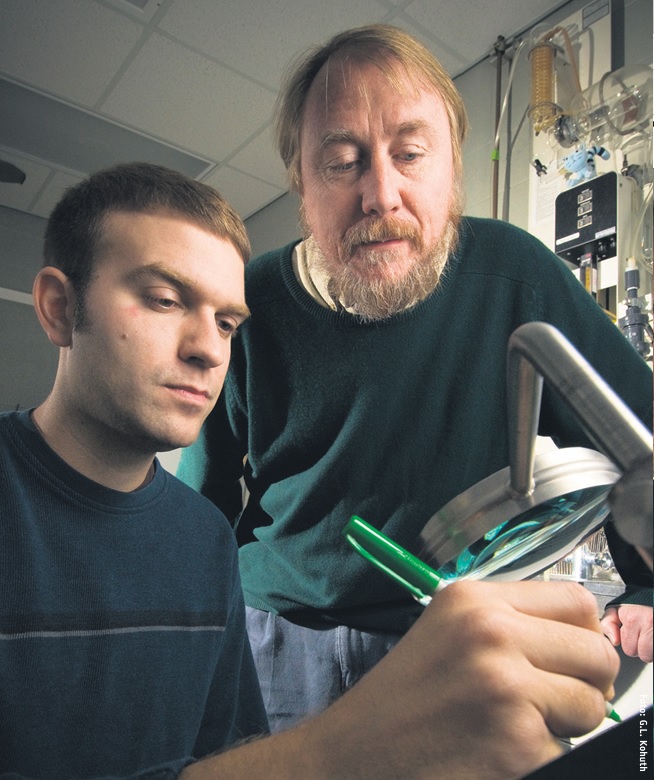 Richard Lenski (right) and one of his postdocs examining a bacterial culture from the long-running evolution study. Photo: G.L. Kohuth.
The two studies above are almost an organised tribute to Richard Lenski. His experiment with twelve lineages of E. coli bacteria at a laboratory of Michigan State University celebrated its 25th anniversary on 24 February 2013. The jubilee of this Long Term Evolution Experiment was marked with typical lab humour: an Erlenmeyer flask wearing a party hat, captioned ‘57204.9 generations of E. coli evolution and counting’. The celebrations continued in the Netherlands on 15 March 2013, when Lenski received an honorary doctorate in Wageningen (Resource, 14 February 2013). A dream come true‘Lenski is without doubt the pioneer of experimental evolution. He made palaeontologist Stephen Jay Gould’s dream come true: rewinding the tape of evolution and playing it again’, says De Visser, who spent two years as a postdoc with Lenski. Lenski started his experiment in 1988 with twelve populations of the E. coli strain Bc251. ‘Evolution is like a game that combines luck and skill, and perhaps bacteria could teach me a few interesting new games’, as he describes his motivation (Microbe, 2011). Each population grows in 10 millilitres of solution with glucose as the limiting substrate and undergoes approximately seven doublings, or generations, per day. Each day, 0.1 millilitres is transferred into 9.9 millilitres of fresh medium. Some of the remainder is periodically placed in the freezer: the ‘fossil archive’ of the experiment. ‘We can revive those bacteria and compare them with living cells from different generations. We can even make them compete with their own ancestors from a thousand generations earlier’, describes Lenski, who affectionately calls his bacteria E. erlenmeyeri. According to De Visser, the great eye-openers of the experiment are the possibilities of using genomic techniques to trace all successive mutations and link them to changes in fitness and chance events. ‘With Darwin’s finches and cichlids you also see evolutionary changes occurring, but you cannot test them experimentally.’ The crowning moment for evolutionary biologists was the discovery that a mutant arose in one Erlenmeyer flask that began using citrate as a carbon source. That substance had been added in small amounts as a pH buffer, partly because E. coli by definition does not grow on citrate. ‘The mutant tasted the forbidden fruit in 2003, and it was good – very good’, Lenski describes. In one flask in Michigan, two lineages now coexist, each exploiting their environment differently. ‘One of the lineages survives by doing something entirely new, something its ancestor could not do. To me, that sounds very much like the origin of species’, says Lenski. Experimental evolution has by now secured a firm place in science, including in the Netherlands. In Wageningen, a group around De Visser works on various fungal and bacterial species; Bertus Beaumont in Delft experiments with Pseudomonas and Nitromonas bacteria; and Danny Rozen works in Leiden with Streptococcus bacteria. On Thursday 14 March, Lenski and several Dutch research groups will take centre stage at a symposium on evolution in the laboratory. De Visser: ‘We are taking small steps, but the ultimate goal is to transform evolution from a descriptive into a predictive branch of science.’ This article was previously published in Bionieuws on 2 March 2013. PHOTOS: G.L. KOHUTH, BRIAN BAER & NEERJA HAJELA, MSU
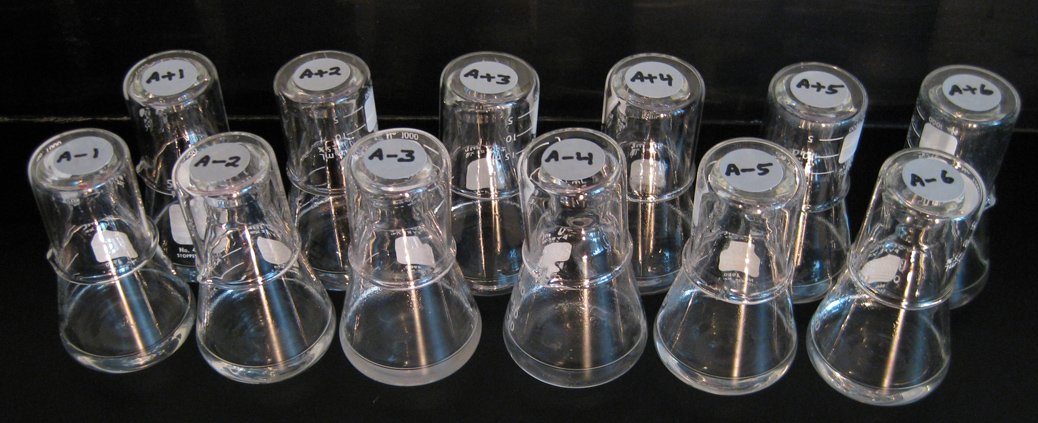 The twelve Erlenmeyer flasks containing E. coli bacteria from Richard Lenski’s long-term experiment. Photo: Brian Baer & Neerja Hajela, MSU
Read now also