


Where grey wolves settle depends on a host of factors. For his extended research project, Sam van Ginhoven set out to capture it all in a mathematical model.
That mathematics and biology can go hand in hand is amply demonstrated by the extended research project of former school pupil Sam van Ginhoven. ‘I built a mathematical model to predict the growth and spread of grey wolves across Europe’, he explains. The result is impressive: Van Ginhoven won the KNAW Education Prize and the Van Melsen Prize, and last month had the opportunity to present his research at the EU Contest for Young Scientists in Riga.
Talent programme
In his extended research project, Van Ginhoven explains step by step how his model is constructed. ‘It starts with an introduction to population dynamics: suppose you have a hundred grey wolves and the population grows by 10 per cent each year – you get exponential growth. But nature cannot sustain that indefinitely, so there is an upper limit to that growth’, says Van Ginhoven. From there, ever more factors are added, for which Van Ginhoven draws on increasingly advanced mathematics – he had already taken a few first-year mathematics courses through a talent programme at Radboud University. ‘By then extending the model to a two-dimensional domain, I was able to determine more precisely how wolf populations spread across a given area.’
Difficulties
Van Ginhoven programmed his model in Python and used existing data – including data on the current distribution of grey wolves in Europe, forest density, and mortality rates – to run it. ‘My computer did struggle a bit with that’, he says with a smile. ‘Because I use a discrete model, the computer has to perform a very large number of calculations over specific intervals. In the end I made those intervals somewhat larger, so that slightly less computing power was needed.’ Van Ginhoven identifies forest density and urbanisation as important influences on the spread of grey wolves. ‘Prey density usually doesn’t seem to matter much, but there are two enormous peaks of wild ungulates in Europe. One of them is in the Netherlands, and that does attract grey wolves here.’ Naturally, Van Ginhoven could not include every factor that might influence the spread of grey wolves. ‘I tried to focus on the major influences. If something only has a minor effect, it makes your model more complicated without necessarily making it stronger. Initially, for example, I also wanted to include the location of motorways, but in the end I left that out.’
Exceptions
Nature is often full of exceptions and unexpected elements. Can something so complex really be captured in a mathematical model? ‘On the one hand, a model is of course never reality. You have to simplify and include only the most important factors. At the same time, you can model a great deal. For my extended research project it would have gone too far, but even something like the (small) probability of a natural disaster can certainly be incorporated, by adding stochastic elements’, says Van Ginhoven. For the EU Contest for Young Scientists, Van Ginhoven had already extended his model in another respect: by incorporating territorial structures.
In the meantime, Van Ginhoven has begun a degree in mathematics and computing science. ‘That fits perfectly with my extended research project. I really enjoyed it. It’s great to apply mathematics in this way. That’s also my advice to other pupils: choose a subject you genuinely find interesting.’
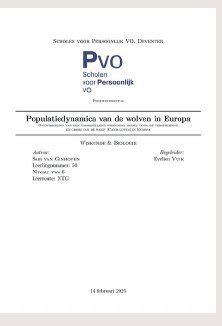
Title: Population dynamics of grey wolves in Europe
Author: Sam van Ginhoven
Category: extended research project
Education: pre-university secondary education (vwo) at Scholen voor Persoonlijk VO, Deventer
Assessor: Evelien Vuik
Grade: 10
Special distinction: winner of the KNAW Education Prize and the Van Melsen Prize
Submit your thesis
Is your master’s dissertation, bachelor’s thesis, or extended research project interesting reading for your fellow biologists? Send an e-mail to redactie@bionieuws.nl