


Using saliva tests, questionnaires and interviews, three pre-university secondary school pupils are investigating how the menstrual cycle affects the mood of adolescents.
‘Fluctuations in hormones during the menstrual cycle can have a major influence on how you feel. We wanted to research the influence of puberty on the development of depressive symptoms, and the menstrual cycle seemed like a good focus for that’, explains pre-university pupil Charlotte Groenendijk. Together with Aarna Bhugra and Isabel Lenting, she is conducting research into the relationship between depression and hormones in adolescents as her extended research project at Pre-University College Leiden.
The three pupils are taking a rigorous approach, following three different research methods: questionnaires, interviews and saliva tests. ‘Initially we wanted to collect saliva samples from young people ourselves, in order to determine hormone concentrations from them. That turned out not to be feasible within the time we had, but fortunately our supervisor at Leiden University still had a dataset from research involving 13- to 18-year-olds’, says Groenendijk. Analysis using the statistics programme SPSS then showed that the depression scores of these participants – determined using a standard questionnaire – were higher at greater concentrations of oestradiol, a form of oestrogen. No association was found with testosterone. ‘This was somewhat contrary to expectations, because our literature review had suggested that women in the follicular phase at the start of the cycle – when oestrogen is rising – are in fact more cheerful and energetic’, Groenendijk notes.
‘We had the questionnaires filled in by people we knew. For two weeks, participants indicated every day to what extent certain descriptions of their mood – such as “full of energy” or “tense” – applied to them. We thought it would be interesting to also include two people with a diagnosed depression. That did mean we had to wait a month for approval from the university’s ethics committee before we could begin’, says Groenendijk. ‘It would indeed have been better if the questionnaires had covered four weeks, to follow the entire cycle, but we had experienced some delay. Because we had asked everyone when their last period was, we were able to divide our participants into groups who were at different phases of their cycle. As it turned out, the distribution was actually quite even.’
Literature
The questionnaires clearly showed, among other things, that girls in the luteal phase – the final phase before menstruation – experience more mood swings and irritability. ‘That also came through in the interviews we held with the same participants, and it is consistent with the literature. The interviews revealed that most participants were aware of the effect their cycle has on their mood. At the same time, they also indicated that many other factors play a role in how they feel, such as school and sport. We had not really taken that into account beforehand’, says Groenendijk.
‘I really enjoyed doing research on a group that I myself belong to. That meant we could genuinely put ourselves in the shoes of the people who took part. It also makes you think, because the results may be relevant to yourself. Working with participants was rewarding for that reason, but also challenging at the same time. At least one person became quite closed off during the interview. That might have been different with a more anonymous researcher.’
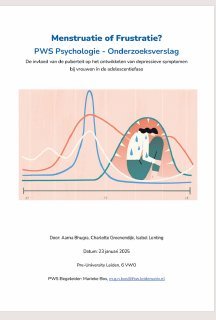
Title: Menstruatie of Frustratie? (Menstruation or Frustration?)
Authors: Aarna Bhugra, Charlotte Groenendijk and Isabel Lenting
Category: extended research project
School: pre-university secondary education at Alkwin Kollege, Christelijk Lyceum Zandvliet and Groene Hart Lyceum
Assessor: Marieke Bos
Grade: 9
Note: written as part of Pre-University College Leiden, an additional educational programme for above-average pre-university pupils
Submit your thesis
Is your master’s dissertation, bachelor’s thesis or extended research project of interest to your fellow biologists? Send an e-mail to redactie@bionieuws.nl