


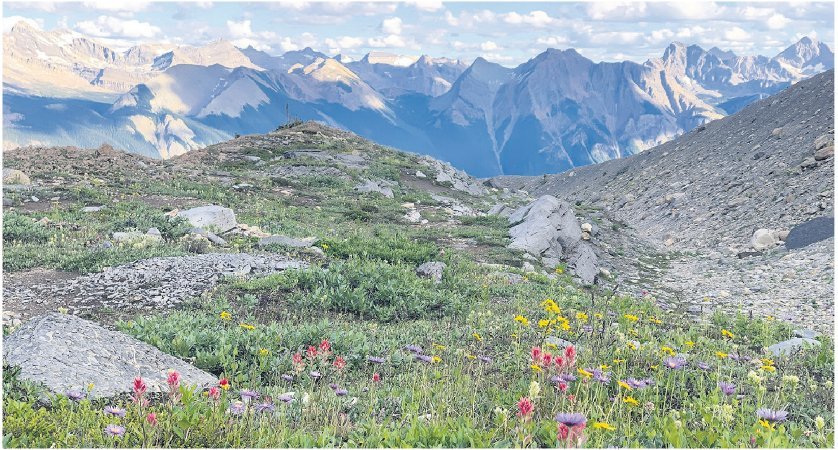
 Some mountain communities are becoming increasingly similar to one another as common lowland species advance upslope. Photo: Kristy Dixon, Unsplash
The researchers compiled more than 8,800 historical and recent records of the elevational ranges of 2,069 plant and animal species in mountain regions across five continents. With these data, they tested a widely held assumption in climate ecology: that species naturally shift upslope as temperatures rise – until they simply have nowhere left to go. In practice, however, this picture turns out to be considerably more nuanced.
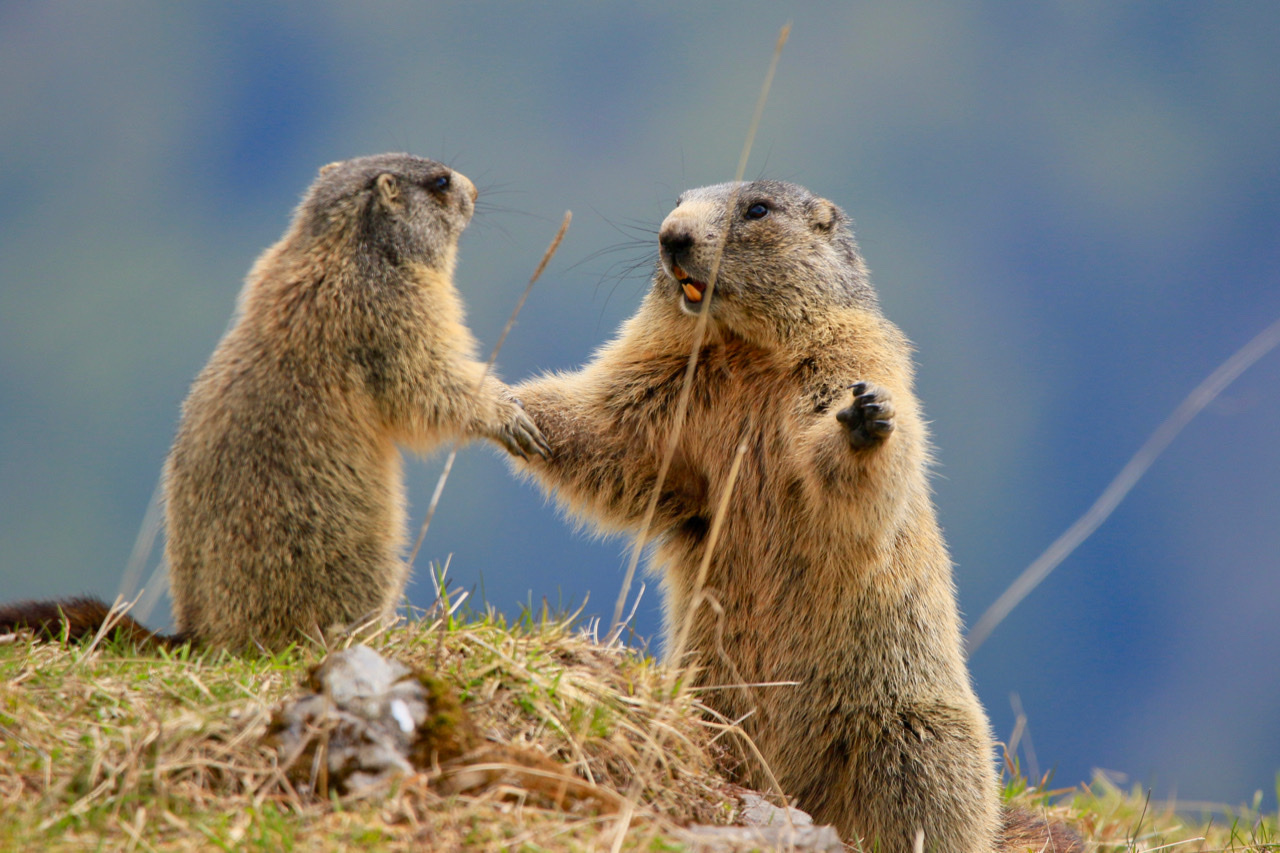 Two Alpine marmots (Marmota marmota) in Bavaria, typical mountain-dwelling rodents in Europe. Photo: (c) Boris Mittermeier, iNaturalist.
Many species do indeed shift upslope, but in doing so they rarely disappear from their original lowland habitats. This applies not only to widespread lowland species, which are expanding their range rather than truly shifting it, but also to species with small distributions. Species in this latter group are often assumed to be particularly vulnerable to extinction on mountain summits, yet they too appear to retain their lower range boundaries whilst simultaneously establishing themselves higher up in the mountains.
The study employs a sophisticated Bayesian model, with which the authors compare observed changes in range boundaries against what would be expected based on the geometry of the mountain landscape. In doing so, they account for the fact that mountain slopes narrow towards the top and therefore offer less space. Most shifts remain within these expected limits, suggesting that mountain species are partly adapting to changing conditions.
Homogenisation
The researchers do, however, identify another, more subtle ecological trend on a number of mountain slopes: biotic homogenisation. Some mountain communities are becoming increasingly similar to one another at different elevations, as common lowland species advance upslope whilst specialised mountain species stagnate or even disappear.
According to the authors, the risk to biodiversity has not disappeared but shifted. It manifests not so much through abrupt extinctions on mountain summits as through a gradual, less visible impoverishment of ecosystems. This can lead to a depletion of interactions between species – such as those between plants and their pollinators, or predators and their prey. Ecosystem services such as water regulation and nutrient cycling may also be affected as a result. Nevertheless, mountain species in general prove to be more resilient than previously thought.
Photos: Kristy Dixon / Unsplash / Boris Mittermeier, iNaturalist