


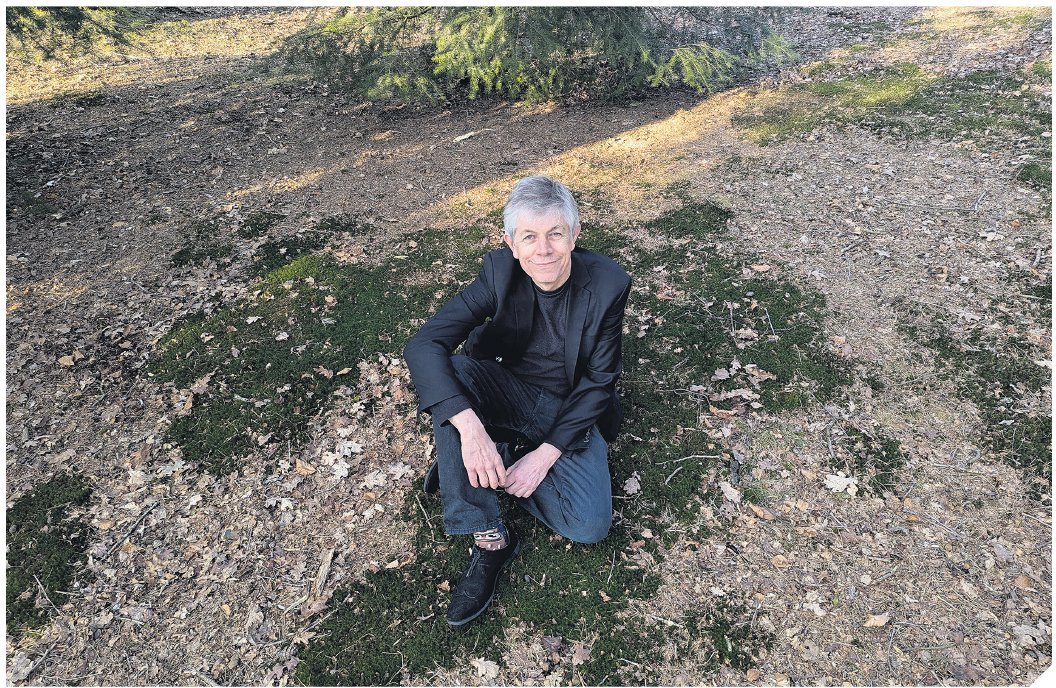
Philosopher Erno Eskens thinks rights for humans are not enough: ‘We need to change strategy and relinquish some of our power.’
We mistreat farm animals and allow nature to wither, despite legislation designed to prevent it. A different strategy is needed, says philosopher Erno Eskens, and he proposes including all living beings in the constitution.
‘Worldwide, I am the first to argue that not only animals, but also plants, fungi and even bacteria should be given rights.’ Philosopher and political scientist Erno Eskens says this with a cheerful laugh, but he means it seriously: ‘We as humans have appropriated all power on earth; now it is time to redistribute it.’ This is the subject of his book, published on 6 March: Het zoölogisch manifest – Rechten voor alles wat leeft. Where biologists read zoölogisch as pertaining to animals, Eskens points out that the ancient Greek zoö means not only animal, but also living being. It is that broader meaning he is concerned with.
Eskens, philosopher, political scientist and publisher at Noordboek, has travelled a long road. It began when he read Animal Liberation by the Australian bioethicist Peter Singer, who argues that we may not discriminate against animals relative to humans. Eskens: ‘The status of the animal is a fascinating philosophical theme: it touches on who we are and what we do. Singer’s book hit me like a sledgehammer and I could not let the subject go. If he is right, we need to reorganise society. But how? I found that a compelling intellectual puzzle.’
Equal treatment
In 2009 he published his book Democratie voor dieren: een theorie van rechtvaardigheid. In it he proposed giving animals rights, just as humans have them. ‘My ethical starting point is: equal cases receive equal treatment, regardless of which species is involved.’ And by now he has taken a considerable step further: he also wants to grant rights to plants, fungi and micro-organisms, as well as to species, relationships between species, and ecosystems. How does he argue for this?
‘You don’t need to know what is going on inside a being to see that it makes an effort’
‘I initially confined myself to animals, because they have brains, feel pain and display behaviour. But I gradually came to realise that plants also pursue things. They are capable of more than we had thought, as keeps becoming apparent. For example: when plants are eaten by insects, they release volatile compounds that attract the natural enemies of those pest insects. Neighbouring plants detect this distress signal and, as a precaution, ramp up their own defences against insects. This shows that plants, like animals, make an effort for things – for instance synthesising volatile compounds or defensive substances. And when a being makes an effort, there is something that matters to it, something that has value. Rights can be attached to that.’
Things evidently matter to fungi and micro-organisms as well. Bacteria in a colony, for example, cooperate and divide tasks: a form of making an effort. ‘You don’t need to know what is going on inside a being to see that it makes an effort, and from that you can infer, at least to some degree, where its interests lie.’
Interests
The interests of living beings can come into contact with our own. ‘That is effectively happening everywhere nowadays, because we influence all habitats in various ways. It is therefore only fair to recognise the interests of other beings and weigh them against our own. By granting all beings rights, we give them a voice.’ Eskens therefore advocates a zoö-inclusive constitution and a zoö-inclusive parliament.
But do we not already take the interests of other species into account? There is a duty of care for animals in our keeping, and there is robust legislation and regulation for nature conservation. ‘Yes, but with all of that we still have the final say – it is paternalistic and demeaning. And it does not work: farm animals are treated scandalously, wild species are declining. We therefore need to change strategy and relinquish some of our power. If we grant rights to all living beings, representatives can claim those rights on their behalf and bring legal proceedings. Only the law can keep us humans in check. Moreover, any compensation awarded would then benefit the beings who have suffered harm. At present that compensation flows into the public purse, which does them no good whatsoever.’
Duties
For Eskens, all living beings are legal subjects, which means they have not only rights but potentially duties as well. ‘I haven’t yet thought through those duties. One might think of ecosystem services such as pollination or water purification, but that is not a direction I want to go in for the time being.’
How will the book be received? ‘When I gave my first lectures on animal rights, the audiences were hostile. Now people find the idea acceptable and ask follow-up questions: how does that work in practice? The first lectures I gave on the basis of this book went down surprisingly well. Even so, I don’t think my argument will convince everyone. Many will raise their eyebrows or burst out laughing at the idea of rights for bacteria. I am deliberately firing a warning shot across the bows. I call the book a manifesto because I am asserting something with great conviction, whilst at the same time being aware of my own fallibility and remaining open to criticism. I expect serious opposition and look forward to a constructive discussion. Bring it on!’