


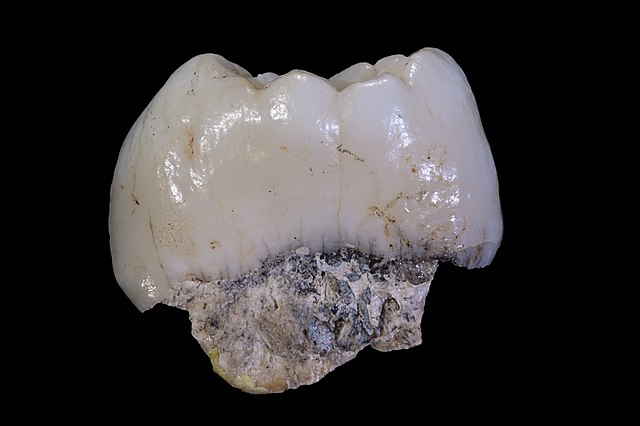
Tooth of Paranthropus robustus from Swartkrans, 1.8 million years old. Photo: Didier Descouens/Wikimedia
Analyses of dental enamel proteins from fossils of the early hominin Paranthropus robustus point to an unexpectedly high genetic diversity and challenge sex classification based on tooth size.
De 1.8 to 2.2 million-year-old fossils of the early hominin Paranthropus robustus from the South African Swartkrans Cave show such great variation in protein structure that questions arise about their relationships. Moreover, the widely used practice of determining sex from tooth size proves questionable, since one specimen with smaller teeth was almost certainly male. This emerges from reconstructions of protein sequences from dental enamel of four P. robustus fossils by an international team of palaeoanthropologists (Science, 30 May). The study, with South African palaeogeneticist Palesa Madupe of the Human Evolution Research Institute in Cape Town and the Globe Institute in Copenhagen as first author, raises the question of whether these fossils truly represent a single species, and casts serious doubt on the sex classification of early African hominins based on tooth size. Paranthropus, which lived in Africa alongside early hominins such as Australopithecus and Homo between 2.8 and 1 million years ago, is often regarded as a single evolutionary group. Because no usable DNA older than twenty thousand years has ever been recovered from African fossil material, this research group analysed ancient proteins preserved in fossilised dental enamel from four well-known Paranthropus fossils (SK 830, 835, 850 and 14132). These come from Swartkrans Cave, a World Heritage site near Johannesburg also known as the Cradle of Humankind. They belong to the earliest known specimens of this species, yet the protein analyses reveal an exceptionally high degree of molecular variation.
Dimorphism
Notably, one individual (SK 835), owing to a single amino acid polymorphism (ENAM-137), does not appear to be closely related to the other three. According to the researchers, this points either to considerable intraspecific variation in P. robustus or to the specimen belonging to a different species within the same genus. The species name P. capensis has recently been proposed for this purpose (Journal of Human Evolution, 2 January). The small teeth of the aberrant specimen have until now been attributed to sexual dimorphism and taken to indicate a female, but the current analyses show it was ‘now with certainty a male’.
Helicopter research
Lead author Palesa Madupe accompanies her publication with a statement against the dominance of ‘scientists from predominantly white, Western institutions’ in palaeoanthropology, which she argues creates ‘colonial dynamics’. For this reason, a large and diverse group of African researchers was involved in the study from an early stage. Madupe: ‘Our hope is that future research will move away from helicopter research and evolve towards a more ethical and socially responsible science that places African knowledge at its centre.’